Wired Telecommunications Industry in Indonesia
KBLI 6110 — how IndiHome, Biznet, MyRepublic, FirstMedia, and MNC Play built Indonesia's fiber broadband market and what comes next as FWA encroaches
KBLI 6110 covers wired telecommunications — fixed broadband (FTTH and legacy copper), enterprise leased lines, wired voice, submarine cable backbone, and selected B2B dedicated connectivity. Telkom Indonesia's IndiHome dominates the consumer book, with Biznet, MyRepublic, FirstMedia, and MNC Play as the meaningful private-sector competitors. Enterprise leased lines are a higher-margin parallel business serving corporates, banks, and data centers. This report unpacks the cost stack, the FTTH competitive dynamics, FWA substitution pressure, and the regulatory architecture.
Industry boundary, KBLI scoping, and what's excluded from 6110
IndiHome's structural dominance versus private FTTH challengers
Enterprise leased line and B2B dedicated connectivity economics
Ecosystem layers: operators, submarine cable, ducting, content, enterprise integrators
Porter's Five Forces, FWA substitution, and entry barriers
Cost structure, ROW (right of way) economics, and Kominfo regulation
Executive Summary
Indonesia's wired telecommunications industry is structurally bifurcated. The consumer fixed-broadband (FTTH) book is dominated by Telkom Indonesia's IndiHome — by a wide margin the largest operator — with Biznet, MyRepublic (now MyRepublic Telkom JV partner), FirstMedia (Lippo group), MNC Play, and a long tail of regional ISPs competing on price, customer experience, and selective coverage build-out. The enterprise leased-line and dedicated-connectivity book is a separate, higher-margin business serving banks, large corporates, data centers, and government, with Telkom (via Telkomsigma, Lintasarta-related, NeutraDC) again as the largest operator alongside specialist providers.
Fiber-to-the-home has displaced copper-based DSL as the dominant access technology for new builds and is the central technology story of the industry. ADSL remains for legacy and selected coverage but is in managed decline. Fiber rollout is concentrated in urban Java, with secondary cities, parts of Sumatra, and selected outer-island metros increasingly covered as operators expand. Suburban and rural reach remains uneven and is increasingly addressed by FWA from mobile operators (Smartfren, Telkomsel, IOH) rather than fiber.
Outlook is shaped by three forces. FTTH penetration continues rising as Indonesian middle-class homes adopt streaming, gaming, work-from-home, and quick-commerce video. FWA substitution from mobile operators competes with fiber in fiber-uneconomic markets and pressures consumer ARPU. Enterprise demand — driven by data center expansion, digital transformation, cloud adoption, and 5G enterprise applications — grows steadily and at higher margin than consumer.
KBLI 6110 is two businesses under one code: high-volume consumer FTTH (price-competitive, infrastructure-heavy) and enterprise leased lines and dedicated connectivity (higher-margin, relationship-driven, lower-churn). Their economics and competitive moats differ sharply.
Telkom Indonesia's IndiHome dominates consumer FTTH by a wide margin, supported by the underlying Telkom fiber infrastructure and the largest residential coverage footprint. Private competitors (Biznet, MyRepublic JV, FirstMedia, MNC Play) compete on price, service, and urban metro coverage.
FTTH is the dominant access technology; ADSL is in managed decline. Fiber rollout economics depend heavily on right-of-way (ROW) access, ducting infrastructure, and the cost of deploying drop fiber to subscribers in dense versus sparse settlements.
FWA from mobile operators (Smartfren, Telkomsel, IOH) substitutes for fiber in markets where fiber is uneconomic. The competitive dynamic with mobile operator FWA is shaping suburban and small-city home-broadband economics.
Enterprise B2B leased lines, dedicated connectivity, and data center interconnect are the higher-margin growth segments. Submarine cable backbone and metro fiber are the underlying infrastructure assets that determine competitive position in B2B.
Why this industry matters in Indonesia
Fixed broadband is the backbone of Indonesia's productive digital economy — work-from-home, e-commerce business operations, online education, video streaming, gaming, and cloud-based business applications all depend on fiber connectivity. Wired telecom infrastructure determines which Indonesian homes and businesses can participate fully in the digital economy.
Enterprise dedicated connectivity is the infrastructure on which Indonesian banks, fintechs, e-commerce platforms, government digital services, and cloud-hosted business applications run. Latency, reliability, and security of wired networks are competitive variables for the entire digital economy.
Submarine cable backbone connects Indonesia to global internet routes. Cable system ownership and access (SEA-ME-WE consortium, INDIGO, others) determine internet costs and international connectivity quality for the entire country.
So what: Practical implications
Operators: Distinguish consumer FTTH (price-competitive, scale-led) from enterprise dedicated connectivity (margin-led, capability-driven); they require different operating models.
Investors: Recognize the structural split between Telkom group dominance and private-sector challengers; the competitive dynamics, not the absolute size, drive opportunity.
Enterprise buyers: Compare leased line, MPLS, SD-WAN, and selected wireless options on total cost and reliability rather than headline price; reliability is the differentiator.
Policymakers: Right-of-way access, ducting infrastructure, and ROW pricing are the binding constraints on fiber rollout speed; policy clarity here matters more than competition rules.
Indonesia at a Glance
Republic of Indonesia: Fiber-led urban broadband with significant rural gaps
Indonesia has roughly 270 million people and 70+ million households, with fixed broadband penetration substantially below mobile broadband. Fiber-to-the-home is the dominant residential technology for new builds; ADSL and legacy copper are in managed decline. Penetration is highest in Java metros, secondary cities, and selected outer-island urban centers.
The market is structurally bifurcated by use case. Consumer FTTH for home broadband (streaming, gaming, WFH, social) drives the headline subscriber count. Enterprise dedicated connectivity (leased lines, MPLS, dark fiber, data center interconnect) drives the higher-margin revenue.
Operator structure is concentrated at the top — Telkom Indonesia's IndiHome dominates consumer FTTH with multi-million subscriber base. Private operators (Biznet, MyRepublic JV, FirstMedia/MNC Play family, regional ISPs) compete on urban metro coverage and price. Enterprise market includes Telkom subsidiaries (Telkomsigma, NeutraDC), Lintasarta (Indosat group), and selected specialist providers.
Geographic coverage is uneven. Java metros (Jakarta, Surabaya, Bandung, Semarang) have multi-operator FTTH competition; secondary cities (Medan, Makassar, Denpasar, Pekanbaru) have growing competition; tier-3 cities and rural areas remain heavily reliant on Telkom-only fiber or FWA from mobile operators.
Hyperlocalization: metro multi-operator FTTH, secondary-city expansion, rural FWA reliance
Jakarta, Surabaya, Bandung, Semarang, and Medan are the metros with deepest FTTH competition. Multiple operators have built parallel fiber networks; consumers can choose among IndiHome, Biznet, MyRepublic JV, FirstMedia, and selected regional ISPs. Pricing competition is real but moderated by network quality and customer-service differentiation.
Secondary cities — Makassar, Denpasar, Yogyakarta, Pekanbaru, Palembang, Batam, Balikpapan, Manado — are seeing expanding FTTH coverage. Private operators selectively build out where economics allow; Telkom IndiHome leverages its underlying fiber infrastructure to cover broadly. Operator-by-operator coverage maps vary materially.
Tier-3 cities and rural areas often have IndiHome-only fiber coverage or rely on FWA from Smartfren, Telkomsel, and IOH. The fiber-uneconomic boundary — where dispersed housing or low subscriber density makes drop fiber unviable — is where mobile operator FWA dominates home broadband. This dynamic is shifting as fiber rollout extends and FWA capacity grows.
Opportunities beyond consumer FTTH: enterprise, data center, submarine cable, smart-building
Consumer FTTH is the volume story; enterprise dedicated connectivity is the margin story. Banks, large corporates, government, e-commerce platforms, cloud providers, and data center operators all require leased lines, MPLS, dark fiber, and selected SD-WAN. Margins are higher and customer relationships are stickier than consumer.
Data center expansion is a meaningful adjacent driver. Domestic data center buildout (NeutraDC, Princeton Digital Group, BDx, Telkomsigma, DCI Indonesia) plus hyperscaler cloud regions (AWS, Google Cloud, Microsoft Azure) generate dedicated connectivity demand for inter-data-center links, hyperscaler peering, and enterprise-to-cloud connectivity.
Submarine cable backbone is the underlying infrastructure for international internet access. Indonesian operators participate in major consortia (SEA-ME-WE consortium, INDIGO, ACE, others) and operate domestic submarine cable systems connecting major islands. Cable system ownership shapes international bandwidth economics and resilience.
Data center expansion driving enterprise dedicated connectivity demand for inter-DC and DC-to-cloud links
Hyperscaler cloud region expansion (AWS Jakarta, Google Cloud Jakarta, Microsoft Azure) growing enterprise cloud connectivity demand
Enterprise digital transformation generating MPLS, SD-WAN, and dedicated line demand
5G fronthaul and backhaul fiber demand from mobile operator 5G rollout
Government digital initiatives (e-government, smart-city, digital identity) generating B2G dedicated connectivity
WFH and hybrid work normalization sustaining home broadband demand growth
Network and distribution realities: ROW, ducting, drop fiber, and enterprise installation
Network deployment economics are dominated by right-of-way (ROW) access, ducting, and drop fiber to subscribers. Underground ducting is expensive but durable; aerial fiber on telephone poles is cheaper but vulnerable. ROW access — getting permission to lay or string fiber along public and private rights — is a real operational variable in some Indonesian provinces.
Drop fiber to subscribers is the customer-acquisition step where unit economics often break for marginal markets. A single subscriber acquisition can require hundreds of meters of drop fiber, an ONT (Optical Network Terminal), installation labor, and time. Subscriber density and addressable home count per kilometer of feeder fiber determine whether a neighborhood is fiber-economic.
Enterprise installation is its own discipline — site survey, dedicated fiber route, installation, SLA-backed activation, and ongoing service. Enterprise customers expect rapid problem resolution and predictable performance; operator capability here translates directly into contract renewal and reference selling.
Master ROW access processes by province and major city — bureaucracy and access economics vary materially and shape rollout pace
Optimize feeder-to-drop fiber ratios — neighborhood density determines unit economics more than headline fiber rollout investment
Build enterprise installation and service capability as a differentiator — enterprise customer renewal economics depend on it more than headline price
Plan for the FWA competitive boundary — FWA from mobile operators substitutes for fiber where drop economics break
Industry Definition
What is KBLI 6110, and where does the boundary sit?
Industry Definition
KBLI 6110 covers wired telecommunications activities — fixed broadband (FTTH and legacy copper), enterprise leased lines, wired voice, dedicated connectivity (MPLS, dark fiber, IPLC), submarine cable system operations, and selected B2B managed connectivity services.
Excluded: wireless telecommunications (KBLI 6120), telecommunications equipment manufacturing (KBLI 2630), tower and infrastructure rental that is wireless-focused (KBLI 6190 partly), retail of telecom products (Division 47), and information/content services (KBLI 63xx).
The clarifying test is technology: if the operator delivers connectivity primarily via wired or fiber infrastructure (including submarine cable), it sits in 6110 regardless of whether the customer is consumer, business, or government.
Indonesia in Focus
In Indonesia, the wired telecom market is dominated by Telkom Indonesia (group entity holding IndiHome consumer, Telkomsigma enterprise, NeutraDC data center, Telkom Akses fiber rollout, and submarine cable assets). Private operators (Biznet, MyRepublic JV, FirstMedia, MNC Play, Iconnect, regional ISPs) compete in consumer FTTH and selectively in enterprise.
FTTH is the dominant access technology; ADSL is in managed decline. ROW access, ducting infrastructure, and drop fiber economics are the binding operational constraints on fiber rollout.
Regulation under Kominfo, BRTI, and selected ATSI coordination shapes spectrum-free wired operations primarily through licensing, USO contributions (1.25% revenue), data protection under UU PDP, and right-of-way coordination with local governments.
Industry Classification
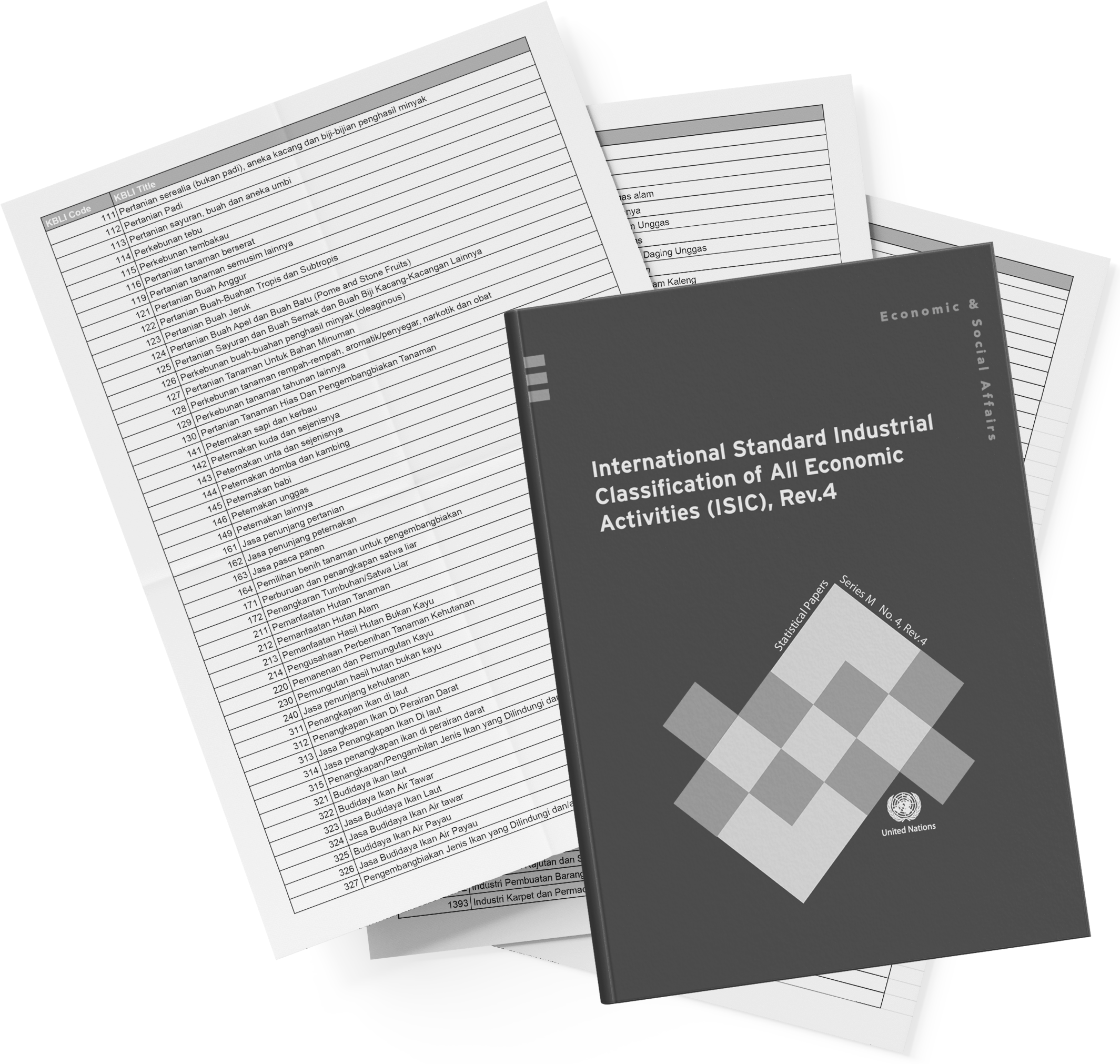
KBLI 6110 (2020 revision) — Aktivitas Telekomunikasi dengan Kabel — covers wired telecommunications activities including fixed-line voice, fixed broadband, leased lines, and selected dedicated connectivity.
Closest ISIC mapping: ISIC Rev.4 6110 — Wired telecommunications activities. Direct equivalence at four-digit level.
NAICS comparable: 517311 (Wired Telecommunications Carriers) — close one-to-one mapping with US classification.
Operators frequently overlap with KBLI 6120 (wireless), 6190 (other telecom including towers and infrastructure), 6311 (data processing and hosting), and 6312 (web portals) depending on integrated services.
Industry Terms that actually matter
Wired telecom vocabulary is dense — the terms below shape technology, regulation, pricing, and competition in Indonesia.
FTTH (Fiber to the Home)
Fiber optic cable extending all the way to the subscriber's premises, providing high-bandwidth connectivity.
Dominant access technology for new builds; the central technology story of Indonesian consumer wired telecom.
ONT (Optical Network Terminal)
Customer-premises equipment that terminates the fiber optic line and provides Ethernet/WiFi interfaces.
Customer-side hardware that defines the broadband experience; operator-provided or customer-owned.
GPON / XGS-PON
Passive optical network technology variants; GPON delivers up to 2.5 Gbps shared, XGS-PON up to 10 Gbps shared.
Defines the bandwidth capability of an operator's FTTH network; XGS-PON upgrades are increasingly visible.
ROW (Right of Way)
Permission and process to lay fiber along public roads, utility corridors, or private property.
Binding operational constraint on fiber rollout speed; varies materially by province and city.
Drop fiber
Fiber section from feeder cable to individual subscriber premises.
Last-mile cost element where unit economics often break for marginal markets.
MPLS / SD-WAN
Multi-protocol label switching (legacy enterprise WAN) and software-defined WAN (newer flexible WAN); both dedicated enterprise connectivity options.
Enterprise dedicated connectivity options; SD-WAN is taking share from MPLS but MPLS retains stronghold in regulated industries.
IPLC (International Private Leased Circuit)
Dedicated international leased line connecting two endpoints across borders.
Premium enterprise connectivity for multinational corporates and international banking.
Submarine cable
Underwater fiber optic cable connecting countries or islands.
Critical international and inter-island internet backbone; Indonesian operators participate in major consortia (SEA-ME-WE, INDIGO, ACE, others).
FWA (Fixed Wireless Access)
Provision of broadband to fixed locations over cellular networks; competes with fiber in fiber-uneconomic markets.
Substitution pressure on fiber, particularly in suburban and small-city home broadband.
USO / BAKTI
Universal Service Obligation (1.25% revenue) administered by BAKTI for rural and remote coverage.
Same regime as wireless telecom; funds rural connectivity programs including Palapa Ring fiber backbone.
Industry Overview – Business Archetypes
KBLI 6110 hosts a small number of distinct operating archetypes built around consumer FTTH, enterprise dedicated connectivity, infrastructure wholesale, and selected niche segments. The archetypes share the code but not the business model.
Integrated Incumbent Operator (Ecosystem Anchor)
Telkom Indonesia is the clearest example. Operates the largest fiber infrastructure footprint, dominates consumer FTTH through IndiHome, runs enterprise B2B through Telkomsigma and subsidiary brands, owns submarine cable assets, and operates data center through NeutraDC.
Vertically integrated across access, transport, data center, and enterprise services. The scale advantage is structural and unlikely to be challenged at the integrated-operator level.
IndiHome consumer FTTH subscriptions with bundled IPTV, content, and selected mobile bundling
Enterprise leased line, MPLS, dedicated connectivity through Telkomsigma and other Telkom group entities
Data center co-location and managed services through NeutraDC and partners
Wholesale capacity to other operators and ISPs
International gateway and submarine cable capacity
Capital-intensive across the full stack; multi-year fiber rollout and submarine cable investment cycles
Regulatory scrutiny that comes with market leadership (price caps, anti-competitive review)
Cross-subsidization opportunities across consumer, enterprise, and infrastructure businesses
Private FTTH Challenger (Bridge Model)
Private operators competing with IndiHome in selected urban metros — Biznet, MyRepublic (Telkom JV partner), FirstMedia (Lippo group), MNC Play, regional ISPs. Build parallel FTTH networks in commercially attractive geography.
Compete on price, customer experience, and service quality rather than coverage breadth. Customer acquisition often through aggressive promotional pricing and selective community-level network rollout.
Consumer FTTH subscriptions with content bundling, gaming-optimized routing, and value-tier pricing
Selective enterprise SME services in covered areas
Selected wholesale arrangements with other operators
Capital-intensive but selective — rollout only where neighborhood density supports unit economics
Customer acquisition cost is meaningful; churn is real
Competitive positioning vs IndiHome requires distinct value proposition (price, service, or content)
Enterprise Dedicated Connectivity Specialist (Specialist Operator)
B2B specialist providing leased lines, MPLS, dark fiber, IPLC, and managed connectivity to corporates, banks, government, and data center customers. Examples include Lintasarta (Indosat group), Telkomsigma (Telkom group), and selected specialist providers.
Higher-margin, contract-anchored, lower-churn than consumer. Capability-led — engineering, service-level commitment, and customer-success matter more than coverage breadth.
Multi-year leased line and dedicated connectivity contracts with SLAs
Managed network services including MPLS, SD-WAN, security, monitoring
Data center interconnect and hyperscaler cloud connectivity
International IPLC and global capacity provisioning
Capability-intensive — engineering and service operations matter more than capex
Customer relationships are multi-year and reference-driven; supplier qualification is hard to win, easy to lose
Strong fit for banks, government, and large corporates with complex connectivity needs
Submarine Cable and Backbone Operator (Infrastructure Enabler)
Operates submarine cable systems and domestic backbone fiber connecting Indonesia internationally and across islands. Telkom Indonesia is the largest participant in major consortia (SEA-ME-WE, INDIGO, ACE, others); selected private operators run domestic submarine cable.
Long-cycle, capital-intensive infrastructure with multi-decade asset lives. Revenue from capacity leases to other operators and enterprise customers.
IRU (Indefeasible Right of Use) sales for long-term capacity
Wavelength and Ethernet capacity leases to operators and enterprise
Premium pricing for resilient route diversity
Capex cycles measured in decades; capital intensive to build, durable revenue once operational
Subject to natural disasters (cable cuts), geopolitical risk, and regulatory approvals
Consortium participation is the structural mode; pure standalone operators rare
Wholesale Fiber Infrastructure Provider (Bridge Model)
Operates wholesale fiber infrastructure rented to operators and ISPs. Telkom Akses (fiber deployment and wholesale arm of Telkom), Iforte, selected TowerCo fiber subsidiaries operate here.
Recurring rental revenue from operators and large enterprise customers. Capital-intensive deployment with utility-like long-run economics.
Long-term fiber capacity leases to operators
Dark fiber rentals to enterprise and selected operators
Backhaul and metro fiber services for tower and mobile operators
Utility-like economics with recurring rental revenue and long capex cycles
Customer concentration on a few large operators
Increasingly important for 5G fronthaul and backhaul as mobile operators densify
Industry Performance & Outlook
FTTH penetration growth, FWA substitution pressure, enterprise digitization tailwind
Headline KBLI 6110 performance is shaped by FTTH subscriber growth on the consumer side and dedicated-connectivity revenue growth on the enterprise side. FTTH penetration is rising as more Indonesian middle-class homes adopt fiber broadband for streaming, gaming, WFH, and quick-commerce video. Enterprise demand is steadier and higher-margin.
FWA substitution pressure from mobile operators is the most visible competitive headwind for consumer FTTH in suburban and small-city markets. In dense urban Java metros, multi-operator FTTH competition continues to pressure pricing; in fiber-uneconomic markets, FWA from Smartfren, Telkomsel, IOH increasingly serves home broadband.
Two structural tailwinds support outlook. Enterprise digital transformation (cloud adoption, data center build-out, SD-WAN deployment, government digital services) sustains dedicated-connectivity demand. 5G backhaul and fronthaul requirements drive fiber demand from mobile operators and TowerCos.
Outlook drivers over the next 24–36 months: continued FTTH penetration growth in urban Java and secondary cities, FWA competitive dynamics in suburban and small-city markets, enterprise dedicated connectivity growth tied to cloud and data center expansion, submarine cable capacity expansion and resilience investment, and regulatory clarity on right-of-way and USO programs.
Performance indicators that matter for KBLI 6110
FTTH subscriber count and penetration
Consumer broadband adoption trajectory
Rising steadily; penetration substantially below mobile broadband; significant headroom in tier-2/3 cities
ARPU per fixed-broadband subscriber
Revenue per consumer broadband subscriber
Competitive pricing pressure in metro markets; selective premium tiers (gigabit, gaming) growing
Enterprise leased line and MPLS revenue
B2B dedicated connectivity demand
Steady growth tied to enterprise digitization; data center expansion driving new demand
Right-of-way access and ducting infrastructure availability
Fiber rollout pace
Binding constraint in many provinces; provincial policy variations material
FWA subscriber additions by mobile operators
Substitution pressure on consumer FTTH
Smartfren, Telkomsel, IOH FWA growth competing with fiber in fiber-uneconomic markets
Data center expansion and hyperscaler cloud region deployment
Enterprise dedicated connectivity demand pull
NeutraDC, DCI Indonesia, Princeton Digital, BDx, hyperscaler cloud regions driving inter-DC and cloud connectivity
Outlook: what to watch over the next 24–36 months
FTTH penetration growth pace in tier-2 and tier-3 cities — significant addressable market still untapped
FWA competitive dynamics with mobile operators in suburban and small-city markets
Right-of-way policy and ducting infrastructure access affecting fiber rollout pace
Enterprise dedicated connectivity growth tied to cloud, data center, and SD-WAN adoption
Submarine cable system investments (new cables, capacity upgrades, resilience routes)
UU PDP implementation effect on operator data-handling and content responsibilities
Industry Growth Drivers
Growth drivers in KBLI 6110 split across consumer FTTH penetration, enterprise digitization, infrastructure adjacency, and policy support. The drivers below are the ones with material effect on operator volume and margin.
FTTH penetration growth in tier-2 and tier-3 cities
Indonesia's fixed broadband penetration is substantially below mobile broadband, with significant headroom in tier-2 and tier-3 cities and selected suburban Java markets. As middle-class homes adopt streaming, gaming, WFH, and online education, fiber demand grows.
Operators that build cost-effective rollout in these markets — managing drop fiber economics, customer acquisition cost, and ROW access — capture incremental subscribers and revenue.
Operator FTTH subscriber additions and coverage announcements
BPS household ICT usage and broadband penetration data
Enterprise digital transformation and cloud adoption
Indonesian enterprises are digitizing operations — cloud migration, SaaS adoption, hybrid work, and data center reliance. Each shift generates dedicated connectivity demand for leased lines, MPLS, SD-WAN, and data center interconnect.
Enterprise B2B is higher-margin and lower-churn than consumer. Operators with credible enterprise capability are capturing this growth at favorable economics.
Indonesian enterprise cloud adoption surveys and reports
Hyperscaler cloud region expansion and data center buildout announcements
Data center expansion and inter-DC connectivity
Domestic data center buildout (NeutraDC, DCI Indonesia, Princeton Digital Group, BDx, regional operators) and hyperscaler cloud regions create demand for inter-data-center connectivity, hyperscaler peering, and enterprise-to-cloud links.
Dedicated connectivity for data center customers is a structurally growing book that benefits operators with metro fiber and submarine cable assets.
Data center capacity announcements and capex programs
Hyperscaler cloud region expansion in Indonesia
5G fronthaul and backhaul fiber demand
Mobile operator 5G rollout requires fiber backhaul and fronthaul. As 4G is densified and 5G expands, the fiber demand from mobile networks grows substantially. This benefits wholesale fiber providers and integrated operators with fiber assets.
Cell-site densification also requires more fiber connections — a structural demand driver tied to mobile capacity growth.
Mobile operator 5G rollout milestones
TowerCo fiber expansion announcements (Mitratel, TBIG fiber, Protelindo fiber)
Government digital initiatives and B2G dedicated connectivity
Indonesian government digital initiatives (e-government, smart-city, digital identity, IKN Nusantara digital infrastructure) generate B2G dedicated connectivity demand. Government tenders, e-katalog, and direct ministry procurement create recurring revenue streams.
BAKTI Palapa Ring fiber backbone has extended fiber reach into eastern Indonesia, opening enterprise and government connectivity opportunities in regions previously underserved.
BAKTI Palapa Ring usage and connectivity expansion
Government digital and smart-city program announcements
Submarine cable capacity expansion and resilience
International bandwidth demand continues growing as Indonesian internet usage scales. Submarine cable consortia (SEA-ME-WE consortium, INDIGO, ACE, INDONESIA GLOBAL GATEWAY, others) and domestic submarine cable systems require capacity upgrades and new route construction.
Cable system resilience (route diversity) is increasingly important after major outage events; operators investing in route diversity capture premium-priced traffic.
Submarine cable system construction announcements
Major cable outage and resilience-investment news
Industry Trends & Development
Industry Development: how the channel reached its current shape
From copper DSL to fiber-led market with IndiHome dominance and private challengers
Indonesia's wired telecom industry evolved through four structural shifts: the copper-based ADSL era dominated by Telkom Speedy, the FTTH inflection that displaced copper as the dominant access technology, IndiHome's dominance establishment, and the emergence of private FTTH challengers in urban metros plus FWA substitution from mobile operators.
Each shift reshaped the operator landscape and the addressable market — fiber unlocked higher bandwidth and quality, IndiHome consolidated consumer share, and FWA introduced competitive pressure in fiber-uneconomic geographies.
Copper ADSL era and Telkom Speedy dominance
Telkom Speedy (ADSL over copper) was the dominant consumer fixed broadband. Speeds were modest by global standards; coverage was concentrated in urban areas. Private ISPs operated as smaller players. International bandwidth ran on early submarine cable consortia.
FTTH inflection and IndiHome launch
Fiber-to-the-home began displacing copper as the dominant access technology. Telkom launched IndiHome bundle (fixed broadband + IPTV + voice + selected content). FirstMedia, Biznet, and selected ISPs began building FTTH in urban Java. Submarine cable capacity expanded.
IndiHome dominance and private challenger emergence
IndiHome scaled to multi-million subscribers; copper-based Speedy migrated to fiber. Biznet, MyRepublic, FirstMedia, MNC Play expanded urban FTTH coverage. Enterprise dedicated connectivity demand grew with hyperscaler cloud region announcements and data center buildout.
Pandemic broadband surge and FWA emergence
COVID-driven WFH, online learning, and streaming surged fixed broadband demand. IndiHome and private FTTH operators added subscribers rapidly. FWA from mobile operators began emerging as a competitive home-broadband option in fiber-uneconomic markets.
FTTH expansion, FWA encroachment, data center boom
FTTH coverage extended into tier-2 and tier-3 cities. FWA competition with fiber intensified in suburban markets. Data center expansion (NeutraDC, DCI Indonesia, Princeton Digital, BDx, hyperscaler regions) drove enterprise dedicated connectivity demand. Telkom-MyRepublic JV reshaped private FTTH landscape. Submarine cable resilience investments accelerated.
Key Trends — what's changing in the business model
The trends below are changing how money is actually made in KBLI 6110 — shifts inside specific Business Model Canvas dimensions rather than macro narratives.
FWA substitution in suburban and small-city markets (Customer Segments)
FWA from mobile operators (Smartfren, Telkomsel, IOH) is increasingly serving suburban and small-city home broadband customers where fiber rollout economics break. This shifts addressable market boundaries for fiber operators.
Operators that recognize the FWA boundary and concentrate fiber investment in dense markets — while selectively partnering or co-existing with FWA — manage capital more efficiently than those that pursue uniform coverage.
Consumer FTTH operators (IndiHome, Biznet, MyRepublic JV, FirstMedia, MNC Play)
Mobile operators with FWA propositions
Suburban and small-city households choosing broadband
Enterprise dedicated connectivity and cloud interconnect growth (Revenue Streams)
Enterprise B2B dedicated connectivity, MPLS, SD-WAN, and especially cloud interconnect generate increasing revenue. Hyperscaler cloud region expansion and data center buildout are the demand drivers.
Operators with metro fiber and submarine cable assets, and B2B enterprise sales capability, are positioned for this growth. Pure consumer operators must build or partner for enterprise capability to access this margin pool.
Enterprise telecom specialists (Telkomsigma, Lintasarta, selected providers)
Data center operators and hyperscaler cloud providers
Enterprises adopting cloud and SD-WAN
FTTH technology upgrade to XGS-PON and 10G (Key Activities)
Higher-bandwidth FTTH technology (XGS-PON, 10G-PON) is being deployed for premium consumer tiers and to support gigabit broadband packages. Operators with XGS-PON capability can credibly market gigabit plans; those without face pricing pressure on premium tiers.
Technology upgrade is meaningful capex but expands the addressable revenue per subscriber for premium tiers (gamers, content creators, smart-home enthusiasts).
Consumer FTTH operators investing in network upgrade
Equipment vendors (Huawei, Nokia, ZTE PON systems)
Heavy data users choosing premium broadband
Content and bundle competition shaping consumer differentiation (Value Proposition)
Consumer FTTH operators are increasingly competing on bundled content (IPTV, OTT video bundling, gaming-optimized routing, smart-home services) rather than pure connectivity price. IndiHome's content bundling, Biznet's value-tier propositions, FirstMedia's Lippo group leverage all reflect this.
Bundling builds stickiness and ARPU but requires content partnership management and customer-experience investment.
Consumer FTTH operators
Content partners (OTT, gaming, smart-home)
Indonesian consumers comparing broadband options
5G backhaul and tower fiber connection growth (Key Resources)
Mobile operator 5G rollout requires fiber backhaul and fronthaul to densified cell sites. Fiber-to-tower volume grows substantially as 4G is densified and 5G expands. Wholesale fiber providers, integrated operators with fiber assets, and TowerCo fiber subsidiaries all benefit.
This is a structural demand driver tied to mobile capacity growth and creates a B2B revenue stream complementary to consumer FTTH.
Wholesale fiber providers and integrated operators
Mobile network operators rolling out 5G
TowerCo fiber subsidiaries (Mitratel, TBIG)
UU PDP compliance and content moderation obligations (Cost Structure)
Indonesia's Personal Data Protection Law and PSE content registration apply to wired telecom operators as to wireless. Compliance overhead includes DPO appointments, breach response systems, content-blocking infrastructure, and audit response capability.
Compliance is not optional and shapes both product design and cost structure. Operators with mature compliance programs handle this more efficiently.
All operators
Operator compliance and legal teams
Customers benefiting from data-protection rights
Impact and Sustainability
Sustainability in KBLI 6110 is significant because the industry sits at the intersection of digital inclusion, infrastructure efficiency, and the digital economy's backbone. The next round of sustainability questions is about rural fiber reach, energy efficiency in network operations, and resilience of the submarine cable backbone.
Digital inclusion and rural broadband reach
Fixed broadband reach correlates with full participation in the digital economy — work-from-home, e-commerce business, online education, government digital services. USO/BAKTI Palapa Ring fiber backbone and rural FWA programs together extend reach beyond commercially viable boundaries.
The boundary between commercially viable fiber and rural FWA reliance defines who participates fully in the digital economy.
Rural fiber rollout is uneconomic on pure commercial terms; USO funding and infrastructure-sharing are required
Coverage equity vs capex efficiency is a recurring tension
Network energy consumption and efficiency
Fixed broadband networks consume substantial energy, particularly in customer-premises equipment (ONTs, modems) and aggregation/transport nodes. Network energy efficiency programs and renewable energy procurement are growing.
Operators with mature energy programs reduce operating cost and meet increasing ESG procurement requirements from enterprise customers.
Energy-efficient equipment is real capex with multi-year payback
Customer-premises equipment energy footprint is large and challenging to address
Submarine cable resilience and digital sovereignty
Submarine cable systems are subject to natural disasters, anchor strikes, geopolitical risk, and intentional sabotage. Cable cuts can disrupt international internet access materially. Route diversity and cable system resilience are increasingly important.
Indonesia's submarine cable assets and consortium participation determine international bandwidth resilience and cost — material economic and security considerations.
Resilience investment (route diversity, repair capability) is real cost without immediate revenue
Cable system geopolitics involves complex consortium and access negotiations
Industry Segmentation
Industry Segmentation – Service categories
Service segmentation in KBLI 6110 reflects how operators actually package and sell wired connectivity. Consumer FTTH dominates volume; enterprise dedicated lines carry higher margin; wholesale and infrastructure are durable utility-like books.
Segmentation by service category
Consumer FTTH home broadband
Fixed broadband to home via FTTH with monthly subscriptions
Indonesian households
Dominant volume segment; substituting copper ADSL and competing with FWA
Legacy copper / ADSL broadband
Fixed broadband over copper telephone lines
Legacy subscribers, areas not yet fibered
Managed decline as fiber extends; remaining base shrinking
Enterprise leased line / MPLS
Dedicated B2B connectivity between enterprise sites and headquarters with SLAs
Banks, large corporates, government, multinationals
Premium margin, sticky customer relationships, multi-year contracts
SD-WAN managed network
Software-defined WAN with operator-managed orchestration
Mid-to-large enterprises with multi-site operations
Growing alternative to MPLS; flexible bandwidth, multi-access (fiber + 4G/5G + satellite)
Data center interconnect and cloud connectivity
High-bandwidth dedicated links between data centers and hyperscaler clouds
Data center operators, cloud-heavy enterprises
Strong growth tied to data center buildout and cloud adoption
International private leased circuit (IPLC)
Dedicated international connectivity
Multinational corporates, banking, government
Premium B2B segment; cable consortium ownership matters
Wholesale fiber and dark fiber
Wholesale capacity to other operators and large enterprises
ISPs, mobile operators, large enterprise
Utility-like recurring revenue; 5G backhaul driving growth
Submarine cable capacity (IRU)
Indefeasible Right of Use for submarine cable capacity
Operators, content providers, international connectivity buyers
Long-cycle infrastructure with multi-decade asset lives
Volume concentrates in consumer FTTH; value concentrates in enterprise dedicated lines and submarine cable; margin concentrates in enterprise and wholesale.
Cross-segment bundling (consumer FTTH + IPTV + voice; enterprise leased line + cloud connect + security) is increasingly common.
Industry Segmentation – Operating model and infrastructure ownership
Beyond service category, KBLI 6110 segments by operating model and infrastructure ownership. The split below shapes competitive dynamics and capital intensity.
Segmentation by operating model and infrastructure ownership
Integrated incumbent operator
Vertically integrated operator with access, transport, data center, and enterprise services
All customer segments
Telkom Indonesia's scale-and-scope advantage
Private FTTH challenger
Private operator with selective urban FTTH and consumer focus
Urban households in covered metros
Compete on price, service quality, content vs IndiHome
Enterprise dedicated connectivity specialist
B2B specialist with engineering and service operations capability
Banks, corporates, government, data centers
Higher-margin segment with capability-led competition
Wholesale fiber infrastructure provider
Operator running wholesale fiber and dark fiber rental
Other operators, ISPs, large enterprises
Utility-like recurring revenue model
Submarine cable consortium participant
Operator with submarine cable ownership and consortium participation
International connectivity buyers, operators
Capital-intensive multi-decade infrastructure
Regional and niche ISP
Smaller regional operator with selective coverage and segment focus
Local households, SMEs, niche enterprise
Local relationships and selective service propositions
Operating models are not always mutually exclusive — Telkom group operates across multiple archetypes via subsidiaries.
Infrastructure ownership predicts capital intensity and competitive moat — submarine cable owners have decade-long advantages.
Customer Segmentation: who actually buys and what they need
Customer segmentation matters because the same fiber connectivity is sold under very different terms to very different buyers. A household, a bank, a data center, and an SME each have different jobs-to-be-done and different needs.
Customer segments and what they value
Urban middle-class household
Family or professional residing in Java metro or secondary city
Reliable home broadband for streaming, gaming, WFH, online learning
Bandwidth, reliability, customer service, content bundling, fair pricing
Direct operator activation, online signup, retail and door-to-door sales
Suburban and small-city household
Household in fiber-uneconomic suburban or small-city market
Get home broadband where fiber doesn't reach
FWA as substitute, basic broadband package, reasonable price
Mobile operator FWA, selected fiber where available
SME and small office
Small business with multi-employee office needing reliable connectivity
Run business operations including cloud applications, video calls, e-commerce
Reliable broadband, business SLA, basic enterprise services, simple billing
Direct operator sales, online activation, channel partners
Mid-to-large corporate
Large enterprise with multi-site operations and digital business needs
Connect sites, run cloud applications, support hybrid workforce
Leased lines, MPLS, SD-WAN, security, multi-site SLA, account management
Direct enterprise sales, account managers, RFP processes
Government and B2G buyer
Ministry or local government with digital services and infrastructure needs
Provide government digital services, connect agency offices, support smart-city programs
Compliance, SLAs, integration with government systems, audit-friendly procurement
Government tender (LKPP, e-katalog), direct operator B2G sales
Bank and financial services
Bank or financial institution with regulatory and security requirements
Connect branches, ATMs, data centers, support core banking and payment systems
Highest reliability, security, regulatory compliance, redundancy, OJK-aware procurement
Direct enterprise sales, multi-year contracts, banking-vertical sales teams
Data center and cloud operator
Data center operator or hyperscaler cloud provider
Inter-DC connectivity, hyperscaler peering, customer enterprise connectivity
High-bandwidth dedicated links, route diversity, low latency, scalable capacity
Direct DC and cloud-operator partnerships, dedicated B2B sales
Multinational corporate and IPLC buyer
Multinational with cross-border operations needing international connectivity
Connect Indonesian operations with global headquarters and regional sites
IPLC, MPLS, SD-WAN, route diversity, global SLA, multilingual support
Direct international sales, global carrier partnerships
Key Players
Ecosystem Mapping: core, extension, and enabling actors
KBLI 6110 sits inside a layered ecosystem from submarine cable through metro fiber to customer premises. Core operators depend on extension actors for infrastructure, content, and enterprise integration, and on enabling actors for regulation, finance, and right-of-way access.
Core — wired telecommunications operators
Primary value creators: operators delivering wired connectivity to consumers, enterprises, and other operators.
Telkom Indonesia (IndiHome consumer, Telkomsigma enterprise, NeutraDC data center, Telkom Akses fiber)
Biznet (private FTTH challenger)
MyRepublic Telkom JV (private FTTH in Telkom partnership)
FirstMedia (Lippo group consumer FTTH and IPTV)
MNC Play (consumer FTTH and content)
Lintasarta (Indosat group enterprise dedicated connectivity)
Regional and niche ISPs
Wholesale fiber providers (Telkom Akses, Iforte)
Extension — content, infrastructure, enterprise integration, distribution
Actors extending operator reach and value — content services, infrastructure, enterprise integrators, and distribution channels.
Submarine cable consortium partners (international consortia, Telkom global)
TowerCo fiber subsidiaries (Mitratel fiber, TBIG fiber)
Data center operators (NeutraDC, DCI Indonesia, Princeton Digital, BDx, Equinix entry)
Hyperscaler cloud providers (AWS, Google Cloud, Microsoft Azure)
Content partners (IPTV providers, OTT video, gaming, smart-home)
Enterprise integrators and managed-service partners
Channel partners and retail distribution for consumer activation
Enabling — regulators, finance, knowledge, infrastructure access
Actors that do not deliver service directly but make the channel possible.
Kominfo administering type approval, ITU coordination, USO obligations
BRTI (Telecommunications Regulatory Body) and BAKTI
Local governments managing right-of-way access
BKPM and Ministry of Industry coordinating investment incentives
Banks, multifinance, capital markets supporting operator finance
Equipment vendors (Huawei, Nokia, ZTE, ADVA PON and transport equipment)
Industry associations (ATSI, MASTEL)
Universities and engineering training institutions
How value flows across the ecosystem
Service value flows from submarine cable through metro fiber and FTTH to subscribers and enterprises. Payment flows in reverse — consumers and enterprises pay operators; operators pay infrastructure providers, content partners, and equipment vendors.
Infrastructure value flows from wholesale providers and submarine cable consortia to operators; operators integrate access, transport, and value-add services to deliver to end customers.
Information and regulatory signals flow from Kominfo, BRTI, BAKTI, and local governments through operators to product design, deployment, and customer service decisions.
Leading Players: who shapes the market and how
Market leadership in KBLI 6110 is concentrated at the top — Telkom Indonesia dominates across consumer, enterprise, and infrastructure. Private FTTH challengers compete in urban metros; enterprise specialists serve high-margin B2B; submarine cable consortia operate the international backbone.
Leading players — positioning, strengths, and constraints
Telkom Indonesia (IndiHome, Telkomsigma, NeutraDC)
Dominant integrated operator across consumer, enterprise, infrastructure
Largest fiber footprint, IndiHome consumer dominance, Telkomsigma enterprise scale, NeutraDC data center, submarine cable assets, FLEGT-style regulatory positioning
Regulatory scrutiny that comes with market leadership; price competition pressure on consumer FTTH; FWA substitution pressure
Biznet
Major private FTTH operator in urban Java metros
Strong urban metro coverage, customer service reputation, gigabit FTTH propositions
Coverage gap outside metros; capital intensity for expansion; competition with IndiHome
MyRepublic Telkom JV
Private FTTH operator now in JV with Telkom
Brand recognition, expanded reach through Telkom partnership, content propositions
JV dynamics and competitive positioning; metro coverage gaps
FirstMedia (Lippo group)
Consumer FTTH and IPTV with strong metro positioning
Established brand, IPTV bundling, Lippo group ecosystem
Limited geographic coverage; pressure from IndiHome and Biznet
MNC Play
Consumer FTTH and content from MNC media group
Content bundling and MNC ecosystem leverage, urban metro coverage
Smaller scale than top three; competitive metro pressure
Lintasarta (Indosat group)
Enterprise dedicated connectivity specialist
Enterprise B2B capability, IOH (Indosat parent) ecosystem, established enterprise relationships
Smaller scale than Telkomsigma; competitive enterprise market
Iconnect, Hypernet, regional ISPs
Regional and niche operators with selective coverage
Local relationships, niche segment focus, flexible service
Limited scale; capital constraint; competition from majors
Telkom Akses
Wholesale fiber deployment and rental arm of Telkom
Largest fiber rollout capability, internal market with IndiHome plus external clients
Internal vs external balance; coordination with Telkom group strategy
NeutraDC, DCI Indonesia, Princeton Digital Group, BDx
Data center operators driving dedicated connectivity demand
Data center capacity, hyperscaler relationships, enterprise customer base
Capital-intensive; competitive data center market; needs reliable fiber backbone
Submarine cable consortium operators
International backbone via SEA-ME-WE, INDIGO, ACE, INDONESIA GLOBAL GATEWAY
International capacity, route diversity, premium pricing for resilient routes
Cable cut and geopolitical risk; capital cycles measured in decades
How competition typically plays out in this industry
Concentration is high at the operator level. IndiHome dominates consumer FTTH with multi-million subscribers; private FTTH operators carry meaningful but smaller urban metro shares. Enterprise dedicated connectivity is concentrated among Telkomsigma, Lintasarta, and selected specialists.
The most durable competitive moats are integrated infrastructure ownership (fiber footprint, submarine cable, data center), enterprise B2B capability depth, customer relationship continuity, and selected content and bundling assets. Pure consumer price competition is real but secondary to these structural assets.
Substitution competition is real — FWA from mobile operators in fiber-uneconomic markets, hyperscaler cloud directly competing with enterprise leased lines via cloud regions, SD-WAN displacing MPLS in some enterprise contexts. Each substitution dynamic shapes specific sub-segments.
Operating Conditions
Operating Model, Cost Structure, and Competitive Intensity
Operating economics in KBLI 6110 are capex-, energy-, and compliance-heavy. The cost stack reflects an infrastructure-led industry where capex efficiency, capacity utilization, and customer acquisition cost determine returns.
Competitive intensity at the industry level is Medium-High overall, with Lower intensity in submarine cable and selected enterprise dedicated connectivity (capital and capability barriers) and Higher intensity in consumer FTTH metro markets. The Porter assessment below sits alongside the cost structure because the two cannot be read separately.
What creates lasting competitive advantage is rarely cheaper operations — operator costs converge for similar scale. It is the combination of infrastructure ownership (fiber footprint, submarine cable, data center), enterprise B2B capability depth, customer relationship continuity, and selected content and bundling assets.
Network infrastructure capex (fiber, equipment)
FTTH rollout (feeder, distribution, drop fiber, ONTs), metro fiber, submarine cable, transport equipment, IT and BSS/OSS systems
FTTH rollout pace and subscriber acquisition pipeline
Right-of-way access cost and ducting infrastructure
Equipment vendor pricing (Huawei, Nokia, ZTE, ADVA)
Submarine cable consortium participation
Capital-intensive especially during fiber rollout phase
Right-of-way and ducting access are real cost drivers that vary by province
Customer-premises equipment and installation
ONT supply, installation labor, drop fiber, customer hardware including modems and selected smart-home devices
Subscriber acquisition pipeline
Drop fiber length per subscriber
Installation labor productivity
ONT hardware sourcing
Material customer-acquisition cost that determines unit economics
Operators sometimes subsidize ONTs to lower entry-tier subscription price
Network operations and energy
Network operations center, field maintenance, energy consumption at aggregation and transport nodes
Network size and capacity utilization
Energy prices and renewable energy procurement
Field maintenance and repair operations
Network operations center staffing
Energy is a meaningful operating cost; energy efficiency programs reduce opex
Reactive maintenance after cable cuts and node failures is unavoidable
Customer acquisition, marketing, and service
Brand marketing, sales channels, customer service, billing operations, churn management
Marketing campaign intensity
Sales channel commissions (door-to-door, online)
Customer service operations
Billing and dispute resolution
Customer acquisition cost is meaningful in competitive metros
Self-service digitization reduces variable cost but requires platform investment
Compliance, regulation, USO
Kominfo licensing, USO contribution (1.25% revenue), UU PDP compliance, PSE content rules, customer KYC
USO contribution as a revenue percentage
UU PDP implementation requirements
Content compliance and PSE registration
Customer identity verification
Material recurring cost line; growing with regulatory development
Compliance overhead is real fixed cost
Content, IPTV, and partner programs
Content licensing for IPTV, OTT partnership programs, gaming and smart-home partners
Content licensing fees
OTT partnership revenue share
IPTV channel acquisition
Smart-home and IoT partner integrations
Higher for IndiHome and operators with strong content bundling
Lower for pure-broadband operators
Corporate overhead and capability investment
Management, finance, IT, strategic capability investment in enterprise B2B, cloud connectivity, SD-WAN
Headcount and salary structure
Digital systems and BSS/OSS modernization
B2B capability investment (sales force, engineering, integration)
Strategic capability building
Scale-sensitive; Telkom group runs elaborate corporate functions
B2B investment is meaningful capex with multi-year payback
Porter's Five Forces — competitive intensity in KBLI 6110
Threat of new entrants
Low to Medium
Submarine cable, integrated operator, and major FTTH rollout require massive capital and ROW relationships. Smaller regional ISPs can enter but cannot compete at scale. New foreign entry constrained by licensing rules.
Bargaining power of customers
Medium to High
Major enterprise customers (banks, government, hyperscalers) have very high power through annual contract negotiations and multi-source supply. Consumer customers have lower power individually but switching is real and pressures pricing in competitive metros.
Bargaining power of suppliers
Medium
Equipment vendors (Huawei, Nokia, ZTE, ADVA) have moderate power balanced by vendor competition. Submarine cable consortium participation requires negotiation but offers route diversity. Right-of-way providers (local governments, utilities) have meaningful power in some provinces.
Threat of substitutes
Medium to High
FWA from mobile operators substitutes for fiber in fiber-uneconomic markets. Hyperscaler cloud direct connectivity substitutes for traditional enterprise leased lines in selected use cases. SD-WAN displaces MPLS for some enterprise customers.
Rivalry among existing competitors
Medium to High in consumer FTTH metros; Medium in enterprise; Low in submarine cable
Consumer FTTH competition in Java metros is sharp on price and bundles. Enterprise dedicated connectivity competition is meaningful but balanced by capability and relationship. Submarine cable competition is muted by consortium structures.
Consumer FTTH ARPU is meaningful but margin per subscriber depends heavily on installation cost amortization and churn.
Enterprise leased line and dedicated connectivity carry materially higher gross margin per customer reflecting capability premium and SLA value.
Submarine cable IRU and consortium economics produce decade-long revenue annuities once capacity is sold.
Right-of-way and ducting access cost variability can compress or expand rollout margin by 200–500 basis points across provinces.
What creates lasting competitive advantage: integrated infrastructure ownership (fiber, submarine cable, data center), enterprise B2B capability depth, customer relationship continuity in B2B accounts, selected content and bundling assets.
Regulation & Compliance: where rules actually bite
Regulation in KBLI 6110 is broad — licensing, USO, UU PDP, content rules, customer KYC, right-of-way coordination. The compliance load is material and growing; new entrants routinely underestimate it.
Operational regulation and compliance touchpoints
Telecommunications operator licensing
Sector-specific operator licensing under UU Telekomunikasi and Kominfo regulations
Mandatory licence to operate as a wired telecommunications operator
Hold appropriate operator license, comply with reporting and audit requirements
Business licensing and NIB
OSS-based business identification covering KBLI 6110 and related codes
Determines legal scope including multi-code coverage for adjacent services
Maintain valid NIB, update KBLI coverage as services evolve
USO / BAKTI contributions
1.25% revenue contribution administered by BAKTI for rural coverage
Material recurring cost; BAKTI co-funds rural fiber and broadband programs
Calculate and remit USO, coordinate with BAKTI on co-investment programs
UU PDP (Personal Data Protection Law)
Indonesia's Personal Data Protection Law with multi-year implementation
Data-protection obligations, consent management, breach notification, DPO requirement
Implement data-protection program, appoint DPO, conduct DPIAs, train staff, manage consents
PSE (Penyelenggara Sistem Elektronik) registration
Kominfo Electronic System Provider registration with content compliance obligations
Applies to operator digital services and content; affects content blocking
Register relevant services, comply with content-takedown obligations
Right-of-way and ducting access
Local government and infrastructure-owner permission and pricing for fiber deployment
Determines fiber rollout pace and cost; varies materially by province and city
Coordinate with local governments and infrastructure owners, manage permits
Customer KYC and registration
Mandatory KYC of fixed-line customers for service activation
Customer-onboarding overhead and ongoing verification
Maintain registration systems, comply with KYC rules
Lawful intercept and content blocking
Operator obligations for lawful intercept and Kominfo content-blocking orders
Requires LI systems and content-blocking infrastructure
Maintain LI systems, respond to blocking orders, coordinate with Kominfo and BSSN
Foreign ownership rules
DNI and successor rules governing foreign ownership in telecom
Shapes operator group structure and M&A possibilities
Comply with ownership thresholds, manage foreign-shareholder reporting
Submarine cable landing rights
Permission to land submarine cables in Indonesia and operate domestic submarine systems
Material regulatory gate for international connectivity
Obtain landing rights, coordinate with Kominfo and other agencies, comply with security and resilience requirements
Taxation
Indonesian VAT, corporate income tax, withholding obligations
Routine compliance with telecom-specific tax treatments
Maintain tax discipline, manage PPN and withholding on supplier payments
UU PDP implementation phase rollout and enforcement guidance
Right-of-way and ducting access policy variations by province affecting rollout pace
Content-blocking obligations under PSE rules and political content cycles
USO program revisions affecting contribution mechanics and benefit
Foreign ownership rule changes affecting operator group structure
Submarine cable landing rights policy and geopolitical considerations
FAQs & Sources
FAQs
What exactly does KBLI 6110 cover, and what is excluded?
Wired telecommunications activities — fixed broadband (FTTH and copper), enterprise leased lines, wired voice, dedicated connectivity (MPLS, dark fiber, IPLC), submarine cable operations, and selected B2B managed connectivity. Excludes wireless telecom (6120), telecom equipment manufacturing (2630), tower rental (6190 partly), retail (Division 47), information/content services (63xx).
How concentrated is the market?
Highly concentrated. Telkom Indonesia (IndiHome consumer, Telkomsigma enterprise, NeutraDC data center, Telkom Akses fiber) dominates across consumer FTTH and enterprise. Private FTTH operators (Biznet, MyRepublic JV, FirstMedia, MNC Play) compete in urban metros. Submarine cable is consortium-based.
What does it take to enter this industry as a new operator?
Integrated operator or major FTTH entry requires massive capital, right-of-way relationships, and licensing. Regional ISP entry is feasible at smaller scale but cannot challenge majors. Submarine cable entry typically through consortium participation rather than greenfield. Enterprise dedicated connectivity entry requires capability and customer relationships.
How does FWA from mobile operators compete with FTTH?
FWA from Smartfren, Telkomsel, IOH increasingly serves home broadband in fiber-uneconomic markets — suburban areas, small cities, and selected dense markets where drop fiber economics break. FWA competes on coverage availability and price; FTTH competes on bandwidth, reliability, and content bundling. The boundary is shifting as both technologies evolve.
Why does right-of-way (ROW) access matter so much?
ROW access determines whether and how quickly an operator can lay fiber along public roads, utility corridors, and private property. ROW pricing, permitting timelines, and ducting infrastructure availability vary materially by province and city. Operators with good ROW relationships can roll out faster and at lower cost; those without face real delays.
How does Indonesia compare to neighboring markets like Singapore, Vietnam, and the Philippines?
Indonesia has lower FTTH penetration than Singapore and is comparable to Vietnam and the Philippines. Singapore is essentially fully fibered with multi-operator competition. Vietnam has stronger enterprise dedicated connectivity competition. Indonesia's structural advantages are scale and growth runway; disadvantages are geographic fragmentation and rural rollout economics.
What are the biggest risks to a wired telecom operator?
FWA substitution pressure on consumer FTTH; ROW access and rollout cost variability; consumer price competition compressing ARPU; capex cycles for FTTH expansion and technology upgrades; submarine cable risk (cable cuts, geopolitical); UU PDP and regulatory compliance load; enterprise hyperscaler cloud direct competition for selected dedicated connectivity. Diversification across consumer, enterprise, and wholesale is the standard hedge.
Where are the most credible growth pockets?
Tier-2 and tier-3 city FTTH rollout, enterprise dedicated connectivity and cloud interconnect, data center buildout-driven inter-DC connectivity, 5G fronthaul and backhaul fiber demand, government digital initiatives and B2G connectivity, submarine cable capacity expansion. Consumer urban metro FTTH is saturating in some markets.
How does the Telkom IndiHome dominance affect competitive dynamics?
IndiHome's multi-million subscriber base, integrated infrastructure (fiber, submarine cable, data center), and ecosystem of Telkom group services create a structural advantage that private FTTH challengers cannot match at integrated-operator level. Private operators compete on selective urban metro coverage, price, customer service, and content bundling rather than ecosystem scale. Regulatory positioning of IndiHome's dominance is ongoing in policy circles.
Sources & Notes
This report is a synthesized industry analysis based on desk research, public regulatory frameworks, and structural reasoning from the KBLI 6110 definition. Where specific market shares, financials, or unit-volume figures are uncertain, the report uses qualitative phrasing rather than fabricating precision.
BPS (Statistics Indonesia)
KBLI 2020 classification reference, telecommunications sector statistics, household ICT usage data.
Kominfo (Ministry of Communication and Informatics)
Telecommunications operator licensing, USO/BAKTI framework, content registration, ROW coordination.
BRTI (Telecommunications Regulatory Body) and BAKTI
Regulatory framework, Palapa Ring fiber backbone program, rural connectivity initiatives.
Telkom Indonesia (PT Telekomunikasi Indonesia Tbk) annual reports
Public disclosures from the largest operator group covering IndiHome, Telkomsigma, NeutraDC, Telkom Akses.
Private FTTH operator disclosures
Public disclosures and announcements from Biznet, MyRepublic Telkom JV, FirstMedia (Lippo group), MNC Play.
Data center operator disclosures
Public information from NeutraDC, DCI Indonesia, Princeton Digital Group, BDx, and Indonesian data center investments.
Submarine cable consortium documentation
SEA-ME-WE consortium, INDIGO, ACE, INDONESIA GLOBAL GATEWAY, and other consortium documentation.
UU PDP (Law No. 27 of 2022 on Personal Data Protection)
Indonesian Personal Data Protection Law with implementation phase guidance from Kominfo.
ATSI (Indonesian Telecommunications Association) and MASTEL
Industry data, policy positions, sector outlook releases.
Credible business press
Kontan, Bisnis Indonesia, Tempo, Katadata, DealStreetAsia coverage of fixed broadband, data centers, and enterprise connectivity.
This report is for informational and strategic-context purposes. It is not legal, regulatory, or investment advice. Market structure, regulatory rules, and company positions evolve; readers should validate specific data points against primary sources before acting on them.