Other Rubber Product Manufacturing Industry in Indonesia
A practical guide to Other Rubber Product Manufacturing Industry in Indonesia—market dynamics, operational realities, and strategic considerations in Indonesia
Manufacture of Other Rubber Products transforms compounded rubber into diverse finished goods like hoses, gaskets, conveyor belts, mats, seals, and hygienic items through processes such as extrusion, molding, calendering, and vulcanization. These products serve industrial applications in automotive, construction, mining, agriculture, and consumer needs, emphasizing durability, flexibility, and resistance to wear, chemicals, or temperature. The industry focuses on value-added conversion rather than raw material production, excluding tires (KBLI 2211), reclaimed rubber (2212), and plastic-dominated items, with operations balancing batch custom work against high-volume runs to meet varying customer specs.
Clear industry definition and scope of activities
Operational realities across Indonesia's regions
Market segmentation and customer analysis
Ecosystem mapping and competitive dynamics
Cost structure and unit economics
Regulatory and compliance considerations
Executive Summary
Manufacture of Other Rubber Products transforms compounded rubber into diverse finished goods like hoses, gaskets, conveyor belts, mats, seals, and hygienic items through processes such as extrusion, molding, calendering, and vulcanization. These products serve industrial applications in automotive, construction, mining, agriculture, and consumer needs, emphasizing durability, flexibility, and resistance to wear, chemicals, or temperature.
The industry focuses on value-added conversion rather than raw material production, excluding tires (KBLI 2211), reclaimed rubber (2212), and plastic-dominated items, with operations balancing batch custom work against high-volume runs to meet varying customer specs.
Vulcanization is core: it cross-links rubber molecules for elasticity and strength, but requires precise heat and sulfur control to avoid brittleness.
SMEs dominate (over 80% of firms), focusing on low-tech extrusion for hoses and mats, while larger players invest in injection molding for precision seals.
Export potential high for conveyor belts and hoses to mining sector in Australia/PNG, but quality certification (ISO, SNI) is key barrier.
Raw material price volatility from global latex swings hits margins, pushing firms toward synthetic blends for stability.
Labor-intensive molding draws from rural workforce, but skilled compounding technicians are scarce outside West Java clusters.
Why this industry matters in Indonesia
Supports Indonesia's economic growth and development objectives.
Creates employment opportunities across diverse skill levels.
Critical for service delivery and value chain integration.
Enables Indonesia's competitiveness in regional and global markets.
So what: Practical implications
Operators: Focus on quality consistency and process standardization
Buyers: Evaluate supplier capabilities beyond pricing
Investors: Look for operational efficiency and scalability
Policymakers: Support infrastructure development
Indonesia at a Glance
Republic of Indonesia: Large and fragmented market
Indonesia's other rubber products market serves booming infrastructure, automotive assembly (e.g., Astra plants), and palm oil machinery needs, with demand concentrated in Java but production rooted in rubber-rich Sumatra. Fragmentation prevails: thousands of small workshops produce basic hoses/mats locally, while certified exporters target ASEAN mining and construction.
Growth ties to FDI in manufacturing zones like Batam and Karawang, where just-in-time supply to auto OEMs favors reliable vulcanizers over spot-market traders. Import substitution push via TKDN (local content) rules boosts domestic hoses/seals, though cheap Chinese conveyor belts pressure low-end segments.
Market dynamics continue to evolve with changing economic conditions.
Hyperlocalization is key to navigate Indonesia's market
North Sumatra (Medan-Asahan) clusters specialize in plantation-grade hoses and mats, sourcing latex within hours to minimize coagulation risks during transport.
West Java (Bekasi-Cikarang) hosts precision molders for automotive gaskets, benefiting from proximity to assembly lines and skilled migrant labor from Central Java.
Opportunities extend beyond cities
Rural Jambi and South Sumatra villages host micro-factories extruding basic tubes for local palm estates, relying on motorcycle deliveries due to poor roads.
Kalimantan sites near mines produce heavy-duty conveyor belting on-site, cutting lead times but exposing ops to flood-season disruptions.
Growing middle class driving premiumization trends across product categories and services
Digital adoption accelerating with mobile-first consumer behavior creating new channel opportunities
Infrastructure investment improving connectivity and reducing logistics costs across the archipelago
Government initiatives supporting domestic industry development and foreign investment attraction
Regional economic integration through ASEAN creating expanded market access and trade opportunities
Sustainability and ESG considerations creating differentiation opportunities for responsible businesses
Distribution realities: logistics, infrastructure, and channel reach
Bulky items like mats and belts favor sea freight from Belawan or Tanjung Priok ports, but inner-island ferries create bottlenecks for Sumatra-Java flows.
Custom seals/hoses use air cargo for urgency, while standard products stack in multi-tier warehouses to buffer peak construction seasons.
Establish robust distribution partnerships covering both modern trade and traditional channels
Invest in localized supply chain capabilities to navigate logistics complexities and reduce costs
Develop region-specific market entry strategies accounting for local competitive dynamics
Build flexibility into operations to adapt to regulatory changes and infrastructure variations
Industry Definition
What is Other Rubber Product Manufacturing Industry in Indonesia?
Industry Definition
KBLI 2219 covers manufacturing of rubber products excluding tires, inner tubes, reclaimed rubber, and footwear, encompassing non-vulcanized forms (plates, sheets, profiles), extruded/vulcanized items (hoses, belts, seals), and specialized goods (hygienic like condoms, technical brushes). Processes start from compounded rubber, applying heat, pressure, and chemicals to shape and cure for end-use properties.
Boundaries exclude upstream latex processing (0121), tire production (2211), rubber compounding if not product-forming (2013), plastic mimics (2220), and repair/rethreading (4520). It includes synthetic/natural blends but not pure synthetics without rubber content.
Indonesia in Focus
Indonesia's archipelago geography creates unique distribution challenges requiring adapted logistics and storage solutions.
High humidity and tropical climate demand specific technical approaches to quality preservation and product integrity.
Industry Classification
Conceptually, industry activities sit under specific regulatory frameworks with classification by operational scale and service model.
Operators may be classified by activity type, by service delivery model, and by end-use applications.
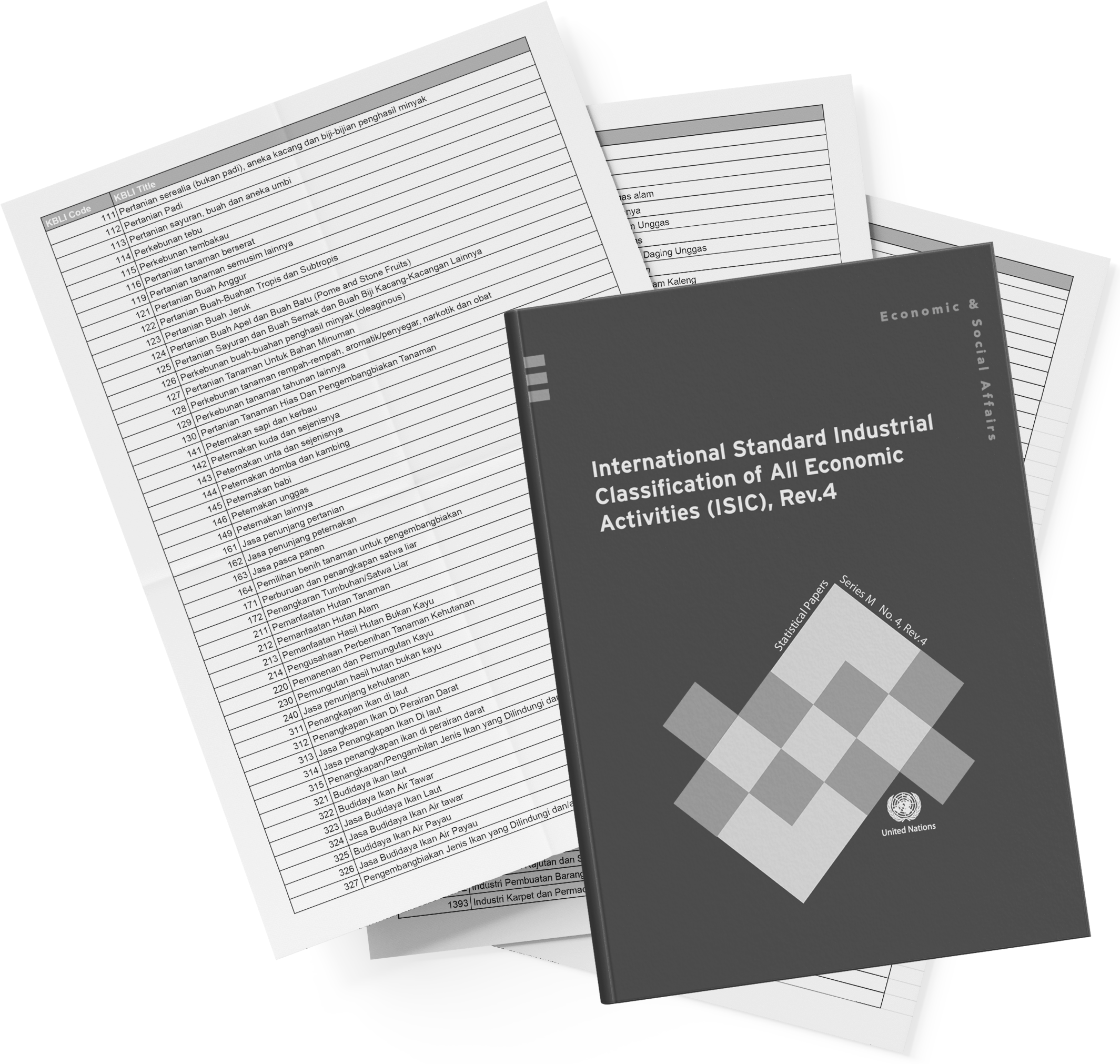
KBLI: 2219: Other Rubber Product Manufacturing Industry in Indonesia
ISIC: Reference: International Standard Industrial Classification
NAICS: Comparable: North American Industry Classification System
Industry Terms
Key terminology for understanding the Other Rubber Product Manufacturing Industry in Indonesia industry.
Vulcanization
Chemical process using sulfur/accelerators under heat to cross-link rubber polymers, enhancing elasticity, tensile strength, and heat resistance.
Determines product lifespan; under-vulcanized rubber cracks prematurely in hoses, over-vulcanized becomes stiff—critical for warranty claims in auto/mining apps.
Extrusion
Continuous shaping of softened rubber through a die into profiles like hoses or seals, followed by curing.
Enables high-volume uniform output for belts/hoses; die precision dictates tolerance, affecting seal leak-proofing in machinery.
Compounding
Mixing raw rubber with fillers, oils, vulcanizers, and stabilizers to tailor viscosity, hardness (Shore A scale), and properties.
Custom recipes match customer specs (e.g., oil-resistant for mining hoses); poor mix leads to batch rejects costing 10-15% throughput.
Industry Overview – Business Types
Different business models operate within the Other Rubber Product Manufacturing Industry in Indonesia industry.
Volume Extruders
High-throughput lines produce standard hoses, tubes, mats from pre-compounded rubber, selling via distributors to construction/agri.
Scale economies on long runs; low customization but fast delivery via stock molds.
Standard industry practices apply.
Precision Molders
Injection/compression molding for custom gaskets, seals using CAD designs, targeting OEMs like auto or machinery assemblers.
Tooling investment for tight tolerances (±0.1mm); traceability via lot coding for recalls.
Standard industry practices apply.
Specialty Hygienic Producers
Cleanroom dipping/molding for condoms, medical seals with sterilization post-vulcanization, compliant to SNI/ISO standards.
Regulatory approvals barrier-to-entry; niche margins from branded consumer packs.
Standard industry practices apply.
Industry Performance & Outlook
Performance outlook for Other Rubber Product Manufacturing Industry in Indonesia
Sector performance hinges on rubber price cycles and downstream capex: auto/infra booms lift volumes, but import dumps erode pricing power for basics.
Outlook positive with EV shift demanding lighter seals/belts and infrastructure push (IBT toll roads, dams), though synthetic adoption tempers natural rubber reliance.
Key performance indicators
Market growth
Industry expansion rate
Driven by domestic demand
Operational efficiency
Cost management
Key competitive factor
Outlook: what to watch
Monitor regulatory changes
Track infrastructure developments
Watch for technology adoption
Industry Growth Drivers
Key factors driving growth in Other Rubber Product Manufacturing Industry in Indonesia.
Growth Driver 1
Domestic consumption growth driven by expanding middle class and rising disposable incomes
Monitor industry reports and market data for trends.
Growth Driver 2
Infrastructure development reducing logistics costs and improving market access
Monitor industry reports and market data for trends.
Growth Driver 3
Government policy support including investment incentives and industrial development programs
Monitor industry reports and market data for trends.
Growth Driver 4
Technology adoption improving productivity and enabling new business models
Monitor industry reports and market data for trends.
Growth Driver 5
Regional economic integration expanding market access and supply chain opportunities
Monitor industry reports and market data for trends.
Growth Driver 6
Urbanization creating concentrated demand centers and distribution efficiencies
Monitor industry reports and market data for trends.
Industry Trends & Development
Industry Development
Evolution of Other Rubber Product Manufacturing Industry in Indonesia
From manual molding in village workshops to semi-automated extrusion lines in industrial parks, evolution driven by OEM quality demands and scale needs.
Shift from pure natural rubber to 30-50% synthetic blends for consistency, as plantations face replanting delays and weather risks.
Key Trends
Major trends shaping the Other Rubber Product Manufacturing Industry in Indonesia industry.
Digitalization and technology adoption
Industry trend shaping market dynamics.
Operators
Investors
Policymakers
Regulatory developments
Industry trend shaping market dynamics.
Operators
Investors
Policymakers
Impact and Sustainability
Sustainability and impact considerations for the manufacture of other rubber products industry.
Economic Impact
Contribution to national economic development.
Balancing growth with sustainability.
Environmental Considerations
Industry practices and environmental impact.
Operational costs vs sustainability.
Industry Segmentation
Industry Segmentation – Product/Service A
Primary market segments based on service type.
Segmentation by offering
Primary Segment
Core offerings
Main market
Addresses primary demand
Secondary Segment
Supporting services
Niche markets
Specialized needs
Segments may overlap based on customer needs.
Industry Segmentation – Product/Service B
Alternative segmentation perspectives.
Segmentation by characteristics
Mass Market
Broad appeal
General consumers
Volume-driven
Premium
High-value offerings
Discerning buyers
Quality-focused
Segment boundaries are fluid.
Customer Segmentation
Different customer segments and their characteristics.
Customer segments and what they value
B2B customers
Various
Multiple needs
Different channels
B2C consumers
Various
Multiple needs
Different channels
Key Players
Ecosystem Mapping
Other Rubber Product Manufacturing Industry in Indonesia ecosystem includes various stakeholders.
Suppliers
Provide inputs and raw materials.
Primary producers
Input suppliers
Operators
Core industry participants.
Main industry operators
Service providers
Distribution
Channel to end customers.
Distributors
Retailers
How value flows across the ecosystem
Value is created through coordinated activities across the ecosystem.
Leading Players
Competitive landscape and key player archetypes.
Competitive archetypes
Market Leader
Dominant position
Scale, brand recognition
Market saturation
Specialist
Niche focus
Expertise, agility
Limited scale
How competition typically plays out
Competition is shaped by scale advantages, operational efficiency, and customer relationships.
Differentiation strategies vary by segment, with some players competing on price and others on service quality.
Operating Conditions
Operating Model & Cost Structure
Operating models in Other Rubber Product Manufacturing Industry in Indonesia vary by business type.
Direct costs
Primary operational expenses
Input costs
Labor
Utilities
Major cost component
Overhead
Indirect operational costs
Administration
Facilities
Marketing
Scale-dependent
Cost structure summary
Direct costs
Volume and input prices
Operations
Efficiency improvements
Overhead
Scale and complexity
Administration
Process optimization
Cost structure varies by business model and scale.
Regulation & Compliance Considerations
Regulatory framework and compliance requirements.
Common compliance topics
Business licensing
Operating permits
Legal operation
Maintain valid licenses
Quality standards
Product/service requirements
Market access
Quality control systems
Stay current with regulatory changes.
FAQs & Sources
FAQs
What is Other Rubber Product Manufacturing Industry in Indonesia?
Other Rubber Product Manufacturing Industry in Indonesia encompasses various business activities in the Indonesian market.
Sources & Notes
This report is a synthesized overview based on industry analysis and desk research.
BPS (Statistics Indonesia)
Official statistics and industry data.
Ministry of Industry regulations
Regulatory framework and compliance requirements.
This report is for informational purposes and should not be treated as legal, regulatory, or investment advice.