Machinery and Equipment Wholesale Industry in Indonesia
A practical guide to Machinery and Equipment Wholesale Industry in Indonesia—market dynamics, operational realities, and strategic considerations in Indonesia
This industry involves the wholesale distribution of diverse machinery and equipment not covered in specialized categories, such as office machines (excluding computers), industrial processing equipment, construction machinery, electrical industrial gear, and related spare parts. Wholesalers source primarily from imports, stock inventory, and supply to manufacturers, contractors, and service providers, often providing after-sales support and financing.
Clear industry definition and scope of activities
Operational realities across Indonesia's regions
Market segmentation and customer analysis
Ecosystem mapping and competitive dynamics
Cost structure and unit economics
Regulatory and compliance considerations
Executive Summary
This industry involves the wholesale distribution of diverse machinery and equipment not covered in specialized categories, such as office machines (excluding computers), industrial processing equipment, construction machinery, electrical industrial gear, and related spare parts.
Wholesalers source primarily from imports, stock inventory, and supply to manufacturers, contractors, and service providers, often providing after-sales support and financing.
Fragmented with large authorized dealers alongside thousands of small traders.
Critical link in supply chains for construction, mining, and food processing sectors.
Spare parts trade offers high margins but requires deep technical knowledge.
Logistics across archipelago drives up costs and demands regional warehousing.
Brand exclusivity provides competitive edge through warranties and training.
Why this industry matters in Indonesia
Connects producers with Indonesia's vast consumer market.
Critical for price discovery and market efficiency.
Supports MSME distribution and market access.
Enables consumption-driven economic growth.
So what: Practical implications
Operators: Focus on quality consistency and process standardization
Buyers: Evaluate supplier capabilities beyond pricing
Investors: Look for operational efficiency and scalability
Policymakers: Support infrastructure development
Indonesia at a Glance
Republic of Indonesia: Large and fragmented market
Demand surges from government infrastructure projects like Nusantara capital and toll roads, plus private mining investments.
Java accounts for majority of transactions, but Kalimantan and Sumatra grow fastest due to resource extraction.
Market dynamics continue to evolve with changing economic conditions.
Hyperlocalization is key to navigate Indonesia's market
Clustering in industrial zones like Karawang, Bekasi, and Surabaya for quick delivery to factories.
Tailored stocking: construction gear in project hotspots, processing machines near palm oil mills.
Opportunities extend beyond cities
In Sulawesi and Papua, focus on mining and agro-equipment resilient to rough terrain.
Small traders dominate rural areas, relying on container trucking despite poor roads.
Growing middle class driving premiumization trends across product categories and services
Digital adoption accelerating with mobile-first consumer behavior creating new channel opportunities
Infrastructure investment improving connectivity and reducing logistics costs across the archipelago
Government initiatives supporting domestic industry development and foreign investment attraction
Regional economic integration through ASEAN creating expanded market access and trade opportunities
Sustainability and ESG considerations creating differentiation opportunities for responsible businesses
Distribution realities: logistics, infrastructure, and channel reach
Imports via major ports like Tanjung Priok, then inter-island shipping or trucking with bonded storage for duty deferral.
Regional depots mitigate delays, but monsoon seasons disrupt outer-island deliveries.
Establish robust distribution partnerships covering both modern trade and traditional channels
Invest in localized supply chain capabilities to navigate logistics complexities and reduce costs
Develop region-specific market entry strategies accounting for local competitive dynamics
Build flexibility into operations to adapt to regulatory changes and infrastructure variations
Industry Definition
What is KBLI 4659, and where does the boundary sit?
Industry Definition
KBLI 4659 covers the wholesale of other machinery and equipment that is not specifically classified under the more focused wholesale codes. Scope spans five sub-groups: office machinery (46591), office furniture (46592), industrial machinery and parts (46593), construction and earthmoving equipment (46594), and other machinery NEC (46599). It is the wholesale channel through which Indonesia's factories, construction sites, mines, and offices procure their capital and operating equipment.
The defining activity is intermediation at scale: importing, holding inventory, and reselling B2B to end-users, contractors, EPC firms, government procurement bodies, and a downstream tier of smaller traders and dealers. Operators may also provide after-sales service, parts supply, and warranty support, but the legal scope of 4659 is the wholesale transaction itself, not the service.
Exclusions are tight. Agricultural machinery wholesale sits in KBLI 4653; computer and IT-hardware wholesale in 4651; motor vehicle and motorcycle wholesale in 4654–4655; fuel and chemical wholesale in 4661 and 4669; and retail sale to end consumers in Division 47. Manufacture of these goods falls under KBLI Section C (Divisions 25–28).
Indonesia in Focus
In Indonesia, the wholesale layer for industrial and construction machinery is unusually visible because nearly all of the equipment is imported and most end-users — even very large mining and contracting firms — do not source directly from the OEM. The sole-distributor (ATPM) and brand-authorized model is dominant in heavy equipment, machine tools, and gensets; multi-brand trading is more common in office machines, industrial supplies, and parts.
Demand is project-led and commodity-cyclical. Coal and nickel mining capex drives construction-equipment volume; toll road and port infrastructure shapes earthmoving and concrete-equipment demand; manufacturing FDI determines machine-tool and materials-handling pull. Each demand pool moves on its own clock, so multi-segment wholesalers structurally smooth their revenue versus single-segment specialists.
TKDN (local content) policy is the most operationally important regulation. Many government and BUMN tenders require minimum local content thresholds, which tilts competition toward operators with local assembly or CKD arrangements and constrains pure-import distributors in public procurement. Bea Cukai and Persetujuan Impor rules determine landed cost and timing for imported equipment.
Industry Classification
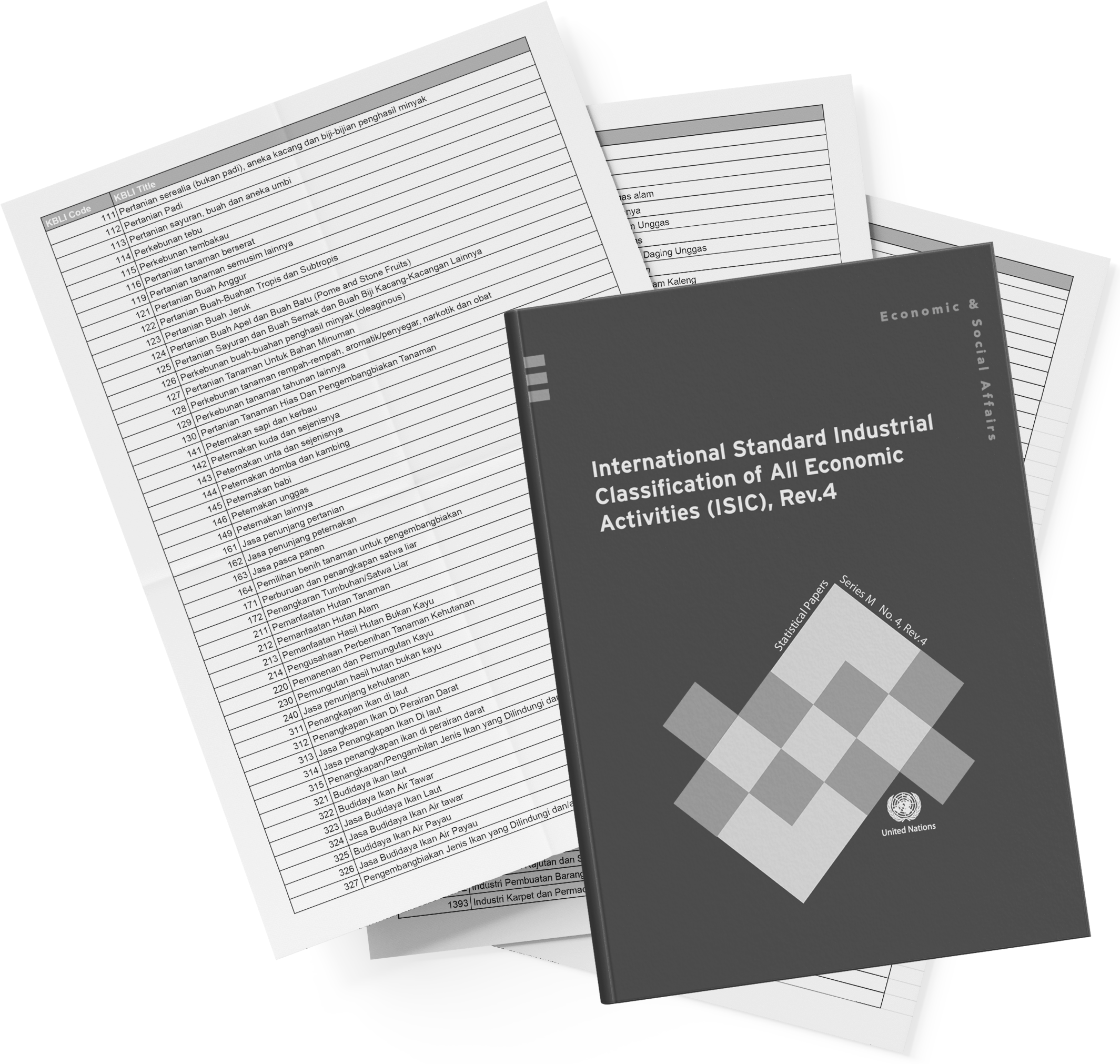
KBLI 2020 — code 4659 — Perdagangan Besar Mesin, Peralatan dan Perlengkapan Lainnya. Five-digit sub-classifications: 46591 (office machinery), 46592 (office furniture), 46593 (industrial machinery and parts), 46594 (construction and earthmoving), 46599 (other machinery NEC).
ISIC Rev.4 alignment: class 4659 — Wholesale of other machinery and equipment. The Indonesian sub-codes add a fifth digit of granularity not present in ISIC.
NAICS analogues: 423810 (Construction and Mining Machinery Merchant Wholesalers), 423830 (Industrial Machinery and Equipment Merchant Wholesalers), 423420 (Office Equipment Merchant Wholesalers). The US classification splits what Indonesia consolidates under one code.
Frequently appears on the same NIB as KBLI 4653 (agricultural machinery), 4651 (IT hardware), 7732 and 7739 (machinery rental — when the operator also runs a rental fleet), 3312 and 3313 (machinery and electronic equipment repair). Multi-code registration is the norm for full-service equipment houses.
Industry Terms that actually matter
The vocabulary in this industry encodes commercial structure. 'Authorized dealer' carries contractual meaning that 'distributor' does not. TKDN turns a procurement decision into a regulatory one. The terms below are the ones that change how a tender, a competitor filing, or a customer contract should be read.
ATPM / Sole Distributor (Agen Tunggal Pemegang Merek)
Indonesian entity holding exclusive rights from an OEM to import, market, service, and warranty an equipment brand at the national level.
The single most valuable asset for many KBLI 4659 operators. Losing or holding the ATPM contract for Komatsu, Caterpillar, Volvo CE, Hitachi, or comparable brands defines the firm's commercial trajectory.
TKDN (Tingkat Komponen Dalam Negeri)
Local content level for goods sold into government procurement and selected commercial tenders; calculated against assembly, materials, and labor contribution.
Determines eligibility for many public-sector and BUMN tenders. Pushes pure-import distributors toward local assembly, CKD arrangements, or partnership with Indonesian manufacturers.
Persetujuan Impor (PI) and HS Classification
Product-specific import approvals issued by Kemendag based on Harmonized System codes; certain equipment categories carry quantitative restrictions or sectoral approval requirements.
Affects timing and feasibility of bringing imported equipment into the country. Mis-classification creates customs disputes and penalty exposure.
CBU vs CKD vs IKD
Completely Built Up (finished imported units), Completely Knocked Down (kits assembled domestically), Incompletely Knocked Down (semi-assembled, partial domestic content).
Determines duty rates, TKDN treatment, and tender eligibility. The shift from CBU to CKD assembly is a structural strategy for major distributors managing local-content pressure.
Grey Market / Parallel Imports
Equipment brought into Indonesia outside the ATPM channel, often without warranty support or service backing.
Pricing pressure on authorized distributors, especially in office machines, light industrial equipment, and parts. Common in price-sensitive SME segments and at the lower end of the construction equipment market.
After-sales Service Network
Workshop coverage, technician headcount, parts depot footprint, and warranty fulfillment infrastructure operated by the distributor.
The most durable competitive moat in capital-equipment wholesale. Customers buy from whoever can keep their fleet running; service depth typically beats list-price difference of 5–10%.
e-Katalog (LKPP)
Government electronic catalog through which ministries, provincial governments, and BUMNs procure machinery; pricing, specifications, and TKDN status are visible publicly.
Gates access to government and BUMN demand. Listing, pricing, and TKDN compliance on e-Katalog determine whether a brand wins a meaningful slice of public procurement.
Working Capital and Inventory Days
Capital tied up in landed inventory across regional warehouses plus receivables on dealer and corporate accounts; often 90–180 days combined.
Wholesale machinery is a working-capital-heavy business. Inventory carrying, FX exposure on imported stock, and extended receivables on EPC and government accounts shape the lessor's balance-sheet strategy.
Industry Overview – Business Archetypes
KBLI 4659 hosts very different businesses under one code. A Caterpillar or Komatsu ATPM with $500m+ revenue and a regional office-machine trader share the classification but share almost nothing else — capex, working capital, customer mix, and competitive moats differ sharply. The five archetypes below capture how value is actually created in this industry.
Brand-Authorized Heavy Equipment Distributor (Ecosystem Anchor)
Holds ATPM or near-exclusive distribution rights from a major global OEM for construction and mining equipment — typically Komatsu (United Tractors), Caterpillar (Trakindo Utama), Volvo CE (Indotruck Utama), Hitachi (Hexindo Adiperkasa), or comparable brands. Operates a national dealer pyramid, captive workshop network, and parts logistics chain.
Effectively the OEM's Indonesian franchise. Reputation, dealer-network depth, technician coverage, and parts-availability commitments are the central commercial assets. Principal contract continuity is the firm's most valuable balance-sheet item even though it does not appear on the balance sheet.
Equipment margin on landed cost to dealer/end-user price; typically low-to-mid teens at gross-margin level, supplemented by parts and aftermarket margin that runs meaningfully higher
Workshop service revenue, scheduled maintenance contracts, technician-day rates, and warranty-extension programs
Volume rebates from the principal tied to annual targets and market-share commitments; co-marketing and dealer-incentive funding
Working capital intensive: imported inventory plus dealer credit lines tie up significant cash; FX exposure on yen, dollar, or euro is structural
Service network is non-negotiable — principals audit technician coverage and parts inventory as a condition of contract renewal
Concentration risk on the principal contract; losing Komatsu or Caterpillar rights would dissolve the business overnight
Industrial Machine Tools and Manufacturing Equipment Specialist (Bridge Model)
Distributes machine tools (CNC machining centers, lathes, milling, grinding), industrial automation equipment (PLCs, robotics, drives), welding equipment, compressors, and other manufacturing-floor capital goods. Serves multinational manufacturers, local industrial estates, and the broader Indonesian manufacturing FDI base.
Brand portfolio breadth across multiple OEMs (Mazak, DMG Mori, Okuma, FANUC, Yaskawa, ABB, Atlas Copco, Sullair, ESAB, Lincoln) is more common here than single-brand exclusivity. Competes on technical sales depth, installation and commissioning capability, and ongoing automation engineering support.
Equipment margin on capital sales, supplemented by service contracts, training, and integration engineering fees
Parts and consumables (cutting tools, welding wire, automation components) at higher gross margin and faster turn rates
Project-based system integration revenue for automation cells, production lines, or factory-fit-out work
Technical sales force is the central capability — knowledgeable application engineers convert opportunities that pure traders cannot
Demo and showroom facilities (often in Cikarang, Karawang, or Surabaya industrial estates) are meaningful customer-acquisition assets
Manufacturing FDI cycle exposure; multinational customers in EV, electronics, and downstream metals are the demand pool
Power Generation and Compressed Air Distributor (Specialist Operator)
Distributes industrial gensets (Cummins, Caterpillar, Perkins, MTU, Volvo Penta), air compressors (Atlas Copco, Sullair, Kaeser, Ingersoll Rand), pumps, and ancillary power and pneumatic equipment. Customer base spans mining, manufacturing, telecom, hospitals, data centers, and event organizers.
Often vertically integrated downstream into rental and service. The wholesale-only player typically partners with a rental arm or service workshop; the integrated player monetizes the same fleet across sale, lease, and aftermarket service.
Equipment margin on gensets and compressors, with strong parts and consumables (filters, lubricants, replacement parts) margin underpinning lifetime value
Service contracts including preventive maintenance, emergency repair, and major-overhaul programs
Cross-sell into rental and used-equipment trading where applicable
Customer concentration in mining, telecom, and industrial backup is meaningful; commodity cycles affect mining-driven volume
Service and parts margin underpins profitability — equipment sale is often near break-even, with money made over the lifecycle
Working capital tied up in spare-parts inventory across provincial depots
Office Machinery and Equipment Distributor (Inclusion Engine)
Distributes office machines (multifunction printers, copiers, presentation equipment, office furniture), increasingly bundled with managed-print and document-services contracts. Customer base spans large corporates, government, BUMN, hospitals, education, and SMEs.
Brand portfolio typically includes Fujifilm Business Innovation (former Fuji Xerox), Konica Minolta, Canon, Ricoh, Brother, Sharp, HP, and similar OEMs. Increasingly competes on managed-services and lease models rather than outright equipment sale.
Equipment margin on outright sales, with growing share of revenue from managed-print contracts and pay-per-page leasing
Consumables (toner, ink, paper) margin on installed base, which is typically more profitable than new-machine sales
Service contracts and document-management software bundles
Channel transition from transactional sales to recurring-revenue managed services is reshaping the business
Office-furniture sub-segment is more fragmented and project-driven, often tied to corporate fit-out and government office construction cycles
Competition from direct OEM models and digital procurement platforms is real, especially for SME accounts
Multi-Brand Trader and Regional Wholesaler (Infrastructure Enabler)
Aggregates multiple second-tier brands, parts, and consumables; serves regional contractors, SME manufacturers, and the long tail of customers that authorized distributors do not prioritize. Fragmented and numerous across Java, Sumatra, and Kalimantan industrial corridors.
Competes on price-point coverage, flexibility on credit terms, willingness to deal in smaller transactions, and same-day or next-day availability for routine spare parts and consumables.
Higher per-unit margin than authorized distributors at the equipment level, offset by lower volume and weaker after-sales credibility
Trading and arbitrage margin on opportunistic stock buys, including used and refurbished equipment
Parts and consumables turnover, sometimes in grey-market segments alongside authorized supply
Lower fixed cost than authorized distributors; service typically outsourced to independent workshops
Vulnerable to brand commoditization, parts-authenticity disputes, and consolidation pressure from national players
Strong fit for Tier-2 and Tier-3 cities where authorized distributors are less aggressive; consolidation candidates over the medium term
Industry Performance & Outlook
Multi-cycle exposure with structural tailwinds from infrastructure, manufacturing FDI, and downstream commodity investment
The directional reading is mixed but tilted positive over the medium term. KBLI 4659 sits at the intersection of several demand cycles: mining capex (coal, nickel, copper), construction and infrastructure (toll roads, ports, IKN, industrial estates), manufacturing FDI (EV, batteries, electronics, downstream metals), and ongoing replacement demand from the installed base. No single cycle drives the whole industry, which damps revenue volatility for multi-segment operators.
Equipment volumes are highly FX-sensitive. Almost every product line in 4659 is imported, so rupiah depreciation passes through directly to landed cost and erodes affordability. Distributors with disciplined hedging programs, structured supplier-financing arrangements, and long-term volume contracts manage this better than those carrying open FX exposure on rolling inventory.
Service and parts revenue continues to grow faster than new-unit sales for the major heavy-equipment distributors. The installed base of construction and mining machinery accumulated over the last 15–20 years now generates a substantial parts and aftermarket pull — and that pull carries higher margin and lower cyclicality than new-unit sales. Distributors that built deep service networks a decade ago are now compounding that advantage.
Forward-looking growth pockets are: IKN-driven construction equipment demand in Kalimantan, downstream nickel and EV-battery manufacturing equipment in Sulawesi and Java, port and logistics infrastructure equipment as supply chains reorganize, and managed-print and office automation as corporate digitization deepens. Each pocket favors a different distributor archetype.
Performance indicators that matter for KBLI 4659
Coal and nickel commodity prices
Mining capex willingness, with 1–2 quarter lag
Most volatile single driver for construction and mining equipment volume; price upcycles trigger fleet expansion orders
Construction activity (private and public)
Demand pulse for construction and earthmoving equipment
Toll road, port, industrial estate, and IKN programs drive multi-year demand visibility
Manufacturing FDI realization
Demand pulse for machine tools, materials handling, and industrial automation
EV/battery, downstream nickel, electronics, and consumer-goods manufacturing are the largest demand pools
USD/IDR and JPY/IDR rates
Landed cost on imported equipment
Direct margin and affordability impact; yen-denominated Komatsu and Japanese machine tools are the most exposed
Aftermarket parts revenue share
Maturity and stickiness of the installed base
Rising structural share of distributor revenue; parts and service increasingly carry equipment-distributor profitability
TKDN-compliant SKU share in portfolio
Access to government and BUMN procurement
Local assembly and TKDN-compliant SKUs increasingly required for public-sector and BUMN tenders
Outlook: what to watch over the next 24–36 months
Coal and nickel commodity price trajectories and the lagged effect on mining-equipment fleet expansion orders
IKN construction phase progression and the resulting demand for earthmoving, concrete, and lift equipment in Kalimantan
Manufacturing FDI realization in EV/battery, downstream nickel, and electronics, which drives machine-tool and materials-handling demand 12–18 months ahead of factory commissioning
TKDN policy evolution and the pace of CBU-to-CKD assembly migration among major distributors
Chinese OEM penetration into mid-tier construction and machine-tool segments, opening price-point bands between premium Japanese and informal alternatives
Trade policy on capital goods imports — duties, exemptions, and bilateral agreements (RCEP, IEU-CEPA progress) shape competitive position
Industry Growth Drivers
Growth in KBLI 4659 is the compound of several independent demand cycles plus the slow maturation of the installed base. The drivers below are the ones that materially move the P&L for major distributors — not generic macro narratives.
Infrastructure programs and IKN-driven construction equipment demand
IKN (Nusantara capital), the toll road expansion network, port and rail upgrades, and continued industrial-estate build-out create direct demand for earthmoving equipment, cranes, concrete pumps, lift platforms, gensets, and supporting machinery. These programs are multi-year and lumpy but provide visibility unmatched in pure commercial channels.
Distributors with pre-positioned inventory in Kalimantan, certified local assembly to meet TKDN, and EPC relationships across major contractors capture disproportionate share when peak demand arrives.
Otorita IKN procurement announcements and major contractor mobilization
Toll-road and port project milestone progress through PUPR and Kemenhub channels
Manufacturing FDI and downstream commodity investment
EV and battery investment (LG, CATL, BYD, Hyundai partnerships), downstream nickel and aluminum smelting, and continued electronics and consumer-goods FDI drive machine-tool, robotics, materials-handling, and factory-fit-out equipment demand. Demand typically lands 12–18 months ahead of operational commissioning as factory build-out begins.
Distributors with technical-sales depth, demo facilities in Cikarang and Karawang, and global OEM relationships convert this demand most efficiently. Local content rules increasingly favor distributors that can structure assembly or component-localization arrangements.
BKPM FDI realization data, especially for downstream metals and EV-supply-chain manufacturing
Major industrial-estate occupancy and tenant ground-breaking announcements
Mining capex cycles and commodity price upcycles
Coal, nickel, copper, and gold capex cycles drive mining-equipment fleet expansion and replacement orders. The lag from commodity price upcycle to actual order placement is typically one to two quarters, with delivery and commissioning extending the cash cycle further.
This is the most volatile single driver in KBLI 4659. Distributors with diversified portfolios across mining and non-mining segments smooth this volatility; pure mining-equipment players experience violent revenue swings.
Coal, nickel, copper, and gold commodity prices and forward curves
Mining contractor fleet announcements and capex commentary in major mining operator filings
Aftermarket and installed-base maturation
Two decades of accelerating equipment sales have created an installed base large enough that parts, service, and major-overhaul revenue now represent a structural and growing profit pool. This shifts the distributor's revenue mix toward higher-margin, stickier aftermarket and away from FX-exposed, cyclical new-unit sales.
Distributors with deep technician networks, well-stocked provincial parts depots, and customer-service-management systems convert installed base into recurring revenue most efficiently. Those who under-invested in service a decade ago face declining customer loyalty as machines age.
Age profile of major operators' deployed equipment base
Parts and service revenue as a share of total distributor revenue (visible in larger group disclosures)
TKDN and local assembly as a strategic capability
Government and BUMN procurement increasingly mandates minimum TKDN thresholds, which favors distributors with local CKD assembly, domestic-component sourcing, and certified local content. Pure-import distributors are progressively shut out of public-sector tenders that previously contributed material revenue.
The strategic response — investing in local assembly facilities or partnering with Indonesian assemblers — takes years and capital. Distributors making this commitment now position themselves for the next decade of public procurement.
Kemenperin TKDN policy announcements and threshold revisions
Major distributor announcements of local assembly investments and CKD partnerships
Chinese OEM penetration and mid-tier price-point expansion
Chinese construction equipment OEMs (Sany, XCMG, Zoomlion, LiuGong, SDLG), machine tools (Haitian, BYJC), and other industrial-equipment makers are establishing meaningful distribution in Indonesia. Their price-to-spec proposition is opening a mid-tier between premium Japanese and informal alternatives.
For Indonesian distributors, this creates both opportunity (taking on Chinese brand authorizations) and threat (price-point compression on incumbent Japanese and Western lines). The competitive shape of the next decade depends heavily on how Chinese OEM service-network credibility evolves.
Chinese OEM market-share movement in heavy equipment and machine tools
Service-network and parts-availability investments by Chinese-OEM-affiliated distributors in Indonesia
Industry Trends & Development
Industry Development: how the wholesale channel reached its current shape
From import-trading houses to integrated equipment-and-service ecosystems
Indonesia's machinery wholesale channel evolved through three structural phases: the consolidation of major OEM brands under sole-distributor agreements, the build-out of national dealer and service networks during the commodity supercycle, and the current phase combining digital procurement, TKDN-driven local assembly, and aftermarket-led profit migration.
Each phase changed what was scarce. The first made principal contracts scarce. The second made service-network depth scarce. The current phase is making TKDN-compliance, local assembly capability, and integrated equipment-service-rental ecosystems scarce — capabilities that take years and capital to build.
Sole-distributor consolidation and commodity-driven volume
Caterpillar (Trakindo), Komatsu (United Tractors), Volvo (Indotruck), Hitachi (Hexindo) anchor their ATPM positions. Mining commodity boom (coal, palm) drives unprecedented equipment volume. Office-machinery channel shifts decisively from typewriters and standalone copiers to multifunction printers. Industrial machine tools market remains thin outside major manufacturing FDI sites.
National service-network buildout and dealer pyramid maturation
Major heavy-equipment distributors invest heavily in workshop networks, parts depots, and technician training to support exploding installed base. Infrastructure programs (toll roads, FTP I/II power plants) sustain construction-equipment demand. Manufacturing FDI in Java industrial estates accelerates machine-tool and automation demand. TKDN policy framework develops as a procurement tool.
Chinese OEM entry, TKDN tightening, and aftermarket strategic shift
Sany, XCMG, Zoomlion, and other Chinese construction OEMs establish meaningful distribution. TKDN thresholds rise for government and BUMN procurement, pushing major distributors toward CKD assembly arrangements. e-Katalog (LKPP) becomes the central public-procurement channel. Aftermarket parts and service emerges as a recognized strategic profit pool, shifting distributor investment patterns.
Pandemic shock and supply-chain resilience push
Shipping disruptions, container shortages, and FX pressure expose distributors with thin inventory buffers. Mining commodity rebound (coal, nickel) revives heavy-equipment demand sharply in H2 2021. Local assembly conversations accelerate as supply-chain resilience joins TKDN as a strategic priority. Digital B2B procurement adoption accelerates in industrial supplies and office machines.
IKN, FDI ramp-up, and downstream commodity-driven demand
IKN construction phase begins driving heavy-equipment demand into Kalimantan. EV/battery and downstream nickel FDI generates machine-tool and materials-handling pull across Java and Sulawesi. Chinese OEMs deepen Indonesian distribution and service-network credibility. Managed-services and equipment-as-a-service models gain traction in office machines and increasingly in industrial equipment.
Key Trends — what's changing in the business model
The most important trends in KBLI 4659 are shifts inside specific parts of the wholesale business model, not generic macro narratives. The six below are the ones that meaningfully change how distributors earn money, what capabilities matter, and which operators thrive over the next decade.
Aftermarket and service revenue as the structural profit pool (Key Resources / Value Proposition)
New-unit equipment margin is FX-exposed, cyclical, and increasingly price-pressured by Chinese OEM competition. Parts, service, and aftermarket revenue runs at higher margin, lower cyclicality, and stickier customer relationships. The strategic implication is that the wholesale channel is becoming a service business with an equipment-sale on-ramp.
Distributors that built service-network depth a decade ago are now compounding that advantage. Those who optimized only for unit sales face declining customer loyalty and margin compression as their installed base ages and aftermarket alternatives multiply.
Authorized distributors with installed-base scale
Aftermarket parts specialists and independent workshops
Mining, construction, and manufacturing end-users managing fleet TCO
TKDN-driven local assembly and supply localization (Key Partners / Cost Structure)
TKDN thresholds for public procurement are pushing major distributors from pure CBU import into CKD assembly arrangements with OEM principals and local component partners. The shift requires capital investment in assembly facilities, supplier-development programs, and certification processes — but it unlocks the public-sector procurement market that pure importers are losing.
Strategically, this is reshaping the supplier base. Distributors with credible CKD operations and local-content stories are winning government and BUMN tenders that previously went to multi-national OEM-direct arrangements. Those without are progressively shut out.
Major brand-authorized distributors investing in local assembly
Local component manufacturers and engineering firms
Government and BUMN procurement buyers
Equipment-as-a-Service and bundled rental-sale-service models (Revenue Streams)
Customer demand is shifting from outright equipment purchase toward bundled offerings combining rental, service, parts, and even output-based contracts (cost-per-ton, cost-per-hour). Distributors that can integrate sale, rental, service, and financing into a single relationship capture more wallet share and longer customer durations.
Revenue streams are shifting from transactional equipment sales to recurring fee-based contracts. The integrated distributor (United Tractors, Trakindo with rental arms, Mitsubishi-affiliated operators) captures this transition more easily than pure-trader competitors.
Integrated distributors building rental and service arms
Pure-import traders without service or rental infrastructure
Mining, construction, and industrial customers preferring opex over capex
Digital procurement and B2B platform emergence (Channels)
B2B procurement platforms (Mbiz, Bhinneka B2B, OLX Business, internal LKPP e-Katalog) are reshaping how routine machinery, parts, and consumables are purchased — especially in office machines, industrial supplies, and standardized parts. Order placement, price discovery, and supplier comparison are increasingly digital.
For distributors, this means investing in digital storefronts, integrated ERPs that can fulfill platform orders efficiently, and content-rich product catalogs that win discovery searches. Pure relationship-based selling still dominates large capital equipment but is gradually eroded for the long tail of routine procurement.
Office-machinery and industrial-supply distributors
B2B platforms and digital procurement intermediaries
Mid-market and SME customers shifting routine purchasing online
Chinese OEM competitive pressure across price tiers (Key Partners / Cost Structure)
Chinese construction equipment, machine tools, and industrial automation OEMs (Sany, XCMG, Zoomlion, LiuGong, Haitian, ESTUN) are building credible Indonesian distribution. Their price-to-spec ratio, willingness to invest in local service, and access to flexible financing arrangements are compressing the price-point structure of the industry.
For incumbent Japanese-affiliated distributors, the response is bifurcating: deeper service differentiation and aftermarket capture, alongside selective price-tier flanker product introductions. For Chinese-affiliated distributors, the focus is building service-network credibility that matches their pricing advantage.
Japanese-affiliated incumbent distributors
Chinese OEM-affiliated emerging distributors
End-users facing wider price-spec choice
Customer concentration and EPC partnership models (Customer Segments)
Major projects — IKN, smelters, EV-battery plants, port expansions — concentrate demand in a small number of EPC firms and large contractors. Distributors that build deep relationships with key EPCs (Wijaya Karya, Adhi Karya, PP Group, Total Bangun Persada, China Construction subsidiaries) capture disproportionate share of project-led demand.
Strategically, this rewards account-management depth at the EPC and major-customer level. Distributors that treat EPCs as strategic partners — embedding engineers, customizing logistics, structuring multi-project supply agreements — win the next-generation infrastructure cycle.
Major heavy-equipment distributors
EPC firms and integrated contractors
Government and BUMN project owners
Impact and Sustainability
Sustainability for KBLI 4659 has both an environmental dimension (the fleet emissions, fuel use, and end-of-life management of the equipment that flows through the channel) and a business-durability dimension (FX exposure, commodity cyclicality, principal contract risk, and TKDN compliance). Reading only one half misses the full picture.
Productivity, infrastructure, and economic-development impact
Machinery wholesale is the practical mechanism through which Indonesia's industrial productivity, infrastructure capacity, and manufacturing competitiveness improve. The channel determines whether a factory in Cikarang can install a robotic cell on schedule, whether a mining operator can replace an aging fleet without months of delay, and whether a contractor can complete a toll-road segment on time.
Where the channel is thin — in eastern Indonesia, remote mining frontiers, and tier-3 cities — equipment availability constrains real economic activity. Distributors that build outward into under-served geographies create disproportionate development impact alongside their commercial returns.
Faster equipment deployment in productive regions widens the productivity gap with under-served areas unless distribution reach is deliberately built outward
TKDN-driven local assembly preserves domestic manufacturing employment but can raise landed cost versus pure import
Environmental footprint and equipment-lifecycle considerations
The equipment flowing through KBLI 4659 — gensets, construction equipment, machine tools, compressors — carries meaningful lifetime emissions, fuel-use, and end-of-life management implications. The shift toward Tier 4 diesel, electric materials handling, and energy-efficient industrial equipment is reducing footprint intensity, but the absolute volume continues to rise as the installed base grows.
End-of-life management — used-equipment trading, refurbishment, recycling — is increasingly important as the first generation of large-volume installed equipment ages out of primary service. Distributors with structured used-equipment programs convert this responsibility into a defensible revenue stream.
Energy-efficient equipment carries higher upfront cost; customer willingness to pay depends on fuel price and TCO economics
Used-equipment trading creates margin opportunity but risks brand dilution and warranty disputes if not managed carefully
Channel durability and capability succession
Many Indonesian wholesale distributors are family-controlled with multi-decade principal-contract histories. Generational succession, professional management transition, and capability investment (technician training, digital systems, treasury and FX management) are the underappreciated risks to channel continuity.
Major distributors are investing in in-house training academies, ERP systems, and management development programs to bridge the next decade. The depth of these investments differentiates structurally durable operators from those at risk of erosion as founding leaders step back.
Investment in capability and systems has multi-year payback and weak appropriability — competitors can poach trained staff
Generational transition can preserve relationships but risks losing entrepreneurial dynamism that built the original franchise
Industry Segmentation
Industry Segmentation – Equipment category and KBLI sub-code
KBLI 4659 segments most usefully along the five-digit sub-code structure that mirrors the actual operating reality. Each sub-segment has different demand drivers, customer base, capex profile, and competitive structure. Construction and earthmoving equipment is the largest revenue pool; industrial machinery captures the manufacturing FDI cycle; office machinery is the most consumer-like sub-segment; the catch-all (46599) covers a diverse long tail.
Segmentation by KBLI sub-code and equipment category
Construction and earthmoving equipment (46594)
Excavators, bulldozers, motor graders, wheel loaders, dump trucks, cranes, concrete pumps, road rollers, lift platforms
Mining operators and contractors, EPC firms, infrastructure contractors, government project owners
Largest single revenue pool; demand directly correlated with mining capex cycles and infrastructure programs
Industrial machinery and parts (46593)
Machine tools (CNC), industrial automation, robotics, welding equipment, materials handling, industrial pumps and motors, factory automation systems
Multinational manufacturers, local industrial operators, fabrication shops, EPC sub-contractors
Tracks manufacturing FDI realization; technical-sales-led distribution model with strong demo and engineering requirements
Power generation and pneumatic equipment
Industrial gensets, air compressors, pumps, water purification, generator paralleling and switchgear (often within 46593 or 46599)
Mining, telecom, hospitals, data centers, manufacturing, events, oil-and-gas
Service- and aftermarket-led business; vertical integration with rental is common
Office machinery (46591)
Multifunction printers, copiers, presentation equipment, scanners, document-management hardware
Corporates, government, BUMN, hospitals, education, SMEs
Transitioning from transactional sales to managed-services and pay-per-page models; competes with B2B platforms
Office furniture (46592)
Workstations, ergonomic chairs, modular partition systems, meeting room furniture, archival storage
Corporate fit-out projects, government office construction, education, hospitality
Project-driven and fragmented; less brand-concentrated than other 4659 sub-segments; competes with retail home-office channel
Other machinery NEC (46599)
Specialty industrial equipment not covered elsewhere — broadcast and pro-AV equipment, laboratory equipment, food-processing machinery, packaging machinery, textile machinery
Industry-specific customers across food, beverage, textile, broadcast, pharmaceutical, packaging sectors
Catch-all category with diverse niches; each niche has its own specialist distributors and competitive dynamics
Revenue concentrates in construction/earthmoving and industrial machinery; margin concentrates in parts and aftermarket across all categories; volume turn concentrates in office machinery and consumables.
Multi-segment distributors (United Tractors, Trakindo) smooth cyclical exposure better than single-segment specialists.
Cross-segment bundling (gensets + ancillary equipment for a single industrial project) is increasingly common in large EPC and BUMN tenders.
Industry Segmentation – Brand tier and channel positioning
Beyond equipment category, KBLI 4659 segments along brand tier, channel type, and procurement model. The same excavator type can be a premium Japanese SKU bid into a private mining contract or a Chinese mid-tier SKU bid into a TKDN-restricted public tender — and the wholesale economics differ sharply.
Segmentation by brand tier and channel positioning
Premium tier (Japanese, US, European OEMs)
Komatsu, Caterpillar, Hitachi, Volvo, Kobelco, Liebherr, John Deere, Mazak, DMG Mori, Atlas Copco-tier equipment with premium pricing and full service ecosystem
Major mining operators, blue-chip industrial customers, blue-chip EPCs, multinational manufacturers
Highest-margin, service-led segment; ATPM distributors hold strong positions; defended by aftermarket and TCO arguments
Mid-tier (Chinese and Korean OEMs)
Sany, XCMG, Zoomlion, LiuGong, SDLG, Doosan, Hyundai CE, Hyundai HCE, Haitian, JMT-tier equipment at meaningfully lower price-to-spec
Price-sensitive contractors, mid-tier mining, public-procurement-driven projects, manufacturing SMEs
Fastest-growing segment by volume; competitive pressure on premium pricing; service-network credibility still maturing
Value tier (regional and informal channels)
Used equipment, refurbished units, generic parts, smaller-scale brands, grey-market imports
Local contractors, SMEs, small mining operators, used-equipment buyers
Highly fragmented; warranty and service support thin; volume meaningful but margin compressed
Government and BUMN procurement
TKDN-compliant SKUs sold via e-Katalog (LKPP) and direct tenders to ministries, provinces, regencies, BUMNs
Kementerian PUPR, Kementerian Perhubungan, provincial governments, BUMNs, BPDPKS-funded smallholder programs
Material slice of annual demand; TKDN compliance and e-Katalog presence are gating capabilities
Private corporate procurement
Direct equipment sales to private corporate customers (mining, manufacturing, construction, oil-and-gas) via tender or direct relationship
Major private operators across mining, oil-and-gas, manufacturing, contracting
Larger volume and looser TKDN constraints; service depth and account-management capability are differentiators
Aftermarket and parts channel
Spare parts, consumables, lubricants, filters, wear parts — often through multi-tier distribution to workshops and service contractors
Workshops, service contractors, independent fleet operators, mining-fleet maintenance teams
Higher-margin, higher-velocity than equipment sale; underpins lifetime distributor profitability
Brand-tier choices increasingly bifurcate the market: premium tier defends on service and TCO; mid-tier wins on price and TKDN flexibility.
Government procurement is a special competitive arena where TKDN compliance and e-Katalog discipline matter more than pure product specs.
Aftermarket and parts channel is where structural distributor profitability lives; new-unit sales are increasingly the on-ramp rather than the destination.
Customer Segmentation: who actually buys and what they need
KBLI 4659 customers operate under very different procurement logics. A coal mining operator buying excavators, an EV battery factory installing automation, an EPC contractor renting equipment across multiple project sites, and a hospital procuring office machines all approach the wholesale channel with different decision criteria and through different paths.
Customer segments and what they value
Mining operators and contractors
Large mining operators (Adaro, Bukit Asam, Berau, Vale, Freeport, AMNT) and mining contractors (Pamapersada, Saptaindra, BUMA)
Maintain and expand mining fleet; minimize downtime; optimize TCO across multi-year operating life
Premium brand reliability, deep service network, multi-province parts depot, technician availability, financing structures
Direct ATPM relationships, master service agreements, structured equipment financing
Construction and EPC contractors
Major EPC firms (Wijaya Karya, Adhi Karya, PP, Total Bangun Persada, Hutama Karya) and mid-tier contractors
Equip multiple concurrent project sites; flexibility on rental vs purchase; project-payment-aligned credit terms
Multi-asset bundling, multi-site mobilization, flexible commercial terms, EPC partnership capability
Account managers at major distributors, project-specific tenders, master agreements
Multinational manufacturers
Foreign-invested factories in Cikarang, Karawang, Cikande, KIIC, JIIPE, and other industrial estates
Equip factory expansions and replacements at global procurement standards; automation engineering support
Compliance documentation, application engineering, demo and trial facilities, global account capability, ESG fleet credentials
Group procurement, technical sales relationships, demo facility engagement
Local industrial and SME manufacturers
Indonesian-owned manufacturers and fabrication shops across food, packaging, textiles, metalworking, plastics
Affordable capital equipment for capacity expansion or replacement; reliable parts supply; informal credit flexibility
Price-tier coverage (mid-tier brands), local service support, flexible commercial terms, financing partnerships
Multi-brand traders, regional distributors, dealer networks, increasingly B2B platforms
Government and BUMN procurement
Ministries (PUPR, Perhubungan, Pertanian, Kesehatan), provincial dinas, BUMNs across infrastructure, energy, transport
Procure equipment under regulated tender rules; meet TKDN thresholds; document compliance
TKDN compliance, e-Katalog presence, certification, audit-friendly documentation, training and warranty packages
e-Katalog (LKPP), open tender processes, direct contracts with appointed distributors
Mining, manufacturing, and corporate aftermarket buyers
Operations teams managing fleets of equipment, sourcing parts and consumables for ongoing maintenance
Keep equipment running with timely parts; manage TCO over equipment lifetime
Parts availability and dispatch speed, OEM-authentic parts, workshop expertise, technician access
ATPM distributor parts channels, aftermarket specialists, increasingly online parts ordering
Corporate office, hospital, and education buyers
Corporate facilities, hospital networks, government offices, education institutions procuring office machines and furniture
Maintain office operations with reliable equipment; manage document workflow; procure within budget cycles
Managed-print contracts, predictable consumables supply, service responsiveness, e-Katalog or digital procurement access
Direct distributor sales, managed-services contracts, B2B platforms, e-Katalog
Key Players
Ecosystem Mapping: core, extension, and enabling actors
The KBLI 4659 ecosystem is layered, not linear. Core wholesalers depend on upstream OEMs, on extension dealer and partner networks for reach, and on enabling regulators, financiers, and infrastructure providers. Understanding which layer an actor sits in clarifies its leverage and its vulnerabilities.
Core — wholesalers, ATPMs, and authorized distributors
Entities that take title to imported or domestically-assembled equipment and resell to end-users, contractors, and downstream dealers. Carry inventory, FX risk, working capital, principal contract obligations, and service-network commitments.
PT United Tractors Tbk (Komatsu construction and mining equipment ATPM, plus adjacent Astra-group equipment lines)
PT Trakindo Utama (Caterpillar ATPM for construction and mining)
PT Hexindo Adiperkasa Tbk (Hitachi Construction Machinery ATPM)
PT Indotruck Utama (Volvo Construction Equipment ATPM and other Volvo group brands)
PT Kobexindo Tractors Tbk (Doosan, Mahindra, and select equipment brands)
Industrial machinery and machine-tool distributors (Mazak, DMG Mori, Okuma, FANUC, Yaskawa-affiliated Indonesian entities)
Power generation distributors (Cummins-affiliated, Caterpillar power, Atlas Copco compressors, Sullair)
Materials handling specialists (Toyota Material Handling, Mitsubishi Logisnext, Linde MH affiliates)
Office machinery distributors (Fujifilm Business Innovation, Konica Minolta, Canon, Ricoh-affiliated)
Long tail of regional multi-brand wholesalers across Java, Sumatra, Kalimantan industrial corridors
Extension — dealers, EPCs, contractors, B2B platforms
Actors that extend the wholesale reach to end users — dealer networks under ATPM pyramids, EPC firms aggregating equipment requirements across project portfolios, contractors making equipment purchase or rental decisions, and emerging B2B platforms.
Authorized dealer networks under ATPM pyramids (Komatsu, Caterpillar, Hitachi dealer chains)
Independent dealers and multi-brand retailers in regency capitals and industrial estates
Major EPC firms (Wijaya Karya, Adhi Karya, PP Group, Total Bangun Persada, Hutama Karya)
Mining contractors (Pamapersada, Saptaindra Sejati, BUMA, Petrosea)
B2B procurement platforms (Mbiz, Bhinneka B2B, internal e-Katalog/LKPP)
Service workshops and independent repair shops servicing the installed base
Enabling — OEMs, regulation, finance, infrastructure, talent
Actors that do not move equipment but make the channel possible — global OEMs providing product, regulators setting the rules, financiers funding inventory and customer purchases, and infrastructure providers enabling logistics.
Global construction OEMs (Komatsu, Caterpillar, Hitachi, Volvo CE, Kobelco, Liebherr, John Deere)
Chinese OEMs (Sany, XCMG, Zoomlion, LiuGong, SDLG, Doosan-Bobcat, Hyundai HCE)
Machine tool and automation OEMs (Mazak, DMG Mori, Okuma, FANUC, Yaskawa, ABB, KUKA, Siemens)
Power equipment OEMs (Cummins, Caterpillar Power, Atlas Copco, Sullair, Kaeser, Ingersoll Rand)
Kementerian Perindustrian (TKDN policy, industrial-equipment sector regulation)
Kementerian Perdagangan (import licensing, distributor regulation)
LKPP (e-Katalog management for public procurement)
Bea Cukai (customs and import duty administration)
OJK-regulated multifinance companies (Astra Sedaya Finance, BCA Finance, Mandiri Tunas Finance, BFI Finance)
Banks providing inventory financing and trade finance
Port and inland logistics operators (Pelindo, JICT, MTI, Tol Laut routes)
Vocational education (SMK Teknik, Politeknik Manufaktur) supplying technician talent
How value flows across the ecosystem
Equipment value flows downward from OEMs through ATPM/sole-distributor balance sheets, into dealer pyramids or direct corporate sales, and finally to end-user fleets. Each layer adds margin for inventory carrying, financing, service capability, and access to specific customer segments. Inventory days and FX exposure aggregate up the chain to the ATPM.
Aftermarket value flows in a tighter loop between the ATPM's parts and service network and the installed base. Parts margin, service-contract revenue, and major-overhaul work generate the most reliable profit pool in the industry and underpin ATPM lifetime returns.
Information value — telematics, fleet-management data, customer-usage patterns — increasingly flows back to OEMs and distributors as connected equipment matures. This data underpins product-development cycles, predictive maintenance, and customer engagement, becoming a competitive variable in its own right.
Leading Players: who shapes the market and how
Leadership in KBLI 4659 is highly sub-segmented. Construction and mining equipment is concentrated among a small set of national ATPMs, often Astra-group or independent family-controlled. Industrial machinery and machine tools have specialist distributors with brand-portfolio breadth. Power equipment leadership splits between brand-affiliated distributors and integrated equipment-rental groups. Office machinery is more fragmented and channel-driven. No single 'market leader' label fits the whole code.
Leading players by segment — positioning, strengths, and constraints
PT United Tractors Tbk (Astra group, Komatsu ATPM)
Anchor in construction and mining equipment via Komatsu ATPM; integrated rental, used-equipment, mining contracting, and adjacent businesses
Astra group scale, Komatsu brand pull, integrated business model spanning equipment, contracting, mining, and energy, extensive national service network
Mining-cycle exposure, FX on imported Komatsu units, capital allocation across many competing units within Astra
PT Trakindo Utama (Caterpillar ATPM)
Caterpillar ATPM for construction and mining equipment; deep national service network with focus on mining, oil-and-gas, and infrastructure
Caterpillar brand strength, multi-decade dealer-to-service experience, multi-province depot reach, used-equipment expertise, family-group strategic continuity
Concentrated exposure to mining capex cycles, FX on imported Caterpillar units, Chinese OEM competitive pressure
PT Hexindo Adiperkasa Tbk (Hitachi Construction Machinery ATPM)
Hitachi Construction Machinery ATPM with focus on mining, construction, and forestry equipment
Hitachi brand reputation in mining excavators, service-network depth, established customer base in coal and nickel mining
Customer concentration on mining, FX exposure, narrower brand portfolio versus multi-brand competitors
PT Indotruck Utama (Volvo CE and Volvo group ATPM)
Volvo Construction Equipment ATPM and Volvo group truck distribution; mining, construction, and logistics equipment focus
Volvo brand premium positioning, multi-product Volvo group breadth, growing local assembly footprint
Smaller market share versus Komatsu/Caterpillar incumbents, premium pricing vulnerable to Chinese mid-tier pressure
Chinese OEM-affiliated distributors (Sany, XCMG, Zoomlion, LiuGong via local partners)
Mid-tier challenger position in construction equipment, particularly in government procurement and price-sensitive private segments
Lowest landed cost in many specs, customization flexibility, attractive in TKDN-restricted tenders, expanding service investment
Service-network credibility still building, parts availability concerns in remote regions, brand reputation gap to Japanese incumbents
Industrial machine tool distributors (Yamazaki Mazak, DMG Mori, Okuma, FANUC, Yaskawa affiliates)
Brand-authorized distribution of CNC machine tools, industrial automation, and robotics for manufacturing FDI customers
Technical sales depth, demo and showroom facilities in Cikarang and Karawang, integration engineering capability
Manufacturing FDI cycle exposure, competition from Chinese machine-tool brands at mid-tier, capital intensity of demo facilities
Power equipment and compressor distributors (Cummins, Atlas Copco, Sullair, Kaeser affiliates)
Brand-authorized distribution of industrial gensets, compressors, and pneumatic equipment with strong aftermarket integration
Service-led business model, deep parts and consumables revenue, vertical integration with rental in some cases
Customer concentration in mining and industrial backup, commodity-cycle exposure, premium pricing pressure
Office machinery distributors (Fujifilm Business Innovation, Konica Minolta, Canon, Ricoh affiliates)
Brand-authorized distribution of multifunction printers, copiers, and document-management systems with managed-services orientation
Recurring-revenue managed-services contracts, established corporate and government accounts, document-workflow software capability
Channel transition disruption, B2B platform pressure on transactional sales, declining paper-document trend
Regional multi-brand wholesalers and SME-focused distributors
Long tail of provincial wholesalers serving SMEs, regional contractors, and aftermarket parts demand
Local relationships, flexibility on credit, deep knowledge of regional customer dynamics, willingness to deal in smaller transactions
Working capital constraints, vulnerability to consolidation, brand authenticity and warranty disputes in parts segment
How competition typically plays out in this industry
Concentration varies sharply by sub-segment. Heavy construction and mining equipment is moderately concentrated among Komatsu (United Tractors), Caterpillar (Trakindo), Hitachi (Hexindo), and Volvo (Indotruck), with Chinese OEMs adding meaningful mid-tier share. Industrial machinery and machine tools are more fragmented, with brand-specialist distributors competing on technical sales depth. Power equipment leadership splits between brand distributors and integrated rental groups. Office machinery is the most channel-driven sub-segment with multiple credible competitors.
The competitive moat that travels best across sub-segments is service-network depth — workshop coverage, technician availability, parts depot footprint, and ability to respond on remote sites within 24–72 hours. Brand and product specification matter, but service reliability is what determines customer renewal and pricing power. Aftermarket parts and service revenue is increasingly the structural profit pool that justifies new-unit sales pricing discipline.
Government procurement is a special competitive arena where TKDN compliance, e-Katalog presence, certification, and ability to fulfill on extended payment terms matter as much as product specs. Major distributors investing in local CKD assembly are positioning for the next decade of public-sector demand; those still pure-import are progressively shut out.
Operating Conditions
Operating Model, Cost Structure, and Competitive Intensity
Operating economics in KBLI 4659 are dominated by landed inventory cost, working capital tied up in dealer credit and customer receivables, and the fixed cost of running a national service network. FX exposure on imported equipment is the largest single risk variable. Aftermarket parts and service revenue is the structural profit underpinning the new-unit business.
Industry-level competitive intensity is Medium to High. New-entrant threat is moderated by ATPM contracts and capital requirements at the top end, but lower for multi-brand and parts trading. Supplier power (OEM principals) is consistently elevated. Customer power varies sharply by segment, with mining operators and large EPCs commanding High power on tenders. The detailed Porter assessment below sits alongside the cost structure because the two cannot be read separately.
What creates durable advantage in this industry is the combination of principal contract continuity, service network depth, working capital scale, TKDN-compliant assembly capability, and access to government procurement. Operators with strength on four of these five defend against competitors with strength on only one or two; pure-trade distributors face structural margin compression.
Cost of goods (landed inventory)
Imported or domestically-assembled equipment, including duties, freight, customs handling, and inland logistics to regional warehouses
FX rate (USD, JPY, EUR, CNY) on imported equipment
Import duty and TKDN local-content treatment
Ocean freight, inter-island shipping, and inland logistics costs
Volume rebates and principal discounts on bulk procurement
Largest line item for equipment distributors; FX hedging and timing of letter-of-credit drawdowns are critical disciplines
TKDN-compliant local assembly increasingly required to access government procurement
Working capital and customer credit
Inventory carry across regional warehouses plus extended credit to dealers, EPCs, and corporate customers, often net 60–180 days
Inventory days across product categories and regional depots
Receivables aging on dealer, contractor, and government accounts
Cost of bank facilities and supply-chain financing
Seasonal and project-cycle pre-positioning requirements
A meaningful share of distributor profitability is effectively working-capital arbitrage
Government procurement extends receivables significantly; operators serving the public-sector channel need stronger balance sheets
Service network and aftermarket operations
Technicians, workshops, parts depots, training facilities, demo units, and warranty obligations across the national footprint
Technician headcount and certification programs
Provincial parts depot inventory and replenishment frequency
Demo unit fleet and field activation costs
Warranty claims and goodwill repair expense
Strategic spend: investment here creates the aftermarket profit pool that compounds over time
Under-investment erodes principal contract standing and customer loyalty across cycles
Sales, channel management, and demo facilities
Area sales force, account managers, EPC and major-account relationships, technical sales engineers, demo and showroom facilities
Sales force headcount and territory coverage
Technical sales engineer specialization for industrial and machine-tool segments
Demo and showroom facility investment in industrial-estate locations
Account management depth at major customer relationships
Technical sales depth is the central capability for machine-tool and industrial-automation segments
Demo and showroom facilities in Cikarang, Karawang, and Surabaya are meaningful customer-acquisition assets
Compliance, certification, and regulatory overhead
Import licensing, customs compliance, TKDN certification, e-Katalog management, product certifications (SNI where applicable), tax compliance
Import license maintenance and customs documentation
TKDN certification and local-content auditing
e-Katalog listing and pricing management
Tax invoicing and PPN reconciliation discipline
TKDN certification cycle is non-trivial and a meaningful barrier to entry for new-entrants
Compliance overhead higher for operators in the public-procurement channel
Corporate overhead and capability investments
Management, finance, treasury, IT systems, ERP, dealer-management software, training academies, and capability building
Headcount and salary structure across functions
Digital systems investment (ERP, dealer portal, CRM, telematics platform)
Treasury and FX management capability
Strategic capability building (technician academies, technical sales engineering)
Scale-sensitive; smaller wholesalers run lean overhead, larger ones invest in systems and capability
Digital and telematics investments are increasingly differentiating among mid-size distributors
Porter's Five Forces — competitive intensity in KBLI 4659
Threat of new entrants — Medium
Capital and OEM principal contracts are real barriers in heavy construction and mining equipment; technical-sales capability is barrier in machine tools; service-network depth is years-long to build. Lower barriers in multi-brand trading, office machines, and parts.
Entry is feasible into multi-brand, regional, parts, and price-tier-specific segments; entry into premium heavy-equipment ATPM positions typically requires acquisition or principal contract win
Build niche position in defensible segment (Chinese-OEM affiliation, parts specialist, regional service depth) rather than attack premium ATPM positions
Bargaining power of customers — Medium to High
Major mining operators and EPC contractors have High power on multi-year contracts; multinational manufacturers have High power on technical-sales-led machine-tool purchases; government procurement has High power via e-Katalog and TKDN rules; SMEs individually have Low power.
Visible in tender pricing pressure, extended-payment-term negotiations, ESG procurement requirements, and TKDN bid disqualifications
Build account-management depth, TKDN-compliant assembly, ESG fleet credentials, service-network differentiation, and bundled-services capability
Bargaining power of suppliers — High
OEM principals (Komatsu, Caterpillar, Hitachi, Volvo, etc.) control product, pricing, and contract terms; switching principals destroys distributor goodwill and service infrastructure. Chinese OEM alternatives moderate this somewhat.
Visible in equipment landed cost, parts pricing, technician training dependency, and principal contract terms (sales targets, market-share commitments)
Multi-brand sourcing strategy where feasible, long-term volume agreements, vertical integration into assembly, and aftermarket capability building
Threat of substitutes — Medium
Equipment rental (KBLI 7732/7739) substitutes for outright purchase in capex-constrained customer segments; financial leasing (KBLI 6491/6492) offers different ownership economics; used and refurbished equipment substitutes for new units in price-sensitive segments.
Rental and leasing alternatives are visible at the customer decision moment; used-equipment market is meaningful in heavy construction and mining segments
Build integrated equipment-sale-rental-finance offering, partner with multifinance affiliates, manage used-equipment trading as a profit contributor
Rivalry among existing competitors — Medium to High
Intense in mid-tier construction equipment among Japanese ATPMs and Chinese OEMs; intense in machine tools across brand-specialist distributors; moderate in heavy-mining premium tier; rising in office machines as channel transitions to managed services.
Visible in tender pricing pressure, principal-contract competition, dealer-network expansion, and demo facility investment
Defend on service depth, build TKDN-compliant assembly, sustain technical-sales capability, and develop aftermarket profit pool
Equipment gross margins typically run in the low- to mid-teens at the ATPM/distributor level; parts and accessories meaningfully higher (often 25–40%), which is why aftermarket carries disproportionate profit weight.
Working capital cycle for institutional and government accounts can extend 90–180 days, which means financing capability is itself a competitive variable.
Service contracts and managed-service revenue carry better margin and lower cyclicality than transactional equipment sales — and represent the structural future of distributor profitability.
Profitability is most resilient for operators with diversified portfolios across construction, industrial, power, and office segments, and most fragile for single-segment heavy-equipment specialists during commodity downturns.
Lasting competitive advantage in this industry combines principal contract continuity, service network depth, working capital scale, TKDN-compliant assembly capability, and government procurement access. Operators with strength on four of these five compound capital; pure-trade distributors face structural compression.
Regulation & Compliance: where rules actually bite
Regulation in KBLI 4659 is moderately heavy and concentrated around import licensing, TKDN compliance, and public procurement rules. Operators feel it most strongly through customs and HS classification, TKDN certification cycles, and e-Katalog management for the government and BUMN channel. Sector-specific regulation adds layers for medical, hazardous-materials, and certain industrial categories.
Operational regulation and compliance touchpoints
Business licensing and NIB (OSS)
OSS-based business identification number under KBLI 4659 and related codes; risk-based licensing under OSS-RBA
Determines legal scope of activities including multi-code coverage for adjacent wholesale and service activity
Maintain valid NIB, update KBLI coverage as product mix evolves, comply with OSS risk-based licensing
Import licensing and customs (API-U, Persetujuan Impor)
Importer identification number and product-specific import approvals for machinery and parts; HS code classification determines duty rates
Gates ability to bring in CBU equipment, parts, and consumables; mis-classification creates customs disputes and penalty exposure
Hold appropriate API and product import approvals; manage HS code classification with customs brokers; document country-of-origin and OEM-authorization paperwork
TKDN local content certification
Tingkat Komponen Dalam Negeri certification under Kementerian Perindustrian; required minimum percentages for government and BUMN procurement
Determines eligibility for many e-Katalog tenders and affects landed cost competitiveness; pushes distributors toward CKD assembly
Pursue TKDN certification across SKU portfolio, structure assembly partnerships to qualify, maintain TKDN audit documentation
e-Katalog (LKPP) participation
Listing on the government electronic catalog for public procurement; pricing, specs, warranty terms, TKDN status all visible
Gates access to a major slice of annual demand for equipment in government and BUMN contexts
Maintain catalog presence across active SKUs, manage pricing and warranty terms, comply with procurement-integrity requirements
SNI (Standar Nasional Indonesia) mandatory standards
Indonesian National Standards mandatory for selected machinery categories — electric motors, certain industrial equipment, fire-safety equipment, office furniture in some contexts
Determines which SKUs can legally be sold; affects product specifications and labelling
Maintain SNI certification for mandatory SKUs, coordinate with OEM principals on specification adjustments, manage label compliance
ATPM and distributor regulation
Kementerian Perdagangan rules on distributor and sole-distributor (ATPM) arrangements; reporting obligations for branded equipment importers
Defines legal structure of principal contracts; affects market-entry strategy for new OEMs
Register ATPM arrangements with Kemendag, manage reporting obligations, comply with distributor-restructuring rules
Worker safety and equipment certification (Riksa Uji)
Kementerian Tenaga Kerja certification for lifting equipment, pressure vessels, forklifts above threshold, and other regulated industrial assets
Required for legal operation of certain equipment by end-users; distributor responsibility to ensure first-use certification
Coordinate Riksa Uji certification process for regulated equipment, document operator training where applicable
Environmental compliance (PROPER, B3 handling)
Wastewater, emissions, and hazardous-materials handling rules for workshops, fuel storage, used-oil disposal, paint and solvent handling
Affects depot and workshop design, waste management, and refurbishment operations
Maintain PROPER certification where applicable, manage B3 handling, train workshop staff on environmental compliance
Medical device regulation (Kemenkes / BPOM, if applicable)
AKD/AKL registration for medical and laboratory equipment when 46599 scope extends to medical wholesale
Determines which medical equipment SKUs can be legally distributed
Maintain device registration portfolio, manage renewal cycles, comply with labelling and documentation
Taxation (PPN, PPh, withholding)
Indonesian VAT, corporate income tax, withholding obligations on transactions; specific treatment for capital equipment imports
Routine compliance overhead; capital-equipment PPN reclaim cycle is meaningful for customer cash management
Maintain tax invoicing discipline, manage PPN reconciliation, handle withholding on imports and dealer payments
TKDN threshold revisions and verification process changes — periodic policy tightening affects which SKUs qualify for public procurement.
Import duty and HS classification policy shifts that change landed-cost competitiveness; FTA renegotiations (RCEP, IEU-CEPA) shape long-term position.
Persetujuan Impor (PI) requirements for specific machinery categories — periodic introduction of quantitative restrictions or sectoral approval gates.
ATPM and distributor regulation evolution under Kemendag — affects contract structure and market-entry options for new OEMs.
Environmental and safety regulation tightening (PROPER tiers, B3 handling rules, Riksa Uji scope expansion) that affects workshop and depot operations.
Public-procurement integrity rules and audit exposure — e-Katalog pricing transparency, supplier evaluation, and integrity audits periodically reset competitive dynamics.
FAQs & Sources
FAQs
What is Machinery and Equipment Wholesale Industry in Indonesia?
Machinery and Equipment Wholesale Industry in Indonesia encompasses various business activities in the Indonesian market.
Sources & Notes
This report is a synthesized overview based on industry analysis and desk research.
BPS (Statistics Indonesia)
Official statistics and industry data.
Ministry of Industry regulations
Regulatory framework and compliance requirements.
This report is for informational purposes and should not be treated as legal, regulatory, or investment advice.