Basic Iron and Steel Manufacturing Industry in Indonesia
KBLI 2410 — Krakatau heritage flat, Gunung Raja Paksi long products, and the Tsingshan-led nickel-pig-iron and stainless wave
Indonesia's basic iron and steel industry is structured around three pillars. First, heritage flat steel anchored by PT Krakatau Steel (IDX: KRAS, state-owned BUMN at Cilegon) plus PT Krakatau Posco joint venture (with POSCO Korea) producing slab, hot-rolled coil (HRC), cold-rolled coil (CRC) and coated steel. Second, long products and merchant steel led by PT Gunung Raja Paksi (IDX: GGRP, the Sinarindo Gunung Raja Paksi group) at Bekasi/Cikarang, plus PT Ispat Indo (now part of ArcelorMittal subsidiaries network), PT Master Steel (Master Steel Group), PT The Master Steel Manufactory, PT Hanil Jaya Steel, PT Krakatau Wajatama, PT Jakarta Cakratunggal Steel Mills. Third, the rapidly grown nickel-pig-iron (NPI) and stainless-steel value chain built by Tsingshan Holding Group and Delong (China) at Indonesia Morowali Industrial Park (IMIP, Sulawesi Tengah) and Indonesia Weda Bay Industrial Park (IWIP, Halmahera Tengah), making Indonesia a global stainless-steel and nickel-intermediate producer.
PT Krakatau Steel (IDX: KRAS) — state-owned BUMN at Cilegon; flat-steel heritage; restructuring under Pupuk Indonesia-style operational reset
Krakatau Posco (KS-POSCO JV) — slab and hot-rolled coil at Cilegon; integrated blast furnace
Gunung Raja Paksi (IDX: GGRP) — long products, sections, rebar, wire rod at Bekasi/Cikarang
Tsingshan Holding Group + Delong nickel-pig-iron and stainless at IMIP (Morowali) and IWIP (Weda Bay)
Other EAF mini-mills and long-products: Master Steel, Ispat Indo, Hanil Jaya Steel, Krakatau Wajatama, Jakarta Cakratunggal Steel Mills
Indonesia is structurally a net importer of HRC and specialty steel but net-exporter of stainless steel and nickel intermediates
Executive Summary
Indonesia's basic iron and steel industry (KBLI 2410) is built on three pillars. First, the heritage state-owned flat-steel anchor PT Krakatau Steel (IDX: KRAS) at Cilegon (Banten) — making slab, HRC, CRC, coated steel — together with PT Krakatau Posco joint venture (Krakatau Steel + POSCO Korea) operating an integrated blast-furnace and converter complex on the Cilegon site (slab and HRC). Krakatau Steel underwent major debt restructuring (mid-2020s) and ongoing operational reset under Kementerian BUMN.
Second, the long-products and merchant-steel segment led by PT Gunung Raja Paksi (IDX: GGRP, Sinarindo Gunung Raja Paksi group) at Bekasi/Cikarang producing structural sections, rebar, wire rod, plates, and engineering steel; plus PT Master Steel (Master Steel Group), PT Ispat Indo (ArcelorMittal affiliated), PT Hanil Jaya Steel, PT Krakatau Wajatama, PT Jakarta Cakratunggal Steel Mills, PT The Master Steel Manufactory, PT Inti General Yaja Steel. Most operate via electric arc furnace (EAF) using scrap and/or DRI/HBI.
Third, the dramatically scaled nickel-pig-iron (NPI) and stainless-steel value chain built by Tsingshan Holding Group (China) and partners (Delong, Eternal Tsingshan, Brunp, Indofood-affiliated CMOC partnerships, MIND ID) at IMIP (Indonesia Morowali Industrial Park, Sulawesi Tengah) and IWIP (Indonesia Weda Bay Industrial Park, Halmahera Tengah). These complexes integrate nickel ore mining (under MIND ID's Antam and private miners), rotary kiln electric furnace (RKEF) for NPI, stainless-steel making, and now also EV battery-precursor chemistry. Indonesia is structurally a net importer of HRC and specialty steel for automotive and machinery, but a net-exporter of stainless steel and nickel intermediates.
Krakatau Steel (KRAS) is sole BUMN flat-steel heritage anchor; restructured mid-2020s
Krakatau Posco JV operates integrated BF-BOF slab and HRC at Cilegon
Gunung Raja Paksi (GGRP) leads long products and merchant steel via EAF
Other EAF mini-mills: Master Steel, Ispat Indo, Hanil Jaya, Krakatau Wajatama, Jakarta Cakratunggal Steel Mills
Tsingshan + Delong built world-scale NPI and stainless capacity at IMIP and IWIP
Indonesia is net importer of HRC/specialty; net exporter of stainless and nickel intermediates
Regulation: Kemenperin (SNI mandatory), KLHK environmental, ESDM nickel ore export ban
Why this industry matters in Indonesia
Steel underpins construction, automotive, shipbuilding, energy infrastructure, machinery — strategic basic-industry status.
Nickel ore export ban (since 2014, reinstated 2020) drove the world-scale NPI and stainless industry at IMIP/IWIP, lifting Indonesia to leading global stainless exporter.
Krakatau Steel restructuring affects BUMN balance sheet and Cilegon industrial cluster employment.
Steel is energy- and emissions-intensive; decarbonisation pressure (green steel, DRI, hydrogen) emerging.
So what: Practical implications
Operators: Maintain integrated BF-BOF efficiency (Krakatau Posco); modernise EAF; secure scrap and DRI/HBI supply; explore green-steel pathways
Buyers (construction, automotive, machinery): Diversify between domestic flat steel, long-products, imports (Vietnam, Korea, China, Japan)
Investors: Tsingshan/IMIP/IWIP stainless and EV-battery integration; Krakatau Steel turnaround; Gunung Raja Paksi (GGRP) growth
Policymakers: TKDN steel rules, anti-dumping enforcement, decarbonisation roadmap, nickel ore policy
Indonesia at a Glance
Republic of Indonesia: crude-steel capacity quintupled by nickel/stainless cluster wave
Indonesia's crude-steel capacity has grown dramatically since 2018 driven by Tsingshan-led NPI and stainless additions at IMIP (Morowali, Sulawesi Tengah) and IWIP (Weda Bay, Halmahera Tengah). Total crude-steel capacity is now in the tens of millions of tonnes annually, placing Indonesia among the top global producers by capacity.
Heritage flat steel: Krakatau Steel + Krakatau Posco at Cilegon. Long products and merchant: Bekasi/Cikarang cluster (Gunung Raja Paksi, Master Steel, Ispat Indo, Hanil Jaya, Krakatau Wajatama, Jakarta Cakratunggal Steel Mills). Stainless and nickel intermediates: IMIP + IWIP.
Apparent steel demand runs in the multi-tens-of-millions-of-tonnes range driven by construction (Jakarta MRT extension, IKN Nusantara new capital, toll roads, ports, housing), infrastructure, automotive (Astra-Toyota, Daihatsu, Mitsubishi, Hyundai BEV plant), shipbuilding (PAL, BBI, Daya Radar), energy (PLN, Pertamina pipelines).
Import dependence remains high for automotive-grade HRC, electrical steel, tinplate, and specialty grades — sourced from Vietnam (Formosa Ha Tinh), Korea (POSCO), Japan (Nippon Steel, JFE), China.
Hyperlocalisation is key to navigate Indonesia's market
Cluster geography is sharp. Cilegon (Banten) is the BUMN flat-steel anchor; Bekasi/Cikarang/Karawang is the long-products and downstream-fabrication corridor; Morowali (Sulawesi Tengah) and Weda Bay (Halmahera Tengah) host the Tsingshan/Delong/MIND ID-backed nickel-stainless clusters; Gresik/Surabaya (East Java) hosts older long-products and ship-plate producers including ArcelorMittal-affiliated and PT Bhirawa Steel.
TKDN (Tingkat Komponen Dalam Negeri — local content) policy under Kemenperin reserves government and BUMN procurement for SNI-certified domestic steel, supporting Krakatau and Gunung Raja Paksi.
Opportunities extend beyond cities
IMIP (Morowali, Sulawesi Tengah) and IWIP (Weda Bay, Halmahera Tengah) — under Bintang Delapan / Tsingshan and Tsingshan / Eternal Tsingshan / IWIP partnership respectively — house RKEF, NPI smelting, stainless steel, and increasingly EV-battery precursor (HPAL high-pressure acid leach) facilities, integrated with captive coal-fired power plants and dedicated ports.
Pomalaa (Sulawesi Tenggara), Konawe (Antam), and Sangihe Talaud (Antam) are emerging nickel-stainless adjacent investments. PT MIND ID (BUMN mining holding) increasingly anchors downstream integration via Antam.
IMIP and IWIP NPI/stainless capacity expansion under Tsingshan/Delong
EV-battery precursor (HPAL nickel intermediates) build-out at IMIP/IWIP
Krakatau Steel operational reset and Krakatau Posco modernisation
Long-products demand from IKN Nusantara, MRT, toll roads, housing
Automotive HRC import substitution pressure (Hyundai BEV, Toyota hybrid)
Green-steel pathway (hydrogen DRI, HBI, scrap-based EAF) emerging
Distribution realities: cluster logistics, dedicated ports, intra-Indonesia shipping
Distribution: dedicated ports (IMIP's Bungku port, IWIP port at Weda Bay, Krakatau Bandar Samudera/KBS port at Cilegon, Tanjung Priok and Tanjung Perak general), intra-Indonesia bulk shipping, rail (Krakatau Bandar Samudera-Krakatau Posco), truck and rail to downstream fabricators in Cikarang/Bekasi corridor.
Inputs: iron ore (mostly imported — Brazil, Australia), nickel ore (domestic Morowali, Halmahera, Pomalaa, Konawe), scrap (imported and domestic), coal (domestic for captive power), natural gas (Pertamina, PHE).
Cluster integration with dedicated ports lowers logistics cost
Iron-ore import dependence ties Krakatau cost to global ore + freight
Nickel ore policy directly anchors Tsingshan/Delong investment
Scrap availability shapes EAF mini-mill economics
Industry Overview
What is the basic iron and steel manufacturing industry?
Definition & Boundaries
KBLI 2410 covers Industri Logam Dasar Besi dan Baja — manufacture of basic iron and steel including pig iron, sponge iron (DRI/HBI), nickel-pig-iron (NPI), crude steel via BF-BOF or EAF, continuous casting (slab, billet, bloom), and primary hot-rolled flat (HRC), cold-rolled flat (CRC), coated steel, long products (rebar, wire rod, sections, plate) and stainless steel slab/sheet.
Included: integrated BF-BOF mills (Krakatau Posco), EAF mini-mills (Gunung Raja Paksi, Master Steel, Ispat Indo, etc.), RKEF NPI smelters (IMIP, IWIP), stainless-steel meltshop (Tsingshan), HRC mills (Krakatau Steel), rebar/section/wire-rod rolling mills.
Excluded: iron ore mining (KBLI 0710), nickel ore mining (KBLI 0729), coal mining (KBLI 0510), basic non-ferrous (copper, aluminium, KBLI 2420), steel forging/foundry (KBLI 2431/2432), structural steel fabrication (KBLI 2511), pipe and tube manufacture (KBLI 2420/2411 depending on process), wholesale of metals (KBLI 4662).
Indonesia in Focus
Three pillars: heritage flat (Krakatau Steel + Krakatau Posco at Cilegon); long-products and merchant (Gunung Raja Paksi anchor + several EAF mini-mills); nickel-stainless cluster (Tsingshan/Delong at IMIP and IWIP).
Capacity boom driven by nickel ore export ban (2014/2020) attracting Chinese investment; Indonesia now leading global stainless producer.
Heritage Krakatau Steel restructured mid-2020s; ongoing operational reset.
Classification
KBLI: 2410 — Industri Logam Dasar Besi dan Baja.
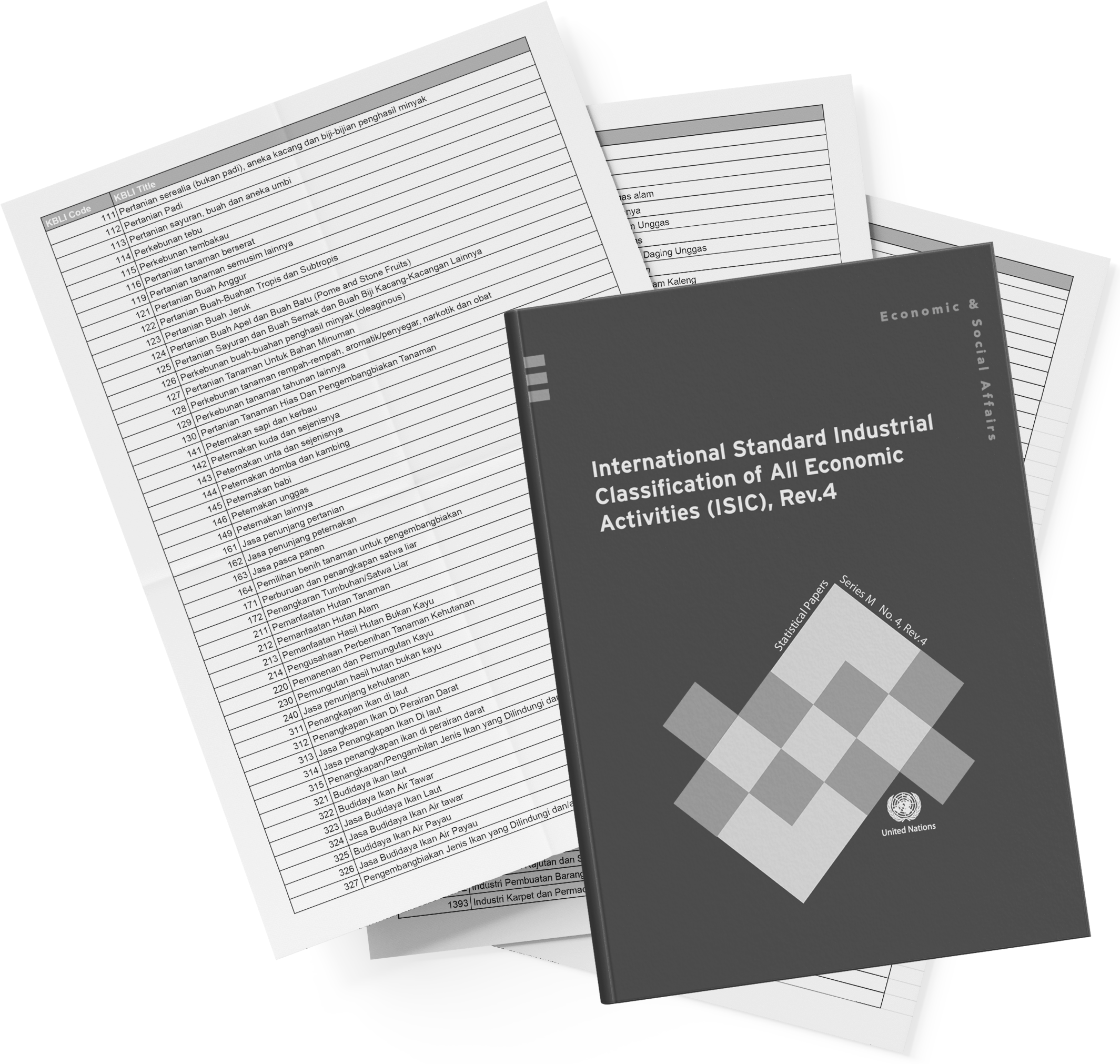
ISIC Rev. 4: 2410 — Manufacture of basic iron and steel.
NAICS comparable: 3311 — Iron and Steel Mills and Ferroalloy Manufacturing.
Industry Terms
Steel vocabulary blends process engineering with Indonesian regulatory anchors and the nickel-stainless cluster terminology.
BF-BOF
Blast furnace + basic oxygen furnace (integrated route).
Krakatau Posco operates this in Indonesia.
EAF
Electric arc furnace (scrap- and DRI/HBI-based).
Most long-products and many flat mini-mills use EAF.
DRI / HBI
Direct reduced iron / hot briquetted iron.
EAF feedstock; Krakatau Steel pellet/DRI Cilegon.
NPI
Nickel pig iron — low-grade ferronickel.
Tsingshan/Delong IMIP and IWIP core output.
RKEF
Rotary kiln electric furnace.
NPI production technology.
HPAL
High-pressure acid leach.
Nickel intermediate for EV-battery precursors.
HRC / CRC
Hot-rolled coil / cold-rolled coil.
Flat-steel products.
Slab / billet / bloom
Cast steel semi-products.
Feedstock to rolling mills.
Long products
Rebar, wire rod, sections, bars, plates.
Construction-anchored demand.
TKDN
Local content level.
Reserves government/BUMN procurement for domestic steel.
SNI Wajib (mandatory)
Mandatory Indonesian National Standard.
Required for rebar, wire rod, sections, etc.
IMIP / IWIP
Indonesia Morowali Industrial Park / Indonesia Weda Bay Industrial Park.
Nickel-stainless clusters.
MIND ID
BUMN mining holding (PT Mining Industry Indonesia).
Increasingly anchors downstream integration.
KRAS / GGRP
Krakatau Steel / Gunung Raja Paksi (IDX tickers).
Flat and long products listed benchmarks.
Business Types & Models — how value is created
Five archetypes share KBLI 2410 — integrated BF-BOF flat, EAF flat/long mini-mills, nickel-stainless RKEF clusters, downstream rolling mills, and emerging HPAL precursor.
Integrated BF-BOF flat steel (PT Krakatau Steel, PT Krakatau Posco JV)
Heritage flat-steel anchor. PT Krakatau Steel (IDX: KRAS) is the state-owned BUMN at Cilegon (founded 1970, BUMN under Kementerian BUMN) with HRC, CRC and coated flat steel via DRI-EAF route historically. Underwent major debt restructuring mid-2020s; operational reset ongoing.
PT Krakatau Posco — joint venture between Krakatau Steel and POSCO (Korea) — operates an integrated blast-furnace/basic-oxygen-furnace and slab/HRC mill at Cilegon (commissioned 2013–2014); modern integrated complex with ~3 mtpa initial slab capacity, with planned phase-2 expansion. Subsidiaries and affiliates: PT Krakatau Wajatama (long products), PT KHI Pipe Industries (pipe), PT Krakatau Bandar Samudera (port), PT Krakatau Daya Listrik (power), PT Krakatau Tirta Industri (water), PT Krakatau Engineering.
Slab and HRC sales (Krakatau Posco)
HRC/CRC/coated sales (Krakatau Steel)
Long products via Krakatau Wajatama
Service-centre and processing revenue
Pipe products via KHI Pipe Industries
Cilegon-integrated complex with port/power/water
BF-BOF route (Krakatau Posco); DRI-EAF historical (Krakatau Steel)
BUMN governance; restructured mid-2020s
EAF long products and merchant steel (Gunung Raja Paksi, Master Steel, Ispat Indo, Hanil Jaya, Krakatau Wajatama, Jakarta Cakratunggal Steel Mills)
PT Gunung Raja Paksi (IDX: GGRP, Sinarindo Gunung Raja Paksi group) at Bekasi/Cikarang is the largest private long-products and merchant-steel producer — structural sections, rebar, wire rod, plates, engineering steel via EAF (scrap + DRI/HBI). Other major EAF mini-mills: PT Master Steel (Master Steel Group, Bekasi/Cikarang), PT The Master Steel Manufactory, PT Ispat Indo (ArcelorMittal affiliated, Sidoarjo), PT Hanil Jaya Steel (Sidoarjo, Korean affiliated), PT Krakatau Wajatama (Krakatau Steel subsidiary), PT Jakarta Cakratunggal Steel Mills, PT Inti General Yaja Steel.
TKDN-protected domestic market for SNI-mandatory rebar, wire rod, sections, light sections.
Rebar and wire rod sales (construction)
Structural section sales (sections H-beam, channel, angle)
Plate and engineering steel
Specialty long products (alloyed grades)
TKDN-protected government/BUMN procurement
EAF + casting + rolling mill
Scrap and DRI/HBI feedstock
Bekasi/Cikarang cluster anchor
Nickel-pig-iron and stainless cluster (Tsingshan, Delong, Eternal Tsingshan at IMIP and IWIP)
World-scale NPI and stainless-steel production at IMIP (Indonesia Morowali Industrial Park, Sulawesi Tengah; operated by PT Indonesia Morowali Industrial Park — Bintang Delapan + Tsingshan) and IWIP (Indonesia Weda Bay Industrial Park, Halmahera Tengah; Tsingshan + Eternal Tsingshan + IMIP). Integrated nickel-ore-to-NPI-to-stainless flow under Tsingshan Holding Group strategy.
Captive coal-fired power plants, dedicated ports, RKEF furnaces, stainless steel meltshop, hot rolling, cold rolling. Stainless export to global markets is meaningful. HPAL (high-pressure acid leach) facilities increasingly produce nickel intermediates for EV-battery precursor.
NPI sales for stainless feedstock (internal + merchant)
Stainless steel slab/coil/sheet/plate sales (export-heavy)
Carbon steel adjacent
Nickel intermediate (MHP/MSP) for EV-battery precursor (HPAL)
Cluster service fees (port, power, logistics)
Integrated nickel-ore-to-stainless flow
Captive coal power and dedicated ports
Tsingshan central group; multiple JVs
Downstream rolling mills and coated steel (NS BlueScope Indonesia, Sunrise Steel, Steel Pipe Industry of Indonesia ISSP)
Rolling and coating-only operations including hot dip galvanised, coated colour (Zincalume, Clean Colorbond — NS BlueScope Indonesia), and pipe/tube/structural processing.
PT NS BlueScope Indonesia (BlueScope Steel Australia + Nippon Steel JV) — Cilegon coated steel. PT Sunrise Steel (Hyundai Steel affiliated). PT Steel Pipe Industry of Indonesia (IDX: ISSP — Spindo group) and pipe/tube specialists.
Coated steel sales (Zincalume, Colorbond) for roofing/walling
Pipe and tube sales
Specialty processed products
Buy HRC/CRC slab and value-add
Premium brand positioning (BlueScope)
Often joint-venture with foreign technology partner
HPAL nickel intermediate for EV-battery precursor (Halmahera Persada Lygend HPL, Huayou-led HPAL, QMB at IMIP, Sumitomo-led)
High-pressure acid leach (HPAL) at IMIP and IWIP and adjacent (Pomalaa, Halmahera) produces nickel intermediate (MHP — mixed hydroxide precipitate or MSP — mixed sulphide precipitate) for EV-battery cathode precursor (NCM, NCA). Halmahera Persada Lygend (HPL — Lygend Resources, Harita Group), Huayou-led HPAL, QMB New Energy Materials (Tsingshan+CATL+CMOC), Sumitomo-led Pomalaa project.
Strategically positions Indonesia in EV-battery upstream value chain.
Nickel intermediate sales to precursor/cathode plants
EV-battery precursor JV revenue
Cobalt by-product
Capital-intensive HPAL plants
Joint ventures with Chinese, Korean, Japanese battery players
Integrated with nickel mining
Performance & Outlook
Capacity boom from nickel-stainless cluster; Krakatau reset; long-products demand from construction
Indonesia's crude-steel capacity has grown into tens of millions of tonnes annually, with rapid expansion at IMIP and IWIP. Carbon steel (HRC, CRC, long products) capacity remains anchored at Cilegon (Krakatau Steel + Krakatau Posco) and Bekasi/Cikarang corridor (Gunung Raja Paksi and EAF mini-mills); stainless and NPI dominate Morowali and Weda Bay.
Forward variables: Krakatau Steel restructuring completion and capacity utilisation; IMIP/IWIP stainless and HPAL build-out; iron ore (Brazil/Australia) and nickel ore prices; coking coal and gas; USD/IDR; downstream construction (IKN, MRT, toll roads, housing) and automotive (Hyundai BEV, Toyota hybrid) demand; anti-dumping and TKDN policy.
Key performance indicators
Crude-steel capacity
Total scale
Tens of millions of tonnes (carbon + stainless)
Krakatau Steel (KRAS) flat capacity
Heritage flat anchor
Multi-million-tonne annually
Krakatau Posco slab/HRC capacity
Integrated BF-BOF
~3 mtpa initial; phase-2 planned
Gunung Raja Paksi (GGRP) capacity
Largest private long products
Multi-million-tonne annually
IMIP + IWIP stainless capacity
Tsingshan-led nickel-stainless
Among largest in world by site
NPI capacity at IMIP + IWIP
Nickel-stainless feedstock
Multi-million-tonne nickel-content
HPAL nickel intermediate capacity
EV precursor
Multiple plants ramping mid-decade
Iron ore imports
Cost base
Multi-million-tonne annually
Stainless steel net exports
Export position
Net exporter to global markets
Outlook: what to watch
Krakatau Steel operational reset and Krakatau Posco utilisation
Tsingshan IMIP/IWIP capacity expansion and HPAL build-out
Construction demand from IKN Nusantara, MRT, toll roads, housing
Automotive HRC demand from Hyundai BEV, Toyota, Daihatsu, Mitsubishi
Anti-dumping enforcement and TKDN policy under Kemenperin
Decarbonisation roadmap (green steel, hydrogen DRI)
Growth Drivers
Six drivers — half demand, half structural — set medium-term direction.
Construction and infrastructure demand
IKN Nusantara, Jakarta MRT extension, LRT, toll roads, ports, housing drive rebar, wire rod, section, plate demand.
IKN construction progress
MRT/LRT extensions
Toll road project pipeline
Housing starts
Automotive HRC demand
Hyundai BEV (Cikarang), Toyota hybrid, Daihatsu, Mitsubishi, Honda drive automotive-grade HRC demand.
Gaikindo car production
Hyundai BEV ramp
Automotive steel imports
Nickel-stainless cluster wave
Tsingshan/Delong/Eternal at IMIP and IWIP expand NPI and stainless capacity; HPAL EV precursor follows.
IMIP/IWIP capacity additions
Stainless export volumes
HPAL commissioning
EV-battery precursor downstream integration
HPAL nickel intermediate plants feed EV-battery cathode precursor; Hyundai-LG, CATL-Brunp-Antam, Foxconn-Vale partnerships.
EV-battery JVs
HPAL milestones
Precursor/cathode plant decisions
Krakatau Steel operational reset
Krakatau Steel restructured mid-2020s; capacity utilisation, modernisation and JV with Posco set growth path.
KRAS results
Cilegon utilisation
Krakatau Posco phase-2
TKDN, anti-dumping, and trade policy
TKDN protection for SNI-mandatory products and anti-dumping on imports protect domestic mills; nickel ore policy continues.
Kemenperin TKDN updates
Anti-dumping cases
Nickel ore policy
Industry Trends & Development
Industry Development
From Krakatau Steel founding to nickel ore ban to Tsingshan-led capacity wave
Indonesia's steel evolved from 1970s state-led Krakatau Steel founding, through 1990s/2000s EAF mini-mill expansion (Gunung Raja Paksi, Master Steel, Ispat Indo), Krakatau Posco JV (2013), nickel ore export ban (2014/2020), and the dramatic Tsingshan-led IMIP/IWIP stainless capacity build-out (2015 onwards).
Next five years pivot on IMIP/IWIP expansion + HPAL, Krakatau Steel reset, automotive HRC demand, and green-steel pathway.
Krakatau Steel founding
Krakatau Steel founded 1970 with Soviet/German support; gradual Cilegon complex build (DRI, EAF, HSM)
EAF mini-mill expansion
Gunung Raja Paksi, Master Steel, Ispat Indo, Hanil Jaya scale EAF long-products; Krakatau Steel IDX listing 2010 (KRAS)
Krakatau Posco JV commissioned
Integrated BF-BOF slab/HRC at Cilegon — Indonesia's first
Nickel ore export ban (first round)
Government bans nickel ore export, partial reversal 2017
IMIP NPI/stainless rampup
Tsingshan/Bintang Delapan IMIP NPI furnaces and stainless meltshop commissioned; Indonesia emerges as top stainless producer
Nickel ore export ban reinstated
Permanent ban; Tsingshan, Delong, Huayou, Lygend accelerate Indonesia investments
IWIP build-out and HPAL wave
IWIP Weda Bay rampup; HPAL plants commissioned at IMIP, Halmahera, Pomalaa; Krakatau Steel debt restructured; Gunung Raja Paksi (GGRP) IDX listing 2021
Key Trends Shaping the Industry (Business Model Canvas view)
Five BMC dimensions are most active: Key Activities, Key Resources, Customer Segments, Cost Structure and Key Partners.
[Key Activities] HPAL nickel intermediate for EV battery extends NPI chain
HPAL plants at IMIP/IWIP/Pomalaa/Halmahera produce nickel intermediates for EV-battery cathode precursor, deepening downstream integration.
Tsingshan, Delong, Huayou, Lygend, Sumitomo
EV-battery cathode players
MIND ID/Antam
[Key Resources] Nickel ore policy is the binding factor for stainless
Nickel ore export ban (2014/2020) drove Chinese investment to onshore stainless smelting; policy continuity is essential.
Tsingshan, Delong
Nickel miners
Government policy
[Customer Segments] Construction (IKN, MRT, housing) drives long-products demand
IKN Nusantara, MRT/LRT, toll roads, ports, housing absorb rebar, wire rod, sections; Gunung Raja Paksi, Master Steel, Ispat Indo benefit.
Long-products mills
Construction firms (Waskita, Wijaya Karya, PP, Adhi Karya, Hutama Karya)
Government
[Cost Structure] Iron ore and coking coal exposure for BF-BOF
Krakatau Posco BF-BOF route is exposed to imported iron ore (Brazil, Australia) and coking coal; USD/IDR amplifies.
Krakatau Steel
Krakatau Posco
Customers
[Key Partners] BUMN, Chinese investors, Korean POSCO partnerships shape strategy
Tsingshan/Delong/Eternal lead nickel-stainless; POSCO partners Krakatau Steel; MIND ID anchors BUMN integration; ArcelorMittal owns parts of Ispat Indo.
Krakatau Steel
POSCO
Tsingshan/Delong
MIND ID
[Channels] Decarbonisation reshapes flat-steel pathways
Green-steel pathways (hydrogen DRI, scrap-based EAF, CCS) emerge as automotive buyers (European in particular) demand low-carbon.
Steelmakers
Auto buyers
Policy
Impact and Sustainability
Impact runs through trade balance, employment in cluster towns, emissions and tailings/effluent management.
Trade balance and downstream value capture
Nickel ore ban moved value capture downstream — stainless and EV-precursor exports replace ore exports.
Export revenue vs upstream miner livelihoods
Downstream value vs Chinese-dominant ownership
Employment in cluster towns (Morowali, Weda Bay)
IMIP and IWIP employ tens of thousands; major economic transformation but social tension over Chinese worker share, safety incidents.
Job creation vs labour relations
Local development vs migrant influx
Emissions and decarbonisation
Captive coal-fired power at IMIP/IWIP and BF-BOF at Krakatau Posco are high-emission; CBAM (EU Carbon Border Adjustment) and global decarbonisation pressure mount.
Cost competitiveness vs decarbonisation
Coal-fired captive vs renewables/hydrogen
Tailings, effluent and environmental risk
HPAL produces tailings; deep-sea tailings disposal (DSTD) considered; KLHK environmental scrutiny increasing.
Capex of dry stack vs DSTD
Project viability vs environmental risk
Industry Segmentation
Product Segmentation
Products differ in process route, alloy content and downstream use.
Segmentation by product
Slab (carbon steel)
Cast semi-product feed to HSM
Krakatau Posco, Krakatau Steel
HRC mill input
Hot-rolled coil (HRC)
Flat-steel coil from hot strip mill
Krakatau Steel, Krakatau Posco
Automotive, pipe, structural
Cold-rolled coil (CRC)
Cold-rolled flat
Krakatau Steel, Sunrise Steel
Automotive, appliance
Coated steel (Zincalume, Colorbond, GI/GL)
Galvanised and coated
NS BlueScope Indonesia, Sunrise Steel, Krakatau Steel
Roofing, walling, appliance
Rebar (BJTP, BJTS)
Reinforcing bar (SNI-mandatory)
Gunung Raja Paksi, Master Steel, Ispat Indo, Hanil Jaya, Krakatau Wajatama
Construction
Wire rod
Wire-feedstock long product
Krakatau Wajatama, Gunung Raja Paksi, Master Steel, Hanil Jaya
Wire drawing, fasteners
Structural sections (H-beam, I-beam, channel, angle)
Hot-rolled structural
Gunung Raja Paksi, Master Steel, Jakarta Cakratunggal Steel Mills, Inti General Yaja Steel
Construction, fabrication
Plate
Heavy plate
Krakatau Steel, Gunung Raja Paksi
Shipbuilding, energy infrastructure
NPI (nickel pig iron)
Low-grade ferronickel
Tsingshan/Delong/Eternal at IMIP and IWIP
Stainless-steel feedstock
Stainless steel slab/coil/sheet
300-series predominantly
Tsingshan IMIP/IWIP and JVs
Stainless products, kitchen, industrial
Nickel intermediate (MHP/MSP)
HPAL output
Halmahera Persada Lygend, Huayou, QMB, Sumitomo Pomalaa
EV-battery cathode precursor
Pipe and tube
Welded and seamless pipe
PT KHI Pipe Industries (Krakatau group), PT Steel Pipe Industry of Indonesia ISSP (IDX: ISSP — Spindo)
Oil and gas, structural, water
Krakatau Steel + Posco anchor flat (HRC, CRC, coated, slab, plate).
Gunung Raja Paksi + EAF mini-mills anchor long products.
Tsingshan + Delong anchor NPI and stainless at IMIP/IWIP.
HPAL nickel intermediate is emerging EV-battery precursor segment.
Process/Format Segmentation
Process routes shape cost base, capex and emissions intensity.
Segmentation by process route
BF-BOF (integrated)
Blast furnace + basic oxygen furnace
Krakatau Posco (Cilegon)
Single complex; phase-2 planned
DRI / HBI + EAF (gas-based)
Direct reduction plus electric arc furnace
Krakatau Steel historical
Operational
Scrap-based EAF
Scrap melted in electric arc furnace
Gunung Raja Paksi, Master Steel, Ispat Indo, Hanil Jaya, etc.
Multiple
RKEF (NPI)
Rotary kiln electric furnace for nickel-pig-iron
Tsingshan, Delong, Eternal at IMIP and IWIP
World-scale
Stainless meltshop and cold rolling
Stainless slab to coil/sheet
Tsingshan at IMIP
World-scale
HPAL
High-pressure acid leach for nickel intermediate
Halmahera Persada Lygend, Huayou, QMB, Sumitomo Pomalaa
Multiple under build/ramp
Continuous casting (slab, billet, bloom)
Strand cast from liquid steel
All steelmakers
Standard equipment
Hot strip mill (HSM)
Slab to HRC
Krakatau Steel, Krakatau Posco
Operational
Cold rolling and coating
CRC, Zincalume, Colorbond, GI/GL
Krakatau Steel, NS BlueScope, Sunrise Steel
Operational
Customer Profiles
Customers vary by downstream industry and product.
Customer profiles and what they value
Construction contractor (BUMN Karya + private)
Waskita, Wijaya Karya, PP, Adhi Karya, Hutama Karya, Wika Beton, private contractors
Rebar, sections, plate, wire
SNI compliance, on-time delivery, TKDN credit
Direct from mill + distributor
Property developer
Sinar Mas Land, Lippo, Ciputra, Agung Sedayu, Pakuwon
Long products for high-rise/township
Volume contracts, quality, SNI
Distributor + mill direct
Automotive OEM
Astra, Toyota Indonesia, Hyundai Motor Manufacturing, Daihatsu, Mitsubishi, Honda Prospect
Automotive-grade HRC, CRC, coated
Quality, surface, gauge tolerance
Direct from Krakatau Posco/Krakatau Steel + imports
Appliance / consumer goods
Polytron, Modena, Sharp Indonesia, Panasonic
CRC, coated steel for appliance casing
Surface, formability, coating
Direct + distributor
Shipyard / shipbuilder
PAL Indonesia, Daya Radar Utama, BBI
Heavy plate, structural sections
Plate grade, certification, volume
Direct from mill
Energy / pipeline (Pertamina, PGN, PLN, oil & gas)
Pertamina pipelines, PGN gas, PLN towers
Heavy plate, line pipe, structural
API specs, ISO standards
Direct + EPC contractors
Stainless processor / fabricator
Kitchen equipment, appliance, industrial
Stainless slab/coil/sheet
Grade specification, surface finish
Direct from Tsingshan/IMIP, imports
EV-battery cathode precursor maker
LG Energy Solution, CATL, Foxconn-Vale, Samsung SDI, Hyundai-LG
Nickel intermediate (MHP/MSP)
Purity, sulphur/cobalt levels
Direct from HPAL plants
Fabricator / steel service centre
PT Krakatau Steel Service Center, distributors
Cut/processed steel
Service, finance, delivery
Service centre intermediation
Ecosystem & Key Players
Ecosystem Mapping
Ecosystem layers from upstream ore through steel producers to downstream fabricators and regulators.
Core (steel producers)
Entities providing KBLI 2410 services.
Flat: PT Krakatau Steel (IDX: KRAS, BUMN), PT Krakatau Posco JV (with POSCO Korea), PT Krakatau Wajatama (long), PT KHI Pipe Industries
Long-products EAF: PT Gunung Raja Paksi (IDX: GGRP, Sinarindo group), PT Master Steel (Master Steel Group), PT The Master Steel Manufactory, PT Ispat Indo (ArcelorMittal affiliated), PT Hanil Jaya Steel, PT Jakarta Cakratunggal Steel Mills, PT Inti General Yaja Steel, PT Bhirawa Steel
Stainless / NPI: Tsingshan Holding Group, Delong, Eternal Tsingshan at IMIP (Morowali) and IWIP (Weda Bay)
HPAL nickel intermediate: Halmahera Persada Lygend (HPL — Lygend/Harita), QMB New Energy Materials (Tsingshan-CATL-CMOC), Huayou-led HPAL, Sumitomo-led Pomalaa
Coated/processed: PT NS BlueScope Indonesia (BlueScope + Nippon Steel JV), PT Sunrise Steel (Hyundai Steel affiliated)
Pipe and tube: PT Steel Pipe Industry of Indonesia (IDX: ISSP — Spindo), PT KHI Pipe Industries
Extension (ore, scrap, downstream fabrication, logistics)
Upstream and downstream partners.
Iron ore: imports from Brazil (Vale), Australia (BHP, Rio Tinto, FMG); limited domestic
Nickel ore: domestic miners (Antam — MIND ID, Vale Indonesia INCO, Bintang Delapan, Harita, Trimegah Bangun Persada, Aneka Tambang)
Coking coal: imports (Australia, US) + domestic (Bukit Asam, Adaro coking blends)
Scrap: domestic + imports
Downstream fabrication: PT Cakratunggal Steel, PT Krakatau Industrial Estate Cilegon, ATM Steel, structural fabricators
Construction (Karya BUMN): Waskita, Wijaya Karya, PP, Adhi Karya, Hutama Karya, Wika Beton
Logistics: Krakatau Bandar Samudera (port), IMIP port, IWIP port, Pelindo
Enabling (regulators, finance, standards)
Regulators and infrastructure.
Regulators: Kementerian Perindustrian (Kemenperin — TKDN, SNI), Kementerian ESDM (nickel ore policy, gas), KLHK (environmental), Kementerian BUMN (Krakatau Steel, MIND ID oversight), BKPM
Standards: SNI (mandatory for rebar, wire rod, sections, structural), API/ASTM for export, ISO 9001/14001, IATF 16949 for automotive
Trade: KADI (anti-dumping committee), Kementerian Perdagangan, BSKLN
Finance: BNI, Mandiri, BCA, syndication; KRAS bonds; GGRP IDX; Chinese policy-bank financing for IMIP/IWIP
Industry: Indonesian Iron and Steel Industry Association (IISIA)
How value flows across the ecosystem
Iron ore (mostly imported) and coking coal → Krakatau Posco BF-BOF; scrap and DRI/HBI → EAF mini-mills (Gunung Raja Paksi etc.); nickel ore (domestic) → RKEF NPI → stainless meltshop (Tsingshan); HPAL nickel intermediate → EV-battery precursor. Steel products → service centres → fabricators → construction/automotive/shipbuilding/energy customers.
Strategic chokepoints sit at iron-ore import logistics, nickel ore allocation, Krakatau Steel/Posco BF-BOF utilisation, TKDN/SNI gating, and HPAL technology/tailings.
Leading Players
Named players below illustrate structural positions; figures are directional industry estimates.
Leading firms by position
PT Krakatau Steel (IDX: KRAS)
BUMN heritage flat anchor
Cilegon complex; port/power/water integration; TKDN access
Restructuring legacy; capacity utilisation; iron-ore import cost
PT Krakatau Posco (KS-POSCO JV)
Integrated BF-BOF flat
POSCO Korea technology; slab/HRC at Cilegon; phase-2 planned
Iron ore + coking coal import exposure
PT Krakatau Wajatama
Long products subsidiary of KRAS
Cilegon; group integration
Smaller scale vs GGRP
PT KHI Pipe Industries
Pipe producer (Krakatau group)
Cilegon; line pipe
Pipe-cycle exposure
PT Gunung Raja Paksi (IDX: GGRP)
Largest private long-products
Bekasi/Cikarang EAF; structural sections, rebar, wire rod, plate; IDX listed
Scrap supply; construction-cycle
PT Master Steel (Master Steel Group)
Long-products EAF
Bekasi/Cikarang; established
Scale below GGRP
PT The Master Steel Manufactory
Long-products EAF
Established Bekasi
Scale
PT Ispat Indo (ArcelorMittal affiliated)
Long-products EAF
Sidoarjo; ArcelorMittal heritage
Foreign-owned EAF
PT Hanil Jaya Steel (Korean affiliated)
Long-products EAF
Sidoarjo; established
Smaller scale
PT Jakarta Cakratunggal Steel Mills
Structural sections
Jakarta corridor
Cluster competition
PT Inti General Yaja Steel, PT Bhirawa Steel
Long-products
Established
Smaller scale
Tsingshan Holding Group (China)
Nickel-stainless leader
World-scale at IMIP and IWIP; integrated nickel-to-stainless-to-EV-battery
Chinese ownership scrutiny; ESG/labour concerns
Delong (China)
NPI + stainless co-investor
IMIP and IWIP partnerships
Same as Tsingshan profile
Eternal Tsingshan
IWIP partner
Halmahera Tengah
Cluster development
Halmahera Persada Lygend (Lygend/Harita)
HPAL nickel intermediate
Halmahera; integrated with Harita mining
HPAL technology execution
QMB New Energy Materials (Tsingshan-CATL-CMOC)
HPAL nickel-cobalt for EV battery
EV-battery anchor partnership
Capex execution
Huayou-led HPAL, Sumitomo-led Pomalaa
HPAL plants
Battery-chemistry expertise
Capex execution
PT NS BlueScope Indonesia (BlueScope + Nippon Steel JV)
Coated steel leader
Cilegon; premium Zincalume/Colorbond brand
Premium-tier scale
PT Sunrise Steel (Hyundai Steel affiliated)
Coated/CRC
Mojokerto; Korean technology
Smaller scale
PT Steel Pipe Industry of Indonesia (IDX: ISSP — Spindo)
Pipe-tube leader
Multi-plant; IDX listed
Pipe cycle
PT MIND ID (BUMN mining holding)
BUMN integration anchor
Antam + Vale Indonesia + Bukit Asam + Timah + Inalum
Strategic alignment with BUMN policy
Competitive dynamics
Flat carbon: Krakatau Steel + Posco vs imports (Vietnam Formosa, Korea POSCO, Japan Nippon Steel/JFE, China). TKDN protection helps domestic in BUMN/government procurement.
Long-products: Gunung Raja Paksi leads private; Master Steel, Ispat Indo, Hanil Jaya compete; Krakatau Wajatama integrated. SNI mandatory protects domestic.
Stainless and NPI: Tsingshan/Delong/Eternal dominate at IMIP and IWIP; export-oriented.
EV-battery precursor: HPAL plants under Lygend/Huayou/QMB/Sumitomo emerging at multiple Indonesia sites.
Operating Conditions
Concentration, Competition, Cost Structure & Economics
Market is moderately to highly concentrated by segment. Flat-steel: duopoly Krakatau Steel + Posco; long-products: Gunung Raja Paksi leads with several EAF mini-mills; stainless: Tsingshan/Delong dominate; HPAL: emerging multi-player oligopoly.
Raw materials (50–70%)
Iron ore (imported for BF-BOF), scrap (EAF), coking coal, nickel ore (NPI), HBI/DRI, alloys (FeCr, FeMn, Mo, Ni)
Global iron-ore prices
Scrap availability
Nickel ore price
USD/IDR
Largest cost; commodity-cycle-driven
Energy (15–25%)
Electricity (EAF, RKEF, rolling), coal (BF), natural gas (DRI)
PLN industrial tariff
Captive coal power (IMIP/IWIP)
Gas pricing
RKEF and EAF power-intensive; captive coal at clusters
Capex amortisation (5–15%)
BF-BOF/EAF/RKEF/HPAL plant; rolling mills; ports
Asset life
Modernisation cycle
Multi-billion-USD at integrated complex; HPAL multi-billion
Labour (4–8%)
Mill operators, engineers, maintenance, sales, mining/cluster labour
Provincial UMR
Engineering skills
IMIP/IWIP face labour scrutiny
Maintenance and refractory (3–5%)
Refractory bricks, furnace maintenance, mill rolls
Refractory supplier
Mill load
Operational discipline
Logistics and distribution (3–6%)
Inbound ore/coal/scrap; outbound steel; intra-Indonesia and export
Port costs
Bulk freight rates
Dedicated ports (KBS, IMIP, IWIP) lower cost
Porter's Five Forces — KBLI 2410
Threat of new entrants
Very Low (BF-BOF, RKEF, HPAL); Medium for EAF mini-mill
Capex, technology, AMDAL, infrastructure barriers; EAF mini-mill more accessible
Bargaining power of customers
Medium
Large auto/construction buyers leverage; smaller fabricators price-takers
Bargaining power of suppliers
Medium-High
Iron ore (Vale, BHP, Rio Tinto, FMG) oligopoly; coking coal global; scrap regional; nickel ore (Antam, Vale Indo, private miners) policy-driven
Threat of substitutes
Low-Medium
Aluminium, composites, concrete substitute marginally
Rivalry among existing competitors
Medium-High
Krakatau Steel + Posco vs imports; long-products competition intense; stainless export-oriented competing globally
Krakatau Steel margin sensitive to HRC-iron ore spread and utilisation
Krakatau Posco BF-BOF benefits from scale but exposed to iron-ore + coking-coal cycle
Gunung Raja Paksi (GGRP) EAF margins depend on scrap-rebar spread
Tsingshan stainless margins reflect nickel-stainless spread and captive coal power cost
HPAL margins reflect nickel intermediate price and acid + autoclave costs
Regulation & Compliance Considerations
Regulation runs through Kemenperin (SNI, TKDN), Kementerian ESDM (nickel ore), KLHK (environmental), KADI (anti-dumping), and BUMN oversight.
Regulatory anchors and operational impact
SNI Wajib (mandatory)
Mandatory SNI for rebar, wire rod, sections, structural
Required for sale
SNI certification and surveillance
TKDN (Tingkat Komponen Dalam Negeri)
Local content level for government/BUMN procurement
Reserves market for domestic
Maintain TKDN scoring
KADI anti-dumping
Anti-dumping duties on imports
Protects domestic mills
Coordinate with Kemenperin and industry
Kementerian ESDM nickel ore policy
Export ban on nickel ore
Anchors downstream investment
Nickel mining IUP and supply contracts
KLHK / AMDAL and B3
Environmental impact and hazardous waste
Required for plants and expansions
AMDAL submission; B3 management
KLHK PROPER
Environmental performance rating
Reputation; investor scrutiny
PROPER target
BPJS, Tax, Customs
Standard tax and labour
Cost base
Standard processes
BKPM investment incentives
Tax holiday for downstream investment
Capex economics
BKPM submissions
Kemenperin Industrial Estate
IMIP/IWIP cluster regulation
Cluster operations
Cluster-level compliance
Nickel ore policy continuity is essential for stainless/HPAL investment
TKDN strengthening (e.g. Permenperin 16/2011 and updates) supports domestic mills
CBAM (EU Carbon Border Adjustment) emerges as decarbonisation pressure
Anti-dumping cases on flat steel imports
Tailings/effluent management for HPAL under scrutiny
FAQs & Sources
FAQs
Who leads Indonesia's iron and steel industry?
Flat: PT Krakatau Steel (IDX: KRAS, BUMN) + PT Krakatau Posco joint venture (with POSCO Korea) at Cilegon. Long-products: PT Gunung Raja Paksi (IDX: GGRP, Sinarindo group) plus PT Master Steel, PT Ispat Indo (ArcelorMittal), PT Hanil Jaya, PT Krakatau Wajatama, PT Jakarta Cakratunggal Steel Mills. Stainless/NPI: Tsingshan Holding Group + Delong + Eternal Tsingshan at IMIP (Morowali) and IWIP (Weda Bay).
What drove the nickel-stainless cluster wave?
Indonesia's nickel ore export ban (first imposed 2014, partially relaxed 2017, fully reinstated 2020) forced downstream onshore investment. Tsingshan led with IMIP from 2015; Delong/Eternal followed; IWIP scaled in 2020s. HPAL nickel-intermediate plants follow for EV-battery precursor.
Who leads HPAL for EV-battery precursor?
Halmahera Persada Lygend (HPL — Lygend/Harita Group at Obi Island), QMB New Energy Materials (Tsingshan-CATL-CMOC at IMIP), Huayou-led HPAL, Sumitomo-led Pomalaa (Pomalaa nickel project).
How concentrated is the industry?
Moderately to highly concentrated by segment. Flat-steel: Krakatau Steel + Posco duopoly. Long-products: Gunung Raja Paksi leads with 5–7 EAF mini-mills. Stainless/NPI: Tsingshan and Delong dominate. HPAL: emerging multi-player oligopoly.
Is Indonesia a net steel exporter?
Net exporter of stainless steel and nickel intermediates. Net importer of automotive-grade HRC, electrical steel, tinplate, specialty grades — sourced from Vietnam (Formosa), Korea (POSCO), Japan (Nippon Steel, JFE), China.
What about decarbonisation?
Steel is energy- and emissions-intensive. Krakatau Posco BF-BOF and IMIP/IWIP captive coal face decarbonisation pressure including EU CBAM (Carbon Border Adjustment Mechanism). Green-steel pathways (hydrogen DRI, scrap-based EAF, CCS) emerging but capital-intensive.
Sources & Notes
This report synthesises publicly available regulatory and industry information, listed-company disclosures (Krakatau Steel KRAS, Gunung Raja Paksi GGRP, Steel Pipe Industry ISSP) and Ravenry analyst commentary. Where exact figures are unavailable, directional and approximate ranges are used.
Kementerian Perindustrian (Kemenperin)
SNI, TKDN, industrial policy
Kementerian ESDM
Nickel ore policy
Kementerian Lingkungan Hidup dan Kehutanan (KLHK)
Environmental, B3, PROPER, AMDAL
Kementerian BUMN
Krakatau Steel and MIND ID oversight
KADI (Komite Anti Dumping Indonesia)
Anti-dumping investigations
PT Krakatau Steel (IDX: KRAS)
Flat-steel benchmark
PT Gunung Raja Paksi (IDX: GGRP)
Long-products benchmark
PT Steel Pipe Industry of Indonesia (IDX: ISSP)
Pipe-tube benchmark
Indonesian Iron and Steel Industry Association (IISIA)
Industry voice
Badan Pusat Statistik (BPS) and Kementerian Perdagangan
Trade and production statistics
This report is for informational purposes and does not constitute legal, regulatory or investment advice. Figures are directional unless otherwise indicated.