Aircraft and Spacecraft Manufacturing Industry in Indonesia
KBLI 3030 — Single-OEM economics, Airbus tier-1 aerostructures, BRIN satellite programmes and defence-anchored demand
Indonesia's aircraft and spacecraft manufacturing industry is structurally compact and strategically charged. PT Dirgantara Indonesia (PTDI, the former IPTN founded in 1976 and Indonesia's sole airframe OEM, headquartered in Bandung with ~5,000–6,000 employees) is the anchor: producing the N219 Nurtanio commuter, CN-235 and NC-212i medium transport, helicopter CKD assemblies under Airbus Helicopters licence (NAS332 Super Puma, EC725 Caracal, AS565 Panther), aerostructures for Airbus A320/A330/A380 (vertical fin, outer wing, leading edges), and selected Boeing sub-assemblies. Spacecraft and satellite work concentrate in BRIN (the National Research and Innovation Agency that absorbed LAPAN in 2021), via the LAPAN-A series and follow-on remote-sensing missions. Outside PTDI and BRIN, the ecosystem comprises tier-2/3 aerostructure suppliers, propulsion partners (Garrett, Honeywell, Pratt & Whitney Canada through licence) and a small UAS cluster.
PTDI is Indonesia's only certified airframe OEM; ~5,000–6,000 employees; Bandung Husein Sastranegara complex
Anchor products: N219 Nurtanio (twin-turboprop commuter), CN-235, NC-212i medium transport; helicopter CKD under Airbus Helicopters licence
Tier-1 aerostructure supplier to Airbus (A320 outer wing, A330/A380 components) and Boeing (sub-assemblies)
Spacecraft: BRIN's LAPAN-A series (LAPAN-A2, A3, A4) for remote sensing; design and integration done in Bogor and Bandung
Defence anchor: Kemhan and TNI procurement of NC-212i, CN-235, helicopters and UAS
Regulation through DGCA (CASR Part 21/25/27/29) for civil; Kemhan for defence; ITAR-equivalent export rules on dual-use; offset/TKDN-driven content rules
Executive Summary
Indonesia's aircraft and spacecraft manufacturing industry (KBLI 3030) is one of the country's most strategically charged but structurally smallest manufacturing sectors. The industry is built around a single airframe OEM — PT Dirgantara Indonesia (PTDI), the BUMN successor to IPTN founded in 1976 by B.J. Habibie's industrialisation vision — with a multi-decade history of producing twin-turboprop commuters (N250, N219 Nurtanio) and medium transports (CN-235, NC-212i, the latter built under licence from EADS/Airbus then taken over locally). PTDI also runs helicopter CKD assembly under Airbus Helicopters (NAS332 Super Puma, EC725 Caracal, AS565 Panther), Bell CKD and is a tier-1 aerostructure supplier to Airbus (A320 outer wing, A330 inboard outer flap, A380 leading edge) and Boeing.
Spacecraft and satellite manufacturing is concentrated in BRIN — the National Research and Innovation Agency that absorbed LAPAN, BPPT, LIPI and BATAN in 2021 — and has produced the LAPAN-A2, A3 and A4 remote-sensing satellites with growing local content. Outside PTDI and BRIN, the ecosystem is a handful of tier-2/3 aerostructure suppliers (PT Industri Kereta Api — INKA — has some aero work; PT Pindad has aerospace-adjacent metallurgy), propulsion suppliers operating under licence, and a nascent UAS (unmanned aerial system) cluster including PT Bhinneka Dirgantara Indonesia and university spin-offs.
Single-OEM structure: PTDI is the only certified airframe OEM in Indonesia
Tier-1 aerostructure exports anchor commercial demand — A320 outer wing programme is the largest single recurring contract
Defence procurement (Kemhan, TNI AU, TNI AL, TNI AD) is the dominant domestic demand pipe
N219 Nurtanio is the flagship indigenous platform — type certificated and entering commercial service via maritime patrol and remote-area operators
BRIN has heritage in LAPAN-A series satellites; future spacecraft work hinges on national space policy and budget
TKDN, offset (Imbal Dagang) and counter-trade rules drive partnerships with Airbus, Boeing, Sikorsky, Embraer
Why this industry matters in Indonesia
Defence sovereignty: indigenous airframe and helicopter capability reduces dependence on foreign suppliers for military transport and SAR.
Remote-area connectivity: N219 and CN-235 platforms enable Perintis routes to short runways in Papua, Maluku, NTT and inland Kalimantan.
High-value manufacturing: aerospace is a knowledge-intensive industry with spillovers into materials, precision machining and avionics.
Export earnings: Airbus and Boeing tier-1 aerostructure contracts generate USD revenue and engineering know-how.
So what: Practical implications
Operators (PTDI): Diversify beyond defence with tier-1 Airbus and Boeing programmes; certify N219 in additional markets
Buyers (Kemhan, airlines): Order-pipeline stability is critical to PTDI capacity utilisation
Investors: Aerostructure tier-2/3 component manufacturing and MRO-adjacent precision machining are the realistic entry points
Policymakers: Predictable Kemhan procurement, offset programmes and SDM (talent) pipeline funding (ITB, Polman Bandung, ITS) are the binding policy levers
Indonesia at a Glance
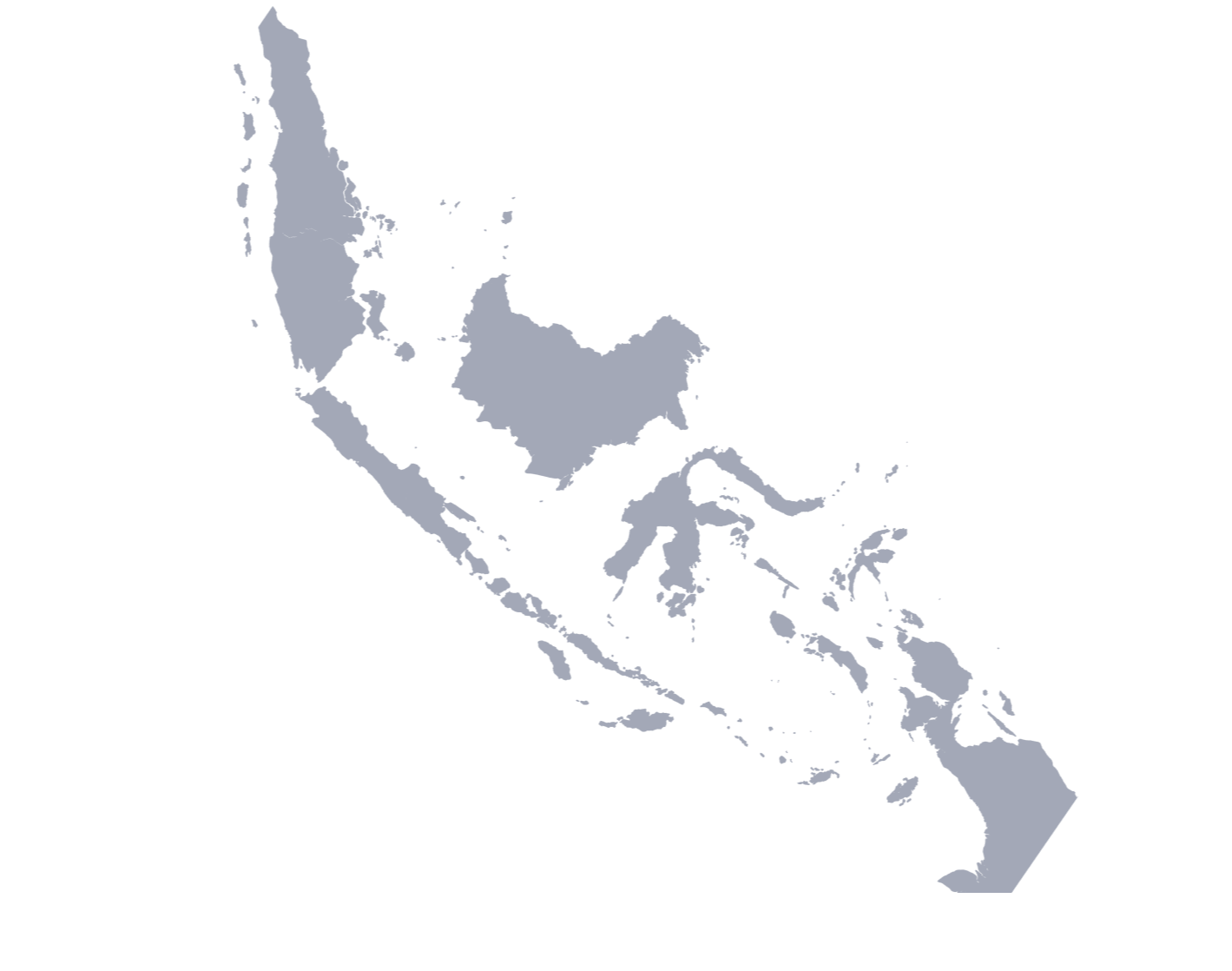
Republic of Indonesia: niche but strategic aerospace cluster
Indonesia's aerospace cluster is geographically and institutionally compact. Bandung (West Java) is the manufacturing heart — PTDI's Husein Sastranegara complex (Bandung) houses fixed-wing and helicopter assembly, machining, composites and design; ITB (Institut Teknologi Bandung) is the engineering talent pipeline; Polman Bandung provides skilled vocational labour. BRIN aerospace operations cluster in Bogor (Rumpin), Subang, Pasuruan and Bandung.
Scale is small relative to Indonesia's overall manufacturing base — PTDI revenue runs in the low-trillions of rupiah annually with workforce ~5,000–6,000; the wider aerospace tier-2/3 ecosystem adds at most another few thousand workers. Yet defence sovereignty and remote connectivity make the industry strategic out of proportion to its size.
Defence-spend context: Indonesia's defence budget is ~IDR 130–160 trillion annually (~0.8–1.0% of GDP), with aviation a meaningful share. Indonesia operates a mixed fleet — F-16, Su-27/30, Hawk, Su-35 pursuit (cancelled), Rafale (on order), KF-21/IF-X joint development with South Korea — alongside transport (C-130, CN-235, NC-212i) and helicopters.
BRIN's space ambition is real but resource-constrained; LAPAN-A series satellites and IoT/comms experiments mark the current state, with Pasir Putih and other ground stations supporting operations.
Hyperlocalisation is key to navigate Indonesia's market
The single-OEM structure makes every PTDI programme a national policy item — order books, financing, certification timelines and offset participation are all set in coordination with Kemenhan, Kemenperin and the BUMN ministry. This shapes how foreign primes (Airbus, Boeing, Embraer, Sikorsky/Lockheed Martin, Korea Aerospace Industries) approach Indonesia: through joint manufacturing, technology transfer, and offset commitments rather than purely arm's-length sales.
BRIN's space programme similarly operates through international partnerships (JAXA on LAPAN-A2 launch via PSLV; Berlin Space Technologies on satellite buses) rather than fully indigenous integration.
Opportunities extend beyond cities
Indonesia's remote-area aviation needs — Papua, Maluku, NTT, inland Kalimantan — sustain demand for short-takeoff-and-landing (STOL) twin-turboprops like the N219 and existing CN-235 variants. Susi Air, Smart Aviation, Demonim Air, Trigana Air and government Perintis operators are the natural domestic customer base.
International niche export markets — Pacific Islands, sub-Saharan Africa, Southeast Asian neighbours — are realistic targets for N219 if certification and product support are sustained. Aerostructure tier-1 supply to Airbus is the existing export anchor.
N219 maritime patrol variant for KKP/Bakamla and remote-area Perintis fleet renewal
CN-235 maritime patrol and tanker conversions for TNI AL/AU and export
Airbus A320neo and A220 family ramp-up potentially expanding tier-1 work for PTDI
BRIN follow-on remote-sensing satellite programmes
Helicopter CKD demand for TNI, Polri and SAR (Basarnas) replacement cycle
UAS demand from TNI, KKP and commercial mapping/agri operators
Distribution realities: certification, offset, supply chain
Sales channel for aircraft is government-anchored: PTDI sells primarily to Kemenhan (defence) and through Perintis Kemenhub channels to government-subsidised remote operators. Commercial sales are case-by-case, often supported by offset participation with foreign primes.
Supply chain runs through Airbus, Boeing, Pratt & Whitney Canada, Honeywell, Garrett, Liebherr, Safran for major components, with local content focused on aerostructures, secondary structures and selected systems.
Build EASA/FAA mutual-recognition pathways for N219 to unlock export markets
Maintain Airbus tier-1 quality system (AS9100, NADCAP) to retain contract base
Invest in composites and additive manufacturing for next-gen aerostructure work
Deepen Kemenhan multi-year contracting for capacity utilisation
Industry Overview
What is the aircraft and spacecraft manufacturing industry?
Definition & Boundaries
KBLI 3030 covers Industri Pesawat Terbang dan Perlengkapannya — manufacture of aircraft (fixed-wing and rotary), spacecraft and launch vehicles, and the manufacture of major parts and accessories: fuselages, wings, empennages, doors, control surfaces, engines (assembly under licence), undercarriage assemblies, propellers, rotors, and aerospace electronics where integrated.
Included: airframe OEM (PTDI), CKD helicopter assembly, tier-1/tier-2 aerostructure suppliers, satellite and spacecraft integration, UAS manufacturing, propulsion assembly under licence, and aerospace component machining.
Excluded: airline operations (KBLI 5110/5120), airport operations and ground handling (KBLI 5223), MRO (often classified separately, KBLI 3315 in some interpretations), aerospace defence weapons (KBLI 2540), and general electronics manufacturing (KBLI 2610).
Indonesia in Focus
PTDI is the focal point. Founded 1976 as IPTN under Habibie, restructured during the 1998 crisis, recapitalised by the state several times, it currently runs roughly 5,000–6,000 employees and operates a substantial complex at Husein Sastranegara (Bandung).
BRIN absorbed LAPAN (Lembaga Penerbangan dan Antariksa Nasional) in 2021 as part of a wider research-agency consolidation; LAPAN's heritage in satellite design (LAPAN-A series), rocket research and ground stations now sits under BRIN's space-related deputyships.
Classification
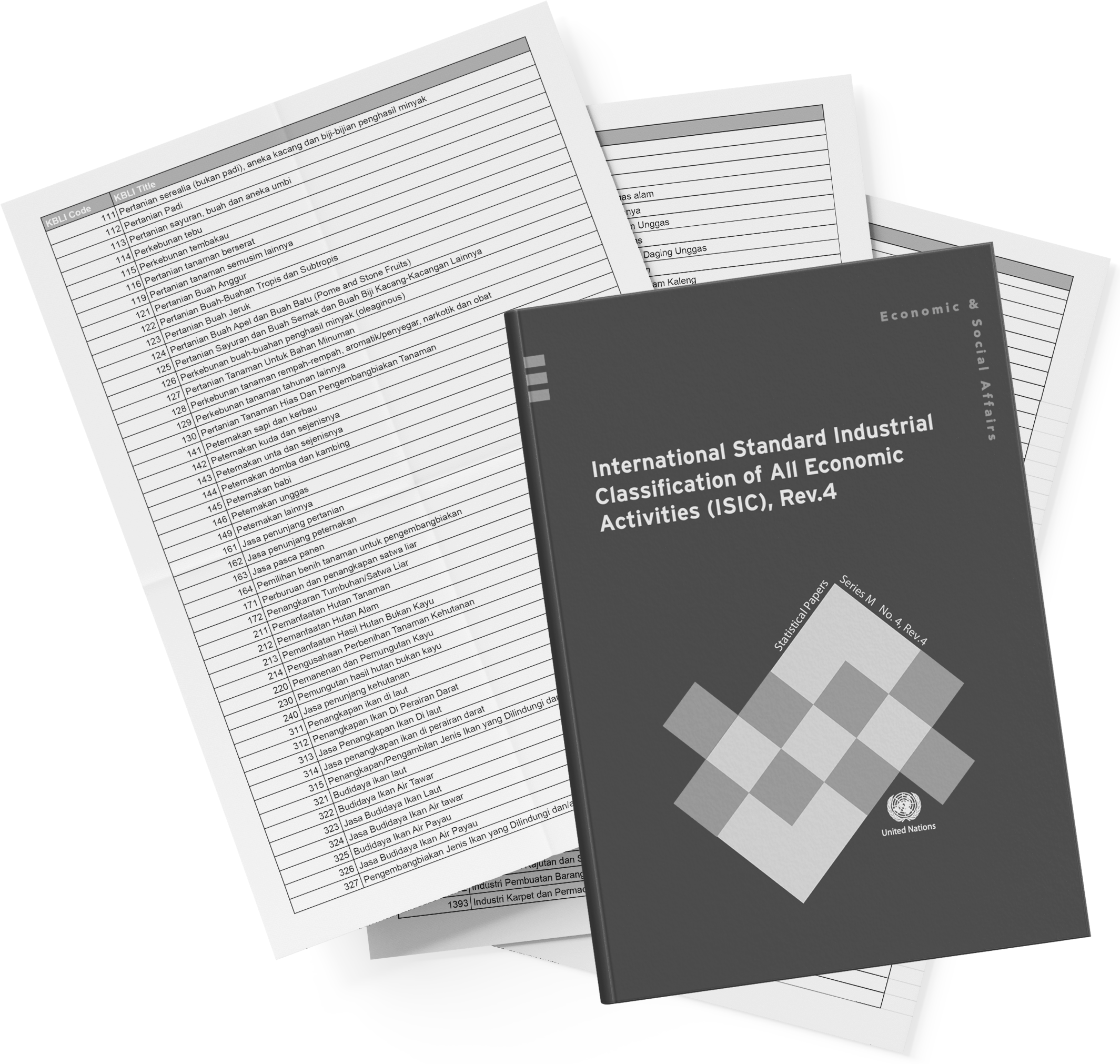
KBLI: 3030 — Industri Pesawat Terbang dan Perlengkapannya.
ISIC Rev. 4: 3030 — Manufacture of air and spacecraft and related machinery.
NAICS comparable: 3364 — Aerospace Product and Parts Manufacturing (33641 aircraft, 33642 engines, 33645 aerospace parts).
Industry Terms
Aerospace vocabulary combines global certification terms with Indonesian institutional acronyms.
PTDI
PT Dirgantara Indonesia, BUMN airframe OEM, formerly IPTN.
Sole certified airframe OEM in Indonesia.
IPTN
Industri Pesawat Terbang Nusantara — predecessor to PTDI, founded 1976.
Historical name still used colloquially; carries Habibie-era legacy.
BRIN
Badan Riset dan Inovasi Nasional — research agency consolidating LAPAN, LIPI, BPPT, BATAN (2021).
Houses national space programme and aeronautics research.
LAPAN-A series
BRIN/LAPAN-developed remote-sensing micro-satellites (LAPAN-A2, A3, A4).
Indonesia's indigenous satellite heritage.
N219 Nurtanio
PTDI twin-turboprop 19-seat commuter; type certificated by DGCA in 2020.
Flagship indigenous platform; named after Indonesia's aviation pioneer.
CN-235 / NC-212i
Medium transport platforms built by PTDI under licence and indigenous development.
Anchor defence platforms; export to several countries.
AS9100
Aerospace quality management system standard (analogous to ISO 9001).
Mandatory for tier-1/tier-2 aerospace suppliers.
NADCAP
National Aerospace and Defense Contractors Accreditation Program — special-process accreditation.
Required for heat treat, NDT, welding, chem processing.
TKDN / Offset (Imbal Dagang)
Local-content rules and counter-trade obligations under Kemenperin and Kemenhan.
Drive partnerships with Airbus, Boeing, KAI, Sikorsky.
DGCA / CASR
DGCA (Kemenhub) civil aviation regulator; CASR (Civil Aviation Safety Regulations) Part 21/25/27/29.
Type certification, production certificate, airworthiness.
Business Types & Models — how value is created
Five archetypes share KBLI 3030, ranging from the OEM to component suppliers, satellite integrators and UAS startups.
Airframe OEM (PT Dirgantara Indonesia)
PTDI is the sole certified airframe OEM in Indonesia. Builds fixed-wing aircraft (N219, CN-235, NC-212i), CKD-assembles helicopters under Airbus Helicopters licence (NAS332, EC725, AS565), and operates tier-1 aerostructure programmes for Airbus (A320, A330, A380) and Boeing.
Anchored by defence orders and aerostructure exports; recurring revenue from spare parts and product support.
Defence aircraft sales to Kemenhan, TNI AU, TNI AL
Helicopter CKD assembly under foreign-licence programmes
Tier-1 aerostructure components for Airbus and Boeing
MRO and product support for in-service fleet
Single-site Bandung Husein Sastranegara complex
Long lead times (5–10 years for new platforms)
Talent pipeline from ITB, Polman Bandung, ITS, UI
Tier-2/3 aerostructure and component suppliers
Smaller manufacturers producing parts and sub-assemblies — machined parts, sheet metal, composites, tubing, harnesses — supplying PTDI and occasionally directly to Airbus/Boeing.
Examples include selected Pindad metallurgy/casting work, INKA's structural fabrication, and specialised SMEs in West Java.
Build-to-print parts for PTDI
Tier-2/3 supply to global OEMs under TKDN offset arrangements
Tooling and jig manufacture
AS9100 and NADCAP critical for export
Capital-intensive precision-machining capability
Talent overlap with automotive and rail manufacturing
Satellite and spacecraft integrators (BRIN, partners)
BRIN's space-related deputyships design and integrate small satellites — LAPAN-A2, A3, A4 — in partnership with foreign primes (Berlin Space Technologies on LAPAN-A3; ISRO/PSLV on launches). Indonesia also has cooperation with JAXA, NASA, ESA.
Future programmes target communications and Earth-observation missions.
Government-funded development (BRIN budget)
International cooperation grants
Mission data services to Kementerian Lingkungan Hidup dan Kehutanan, KKP, Kementan, BMKG, BNPB
Engineering and integration in Bogor (Rumpin) and Bandung
Ground stations at Pasir Putih and partner sites
International partnerships for launch and bus supply
UAS (unmanned aerial systems) cluster
Emerging cluster of UAS designers and assemblers — PT Bhinneka Dirgantara Indonesia, PT Bayu Wibawa Persada, university spin-offs from ITB and ITS — building fixed-wing and rotary UAS for defence, mapping, agri-spraying and ISR.
Some foreign technology partnerships (Turkish, Korean) supplement domestic capability.
Defence and government UAS orders
Commercial mapping and agri-spray contracts (DJI Agras, XAG competition)
ISR data services
Lower capex than airframe OEM
Regulatory rules under DGCA (RPAS) and Kemhan evolving
Talent overlap with electronics and IoT
Propulsion and systems suppliers (licensed)
Engine and avionics work in Indonesia is largely licensed assembly or component supply. PTDI assembles Pratt & Whitney Canada PT6 family engines for certain platforms under arrangement; avionics integration uses Honeywell, Garmin, Rockwell Collins (Collins Aerospace) systems.
Indigenous engine development remains aspirational.
Licensed engine and systems assembly
Spares and support services
Integration revenue
Heavily dependent on foreign IP licences
ITAR/EAR considerations for US-origin technology
Limited indigenous engine capability
Performance & Outlook
Defence-anchored cycle with tier-1 export annuity and N219 ramp
PTDI's annual revenue runs in the low-trillions of rupiah, mixed between defence aircraft and helicopter contracts, Airbus tier-1 aerostructure shipments, and product support. Cycles are lumpy — driven by Kemenhan order books and Airbus production rates. The N219 programme is moving from certification (DGCA type certificate 2020) to early commercial deliveries, with maritime patrol variant targeted at KKP/Bakamla and remote-area operators.
Spacecraft revenue is small in absolute terms but strategically important; BRIN's satellite budget is in the low-hundreds-of-billions of rupiah annually. Future programmes hinge on national space policy under the Cipta Kerja-era research framework and Kementerian PPN/Bappenas planning.
Forward, the binding variables are Kemenhan order stability, Airbus production rate (A320neo and A330neo), N219 commercial ramp, and BRIN budget.
Key performance indicators
PTDI annual revenue
OEM scale
Low-trillions of rupiah
PTDI workforce
Capacity proxy
~5,000–6,000 employees
N219 production rate (target)
Indigenous platform ramp
Low single-digit units annually targeting growth
Airbus tier-1 contract scope
Recurring export annuity
A320 outer wing, A330 inboard outer flap, A380 leading edge
Helicopter CKD volume (PTDI)
CKD assembly base
Low single-digit units annually under Airbus Helicopters licence
BRIN satellite missions
Spacecraft heritage
LAPAN-A2, A3, A4 in service
Defence budget — aviation share
Demand anchor
Material share of IDR 130–160tn defence budget
Aerospace tier-2/3 suppliers
Ecosystem breadth
Small base, growing under TKDN/offset
Outlook: what to watch
Kemenhan multi-year procurement plan (Renstra) execution for transport aircraft and helicopters
N219 commercial deliveries and certification expansion
Airbus A320neo and A220 family ramp impact on PTDI tier-1 contract base
KF-21/IF-X joint development with KAI status and impact on aerostructure supply
BRIN budget allocation for follow-on satellite missions and rocket research
Growth Drivers
Six drivers — half demand, half structural — set medium-term direction.
Defence procurement cycle (Kemhan, TNI)
Kemhan Renstra and TNI replacement cycles drive transport aircraft, helicopter and UAS orders; CN-235 maritime patrol and helicopter replacements are the largest near-term pull.
Renstra Kemhan publications
Defence budget APBN allocation
TNI fleet retirement schedules
Airbus tier-1 aerostructure programme
Airbus A320neo, A330neo and A220 production rates flow through to PTDI tier-1 contract volume; A320 outer wing is the recurring anchor.
Airbus production rate guidance
PTDI/Airbus contract extensions
AS9100/NADCAP certifications
N219 commercial ramp
DGCA type certificate (2020) opens the path to commercial deliveries; maritime patrol variant and Perintis fleet renewal are the early markets.
DGCA certification expansions
EASA/FAA pathway progress
Order book disclosure
KF-21/IF-X joint development
Joint development with Korea Aerospace Industries (KAI) on KF-21 (Boramae) gives Indonesian engineers fighter-aircraft experience and component-supply potential.
KF-21 development milestones
Indonesian participation status
Component contract awards
BRIN space programme
BRIN budget and policy continuity drive follow-on satellites, ground station expansion and rocket research.
BRIN deputi for space budget
International cooperation announcements (JAXA, ESA, NASA)
Satellite launch milestones
UAS demand from TNI, KKP and commercial
UAS for defence ISR, maritime surveillance (KKP, Bakamla) and commercial mapping/agri create scale opportunity outside the PTDI envelope.
Kemhan UAS tenders
KKP and Bakamla acquisitions
DGCA RPAS regulatory framework
Industry Trends & Development
Industry Development
From Habibie's IPTN vision to PTDI tier-1 and N219
Indonesia's aerospace journey is a story of ambition, crisis recovery and pivot from full OEM dream to a balanced model of indigenous platforms plus tier-1 export work.
The next five years pivot on N219 commercial ramp, defence pipeline execution and BRIN policy continuity.
IPTN era under Habibie
Industri Pesawat Terbang Nusantara founded 1976; CN-235 joint development with CASA; N250 first flight 1995; ambitions to develop N2130 regional jet
Asian crisis restructuring
N250 and N2130 suspended; IPTN restructured into PT Dirgantara Indonesia; workforce reduced; financial recovery
Tier-1 pivot
PTDI rebuilds via Airbus A320 outer wing, A330/A380 components; helicopter CKD restart; CN-235 production continues
N219 development and defence orders
N219 first flight 2017; type certification activity; defence orders for CN-235 maritime patrol and NC-212i
N219 certification and BRIN consolidation
N219 DGCA type certificate 2020; commercial ramp begins; BRIN absorbs LAPAN (2021); KF-21/IF-X joint development matures
Key Trends Shaping the Industry (Business Model Canvas view)
Five BMC dimensions are most active: Key Partners, Key Resources, Value Proposition, Customer Segments and Channels.
[Key Partners] Foreign primes drive technology transfer through offset
Airbus, Boeing, Sikorsky/Lockheed Martin, KAI and Embraer use TKDN/offset frameworks as routes to Indonesian defence and civil sales. PTDI is the principal partner; component SMEs benefit indirectly.
PTDI
Foreign primes
Tier-2/3 SMEs
[Key Resources] Engineering talent pipeline (ITB, Polman, ITS)
ITB aeronautical engineering, Polman Bandung aerospace mechatronics, ITS aerospace programmes feed the workforce; competition with Singapore, Malaysia and Korea for talent persists.
PTDI
BRIN
UAS startups
[Value Proposition] N219 differentiates on STOL and remote-area mission fit
The N219 Nurtanio's STOL capability and unimproved-strip operation match Indonesia's remote-area mission profile better than off-the-shelf alternatives; this is the indigenous platform's commercial case.
PTDI
Susi Air, Demonim Air, Trigana
Perintis programme
[Customer Segments] Maritime patrol variant opens new institutional buyers
KKP, Bakamla and TNI AL increasingly procure maritime patrol aircraft; CN-235 MPA, N219 MPA and helicopter MPA variants address this segment.
PTDI
KKP, Bakamla, TNI AL
Specialist sensor integrators
[Channels] Offset-led international sales
International sales of PTDI products often come through offset arrangements with foreign primes (e.g. helicopter co-production with Airbus Helicopters); pure arm's-length sales remain niche.
PTDI
Foreign primes
Export markets (Senegal, UAE, S Korea, ASEAN neighbours)
[Key Activities] Composites and additive manufacturing investment
Next-generation aerostructures rely on composites and additive manufacturing; PTDI and tier-2/3 suppliers are investing to retain competitiveness on Airbus and Boeing programmes.
PTDI
Tier-2/3 SMEs
Materials suppliers (Hexcel, Toray)
Impact and Sustainability
Aerospace impact runs through defence sovereignty, remote-area connectivity, high-skill employment and STEM education.
Defence sovereignty
Indigenous airframe and helicopter capability reduces dependence on foreign suppliers for tactical and SAR aviation.
Cost of indigenous platforms vs imported alternatives
Sovereignty value vs unit economics
Remote-area connectivity
N219 and CN-235 platforms enable Perintis routes to short and unimproved strips in Papua, Maluku, NTT, inland Kalimantan.
Subsidy cost vs remote access
Indigenous vs proven foreign platforms
High-skill employment and STEM
Aerospace is a knowledge-intensive sector that anchors ITB aeronautical and related programmes; talent flows to/from Singapore and South Korea.
Investment in talent vs poaching risk
Indigenous capability vs reliance on partners
Environmental footprint
Aerospace manufacturing has chemical processing, composites and metal-finishing footprints; SAF adoption and CORSIA shape the operational tail.
Process emissions vs production capacity
SAF cost vs decarbonisation roadmap
Industry Segmentation
Product Segmentation
Product segmentation reflects platform type and certification regime.
Segmentation by product
Twin-turboprop commuter (N219)
19-seat STOL commuter for remote routes
Susi Air, Smart Aviation, Demonim, KKP, Bakamla
PTDI Bandung
Medium transport (CN-235, NC-212i)
Tactical and utility transport for defence and SAR
TNI AU, TNI AL, Basarnas, export
PTDI Bandung
Helicopter CKD (NAS332, EC725, AS565, Bell)
CKD assembly under Airbus Helicopters and Bell licence
TNI, Polri, Basarnas
PTDI Bandung
Aerostructures tier-1 (A320 outer wing, A330 flap, A380 leading edge)
Sub-assemblies for global Airbus production
Airbus
PTDI Bandung
Aerostructures tier-2/3
Machined parts, sheet metal, composites, tubing
PTDI, Airbus, Boeing via PTDI
SME ecosystem in West Java
Satellites (LAPAN-A series)
Remote-sensing micro-satellites under BRIN
BRIN, partner ministries
BRIN Bogor (Rumpin)
UAS / RPAS
Fixed-wing and rotary UAS for defence and commercial
TNI, KKP, Bakamla, commercial mappers
Small cluster of SMEs and university spinoffs
Propulsion and systems (licensed)
Engine assembly under Pratt & Whitney Canada licence; avionics integration
PTDI internal and customers
PTDI
N219 is the flagship indigenous commercial platform; CN-235 anchors defence transport.
Tier-1 aerostructure for Airbus is the recurring revenue annuity that smooths defence-cycle volatility.
Demand Segmentation
Demand sources differ on scale, predictability and procurement process.
Segmentation by demand source
Kemhan / TNI (defence)
Indonesian Ministry of Defence and armed services
Renstra five-year cycle; APBN annual
Government tender, often with offset
Kementerian Perhubungan (Perintis)
Subsidised remote-area passenger flights
Annual subsidy cycle
Subsidy contracts to operators who buy from PTDI
KKP / Bakamla (maritime patrol)
Fisheries surveillance and maritime safety
Project-based with multi-year operations
Government tender + maritime equipment package
Polri / Basarnas (police/SAR)
Domestic security and search-and-rescue
Replacement cycle for ageing fleet
Government tender
Civil operators (Susi Air, Smart, Demonim, Trigana)
Remote-area commercial passenger/cargo
Commercial fleet planning
Direct purchase, sometimes with finance
Foreign defence customers
Senegal, UAE, S Korea, ASEAN neighbours
Project-based, multi-year contracts
Government-to-government with offset
Airbus / Boeing (tier-1)
Global commercial aerospace primes
Production rate-driven
Long-term supply agreements
BRIN / Bappenas (space)
National research budget
APBN annual; mission-based
Internal allocation + international cooperation
Customer Profiles
Customers vary by institutional role and what they value in a platform.
Customer profiles and what they value
Kemhan / TNI procurement officer
Defence procurement under Renstra
Mission readiness, sovereignty value, offset participation
Type certification, mission flexibility, support
Government tender with PTDI as anchor
KKP / Bakamla operational head
Maritime surveillance lead
Persistent maritime patrol capability
Endurance, sensor integration, mission systems
PTDI MPA variants + sensor integrators
Basarnas SAR commander
National SAR coordination
Reliable SAR helicopter and fixed-wing capability
Hot-and-high performance, rapid deployment, training
PTDI helicopter CKD and N219/CN-235
Civil remote-area operator
Susi Air, Smart Aviation, Demonim, Trigana
Reliable STOL aircraft for short strips
Operating cost, parts availability, training
PTDI N219 + foreign alternatives
Airbus programme manager
Tier-1 procurement at Airbus
Schedule reliability, quality, cost competitiveness
AS9100, NADCAP, on-time delivery
Long-term supply agreements
Foreign defence buyer
ASEAN, Middle East, Africa procurement
Affordable transport/SAR, offset, training
Type certification, finance, support package
Government-to-government with offset
BRIN programme manager
Space mission lead
Mission delivery, scientific return
Bus design, payload integration, ground segment
Internal BRIN + international partners
Ecosystem & Key Players
Ecosystem Mapping
Ecosystem layers from regulator and customer through OEM and partners to component and talent suppliers.
Core (OEM, satellite integrator, UAS cluster)
Entities producing aircraft, helicopters, satellites and UAS in Indonesia.
Airframe OEM: PT Dirgantara Indonesia (PTDI)
Satellite integrator: BRIN (formerly LAPAN, absorbed 2021)
UAS: PT Bhinneka Dirgantara Indonesia, PT Bayu Wibawa Persada, university spin-offs (ITB, ITS)
Tier-2/3 component suppliers: selected aerospace SMEs in West Java; PT Pindad metallurgy/casting; PT INKA structural fabrication
Extension (foreign primes, customers, finance)
Foreign primes, government customers and financiers.
Airbus Commercial, Airbus Helicopters, Airbus Defence and Space
Boeing Commercial Airplanes, Boeing Defense
Sikorsky (Lockheed Martin), Bell Helicopter, Embraer, Korea Aerospace Industries (KAI)
Customers: Kemenhan, TNI AU, TNI AL, TNI AD, Polri, Basarnas, KKP, Bakamla, Susi Air, Smart Aviation, Demonim Air, Trigana Air
Finance: BNI, Mandiri, BRI for export credit; LPEI (Indonesia Eximbank)
Enabling (regulators, standards, training, materials)
Rule-setters, standards, training and material suppliers.
Regulators: Kemenhub DGCA (CASR Part 21/25/27/29), Kemhan/Ditjen Pothan, Kemenperin (TKDN), BSN (SNI)
Standards: AS9100, NADCAP, EASA, FAA, ICAO Annex 8
Training: ITB aeronautics, Polman Bandung, ITS, UI; Garuda Indonesia Training Centre (GITC); ATKP
Materials: Hexcel, Toray composites; Alcoa, Constellium aluminium; precision machine tool suppliers
How value flows across the ecosystem
Government and foreign primes set demand; PTDI integrates platforms and aerostructures; tier-2/3 SMEs provide parts; foreign primes contribute IP, licensing and major systems; regulators certify; training institutions supply talent.
The single-OEM structure concentrates strategic risk on PTDI; offset and TKDN policy decisions ripple through the entire ecosystem.
Leading Players
Named players below illustrate structural positions; figures are directional industry estimates.
Leading firms by position
PT Dirgantara Indonesia (PTDI)
Sole airframe OEM
Indigenous platforms (N219, CN-235, NC-212i); Airbus tier-1 anchor; helicopter CKD
Order-book volatility; talent retention; financial recapitalisation history
BRIN — Space deputyship (former LAPAN)
National satellite integrator
LAPAN-A heritage; international cooperation (Berlin Space Technologies, JAXA)
Budget dependence; consolidation transition
Airbus (Commercial, Helicopters, Defence and Space)
Anchor foreign prime
Tier-1 aerostructure orders; helicopter CKD licensor
Production-rate volatility flows through to PTDI
Boeing
Foreign prime
Tier-2/3 sub-assembly opportunities; defence import counterparty
Programme cycles; offset participation
Sikorsky (Lockheed Martin) / Bell / Embraer / KAI
Foreign primes (defence and rotorcraft)
Helicopter and KF-21 partnerships
Geopolitical and offset complexity
Pratt & Whitney Canada (PWC)
Engine licensor and supplier
PT6 engine family; established support
ITAR/EAR considerations
Honeywell / Collins Aerospace / Garmin
Avionics suppliers
Mission systems and avionics integration
Foreign dependence on US-origin tech
PT Bhinneka Dirgantara Indonesia / UAS startups
UAS cluster
Lower capex; domestic ISR and commercial demand
Scale below airframe OEM; regulatory framework still evolving
ITB / Polman Bandung / ITS aeronautical programmes
Talent supply
Engineering and technician pipeline
Singapore/Korea poaching
LPEI (Indonesia Eximbank), BNI, Mandiri
Trade finance
Export credit for aircraft sales
Foreign sovereign credit exposure
How competition typically plays out
Within KBLI 3030 there is no direct domestic competitor to PTDI — competition is between PTDI and foreign primes for Kemhan orders (e.g. CN-235 vs C-295W, N219 vs DHC-6 Twin Otter, helicopters vs imported alternatives).
On tier-1 aerostructures, PTDI competes globally with Chinese, Turkish, Indian and East European suppliers for Airbus and Boeing contracts.
Operating Conditions
Concentration, Competition, Cost Structure & Economics
Market structure is heavily concentrated around PTDI and BRIN. Tier-2/3 supply is fragmented but small. The single-OEM structure is the defining feature.
Materials and bought-in parts (35–50%)
Aluminium, titanium, composites (Hexcel, Toray), engines, avionics, landing gear
FX (USD/IDR)
Global aerospace material cycle
Single-source vendor lock-in
Largest cost; heavily import-dependent
Direct labour (15–25%)
Engineering, manufacturing, assembly, quality, certification
Skilled-talent pipeline
Wage competition with SG/KR
Programme cadence
Skilled labour is the binding constraint
Tooling and capital (10–20%)
Jigs, fixtures, CNC machining, autoclaves, hangars, test rigs
Programme launch cycles
Asset useful life
High capex per programme
R&D and certification (5–15%)
Engineering, flight test, DGCA/EASA/FAA certification
Programme phase
Certification scope
Peaks during new platform development (N219)
Compliance and quality (3–5%)
AS9100, NADCAP, ITAR/EAR compliance, customs
Customer audit cycles
Documentation overhead
Mandatory for tier-1/2 supply
Overheads and finance (5–10%)
Admin, IT, finance, insurance, hangar utility
Scale
Programme mix
State backing reduces some finance cost
Porter's Five Forces — KBLI 3030
Threat of new entrants
Low
Certification, capex, IP and talent barriers are extreme; aerospace OEM entry is a multi-decade investment
Bargaining power of customers
High
Kemhan is the dominant domestic customer with monopsony power; Airbus and Boeing hold prime-supplier leverage in tier-1 contracts
Bargaining power of suppliers
High
Engine, avionics and material suppliers (PWC, Honeywell, Hexcel, Toray) hold structural pricing power and IP control
Threat of substitutes
Medium
Foreign alternatives (C-295W, DHC-6, Mi-8, etc.) substitute domestic platforms in defence procurement
Rivalry among existing competitors
Medium-High
Global tier-1 aerostructure competition is intense (Chinese, Turkish, Indian, East European suppliers); domestic single-OEM has no direct rival
PTDI unit economics depend on programme mix — defence orders smooth tier-1 cycle; helicopter CKD has thinner margins than aerostructure work
N219 ramp economics depend on production rate scaling — early units carry high NRE recovery
Aerostructure tier-1 unit margin is modest but recurring
BRIN satellite work is government-funded; commercial economics secondary
Regulation & Compliance Considerations
Regulation in aerospace is dense and multi-jurisdictional — civil aviation, defence, export control, customs and TKDN all overlap.
Regulatory anchors and operational impact
DGCA CASR Part 21/25/27/29
Type certificate, production certificate, airworthiness
Mandatory for civil aircraft
Type design, flight test, production certificate
Kemhan/Ditjen Pothan
Defence procurement and offset
Determines TKDN, offset and counter-trade
Offset programme participation
TKDN (Permenperin)
Local-content thresholds
Affects tender qualification and incentives
TKDN certification; localisation strategy
ITAR / EAR (US)
US export control on dual-use and defence technology
Constrains use of US-origin technology
Compliance reviews; partner selection
EASA / FAA / TCCA mutual recognition
International airworthiness recognition
Determines export potential
Bilateral aviation safety agreements
AS9100 / NADCAP / ISO 9001
Aerospace quality and special-process standards
Mandatory for tier-1/2 supply
Audit cycles, continuous improvement
Bea Cukai customs and HS coding
Aerospace component import/export
Affects working capital and inventory
AEO status; correct HS codes; customs facilitation
Tax (PPh 25, PPN 11%, BMDTP)
Income tax, VAT, import-duty-borne-by-government
Pricing and cash-flow
Standard tax processes; BMDTP eligibility
TKDN scoring methodology changes can move tender eligibility
ITAR/EAR scope changes constrain US-origin technology use
Bilateral airworthiness recognition is multi-year
Defence budget volatility under APBN cycles disrupts production planning
FAQs & Sources
FAQs
Who is the only airframe OEM in Indonesia?
PT Dirgantara Indonesia (PTDI), the BUMN successor to IPTN founded in 1976. PTDI builds the N219 Nurtanio, CN-235, NC-212i, assembles Airbus Helicopters platforms under licence, and is a tier-1 aerostructure supplier to Airbus and Boeing.
What is the N219 Nurtanio?
A 19-seat twin-turboprop STOL commuter developed by PTDI with BRIN/LAPAN heritage; received DGCA type certification in 2020. Designed for Indonesia's remote-area mission profile — short and unimproved strips in Papua, Maluku, NTT, inland Kalimantan — and being marketed in maritime patrol variants for KKP/Bakamla.
What does BRIN do in aerospace?
BRIN — formed in 2021 by consolidating LAPAN, BPPT, LIPI and BATAN — houses Indonesia's national space programme. LAPAN heritage includes the LAPAN-A2, A3 and A4 remote-sensing micro-satellites; future programmes focus on Earth observation and IoT/comms missions, supported by international partnerships (Berlin Space Technologies, JAXA, ISRO).
How does Indonesia participate in the global commercial aerospace supply chain?
Primarily through PTDI tier-1 aerostructure contracts with Airbus (A320 outer wing, A330 inboard outer flap, A380 leading edge) and selected Boeing sub-assemblies. AS9100 and NADCAP certifications are the entry tickets; offset arrangements often link to Airbus and Boeing commercial sales into Indonesia.
How concentrated is the industry?
Extremely concentrated. PTDI is the only certified airframe OEM; BRIN is the only national satellite integrator; tier-2/3 supply is fragmented but small. Foreign primes (Airbus, Boeing, KAI, Sikorsky) dominate the systems and licensor side.
What determines profitability?
Order book stability (Kemhan defence procurement), programme mix (defence vs tier-1 aerostructures vs CKD assembly), and certification expansion (N219 to additional markets). Talent retention is the binding constraint on capacity utilisation.
Sources & Notes
This report synthesises publicly available regulatory and industry information, BUMN disclosures, BRIN publications and Ravenry analyst commentary. Where exact figures are unavailable, directional and approximate ranges are used.
PT Dirgantara Indonesia (PTDI)
Programme portfolio, employment, capacity
BRIN (former LAPAN deputyships)
Satellite missions, ground stations, partnerships
Kementerian Perhubungan, Ditjen Perhubungan Udara (DGCA)
CASR Part 21/25/27/29; type certificates
Kementerian Pertahanan (Kemhan) and Ditjen Pothan
Defence procurement and offset
Kementerian Perindustrian (Kemenperin)
TKDN; aerospace policy
Badan Pusat Statistik (BPS)
Manufacturing statistics
ICAO, EASA, FAA, AS9100, NADCAP
Civil aviation and aerospace quality standards
Annual reports of foreign primes (Airbus, Boeing, KAI)
Programme rate and offset commitments
This report is for informational purposes and does not constitute legal, regulatory or investment advice. Figures are directional unless otherwise indicated.